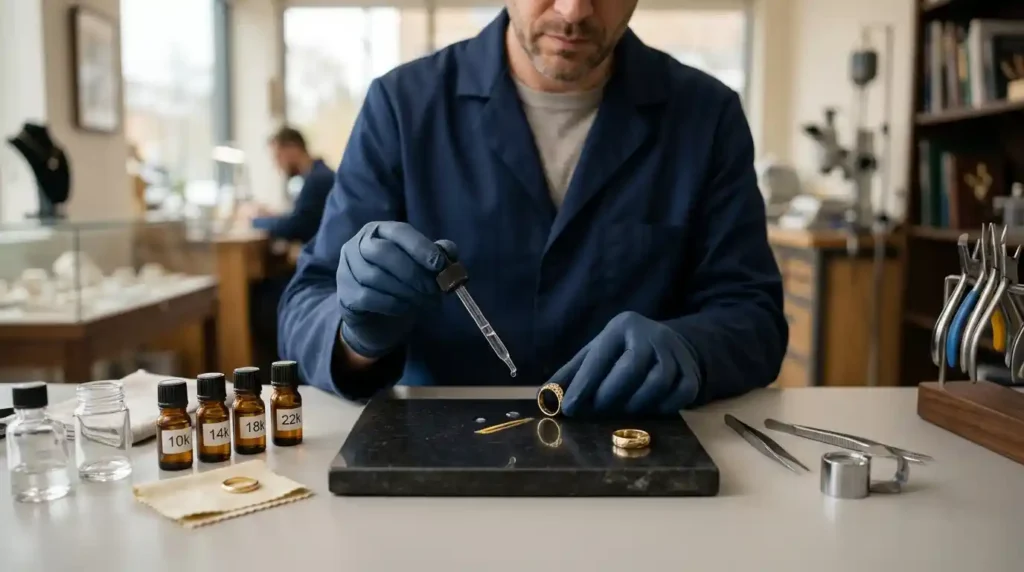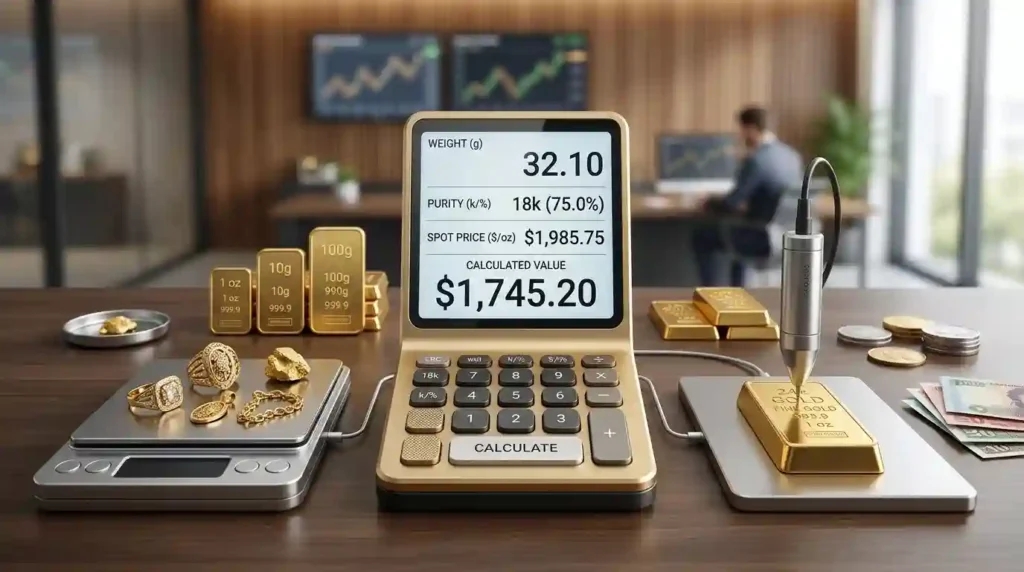
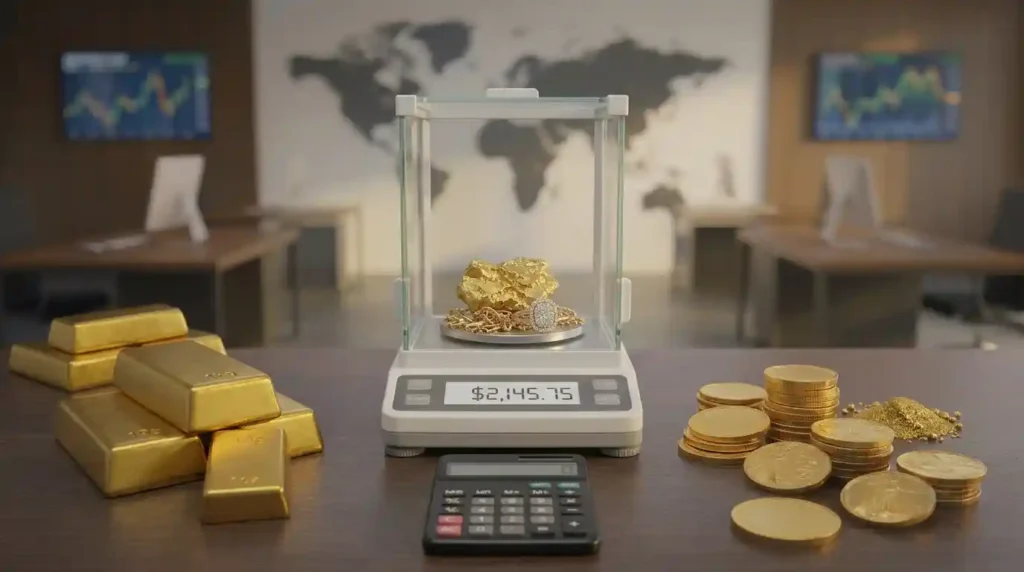
Picture a quiet Saturday morning in Minneapolis, and you find an old 18K bracelet in a drawer. Maybe it was your grandmother’s. You check the gold price online, set the bracelet on a kitchen scale, and wonder if it is worth $200, $500, or more. I get this question a lot. So here is how to calculate today’s value of old gold. Find the gold alloy weight, check the karat, turn that into pure gold weight, and multiply by today’s price. That gives you the metal’s value before buyer fees, refining costs, and dealer margins. A quick guess can miss, as you will see below.
Here is why a quick guess can be wrong:
- The gold price changes over time.
- Old jewelry may be 10K, 14K, 18K, or another purity.
- The total weight may include stones or non-gold parts.
- A buyer’s offer may be lower than the metal value.
What Determines the Value of Old Gold Today?
Old gold is worth what is in it, not how long it sat in a box. Its gold content and today’s market price matter most. Four things drive the number. Let us take them one by one.
Think of old gold like a loaf of bread. What matters is the weight of the flour, not the age of the pan. The same idea holds here.
Today’s Gold Market Price
The spot price is the market price for gold right now. The CFTC describes it as the cash price for immediate delivery of the metal. It is a guide for raw gold, not a price for your ring.
Prices move during the trading day. News, money markets, and demand all push them. So a quote from last week may be far off. A live quote has a time on it. An old one does not, or it shows an old date.
In the U.S., gold prices are often shown in dollars per troy ounce. Keep that in mind. We will convert it later. To learn what moves the price, read why gold prices change every day.
Do not trust a price that has no date. I once saw a seller use a screenshot from a month back. The price had moved by a few hundred dollars per ounce. That gap cost him real money. Always use a fresh quote, and see our guide to live gold price sources.
Gold Purity or Karat
Karat tells you how much of the alloy is gold. Pure gold is 24K. Lower karats mix in other metals. So 10K, 14K, 18K, and 22K all hold different amounts of gold.
This is why two rings of the same weight can have different values. A 10 gram 18K ring holds more gold than a 10 gram 14K ring. The scale cannot tell them apart. The karat can.
You can learn more in our guide on how gold purity is calculated.
Old pieces often carry lower karats than people expect. In many homes, 10K and 14K rings are far more common than 18K. So do not guess high. Check the stamp first.
Gold Weight
Weight is the third piece. But be careful. The weight on your scale is the total weight of the item. That may include gemstones, enamel, springs, and other non-gold parts.
Only the gold alloy weight counts for metal value. A small gap in weight can change the result. One extra gram of stone can mean real dollars. So take care here. I always weigh twice.
Think of weight as the size of your pile. Karat tells you how much of the pile is gold. Price tells you what each gram of gold is worth. All three must be right for the math to work.
Condition, Design, and Collectible Value
A scrap gold math problem looks at metal only. It does not care about style or age. But some pieces are worth more than their metal.
Antique jewelry, designer pieces, and collectible coins may be worth more than melt value. If you sell them for scrap, you may leave money on the table. Look at maker marks and old styles before you sell. A short check by a specialist can pay off.
Dents and scratches do not cut the gold value. Gold is gold. But broken parts, missing stones, and old repairs can change what a buyer will pay. Ask about these before you sell.
Step 1: Find Today’s Gold Price
Start with a clear, current price. A calculation built on last month’s quote can be neat math and still be a weak guess. Let us find a good number.
This step takes five minutes. But it sets the base for every number after it. Take it slow.
Where to Check the Current Gold Price in the USA
Use a trusted source of metals market data. Established bullion dealers and market data providers are good places to look. See our list of gold price data sources for ideas.
- Confirm the quote is in U.S. dollars.
- Write down the date and time.
- Use the same quote for all your math.
A note on time. Prices can change in minutes. If you plan to sell today, check again right before you visit a buyer.
One more tip. Compare two sources. If they match within a small gap, you can trust them. If they differ by a lot, look for the reason. One may be a retail price, not a spot price.
Understand Spot Price, Bid Price, and Ask Price
Three prices matter here:
- Spot price: A market reference price for gold.
- Bid price: The price a buyer is willing to pay.
- Ask price: The price at which a seller offers gold.
They differ because dealers need to earn a living. The CFTC says a dealer sells above spot and buys back below spot. The gap is the dealer’s spread. So the price you can sell at is lower than the price you can buy at. Learn how the market sets these in how the price of gold is calculated.
Here is an easy picture. Think of a used car lot. It buys your car for less than it sells the same car. Gold dealers work the same way. The gap pays for their costs and profit.
Check Whether the Price Is Per Gram or Per Troy Ounce
Gold market quotes often use troy ounces. Many jewelry scales and some buyers use grams. If you mix them, your answer will be wrong.
Confirm the unit before you multiply. Look for a label like “per oz” or “per gram” next to the price. If there is no label, look elsewhere.
U.S. readers often see gold quoted per troy ounce, while jewelry scales show grams. NIST sets the conversion standards for precious metals. The table below shows the key ones.
Table 1: Gold Price Units and Conversions
| Unit | Equivalent |
|---|---|
| 1 troy ounce | 31.1034768 grams |
| 1 gram | 0.0321507 troy ounces |
| 1 pennyweight (dwt) | 1.55517 grams |
| 1 troy ounce | 20 pennyweights |
For more on units, see our guide to grams, ounces, and pennyweights.
A quick check helps. A gram price is far smaller than an ounce price. If you see $96, it is likely per gram. If you see $3,000, it is likely per troy ounce.
Convert Today’s Gold Price to Price Per Gram
Here is the formula:
Gold price per gram = Gold price per troy ounce / 31.1034768
Here is an example with a made up price. Say gold is quoted at $3,000 per troy ounce:
$3,000 / 31.1034768 = about $96.45 per gram
This is an example, not a live quote. Use the real price on the day you check. For more steps, see how to calculate gold price per gram.
Round with care. Keep two or three decimals until the end. Round only on the last step. That keeps small errors from adding up.
Step 2: Weigh Your Old Gold Correctly
Before you use a calculator, make sure the weight is the gold weight. The number on your scale may hold more than gold. This step trips up more people than any other.
Take a few minutes here. A tiny slip in weight can swing the final number. Good habits pay off.
Use a Digital Jewelry Scale
A good scale makes the job easy. Follow these tips:
- Use a scale that reads in grams.
- Set it on a firm, level surface.
- Check that it reads zero before you weigh.
- Do not weigh a piece while it sits in a box or pouch.
- Record each piece on its own if you have several.
A kitchen scale can work for a rough check. But a small jewelry scale that reads to 0.01 gram is better. Small pieces need small steps. Weigh each piece twice to be sure.
Wash your hands and dry the piece first. Dirt and lotion add weight. A speck here and there is small. But on tiny pieces it can matter.
Understand Gross Weight vs. Net Gold Weight
Gross weight includes the whole item. Net gold alloy weight leaves out stones and other non-gold parts. Some parts may even be another metal or karat.
The right weight is key to a fair guess. Use the gold alloy weight in your math. For a deeper look, read our guide on how to calculate the value of gold by weight.
Think of a gift box. The box and the gift both weigh something. You only want the weight of the gift. Gold jewelry is the same. You only want the gold.
What If Your Old Gold Has Gemstones?
Do not count the stone weight as gold. It is not gold. Follow these tips:
- Ask a jeweler to assess the stone and the setting.
- Do not guess the weight of a diamond or other gem.
- Get a separate appraisal for antique or costly gem jewelry.
A stone can be worth more than the gold around it. Or it can be worth very little. Only a pro can say. So get the stone checked before you sell the piece for scrap.
Some old rings hold real diamonds. Some hold glass. You cannot tell by eye. A jeweler can check in a minute. It is worth the visit.
What to Do If You Cannot Separate the Gold Weight
Sometimes you cannot split the parts. That is common with old jewelry. Here is what to do:
- Ask a professional to assess the item.
- Ask for the tested gold weight, not just the total weight.
- Keep the buyer’s written weight breakdown.
- Get a second look for high value pieces.
A fair buyer will show you the numbers. If one will not, find another.
Table 2: Example of Calculating Gold Weight in Old Jewelry
Total weight and gold weight are not always the same. This simple table shows why. The numbers are made up to teach the idea.
| Component | Weight |
|---|---|
| Complete ring | 12.0 g |
| Gemstone and non-gold parts | 2.0 g |
| Gold-alloy weight | 10.0 g |
The formula is:
12.0 - 2.0 = 10.0 g
Keep a photo of the weighing too. If you ever question a result, the photo helps. It is a small step that gives you proof.
Step 3: Identify the Gold Purity
The karat tells you how much of the alloy is gold. This step keeps you from treating 14K gold as if it were 24K. It is quick, and it matters a lot.
Purity is the least visible part of the math. You cannot see it. You can only read it from a stamp or a test. So take care.
Find the Karat Stamp on Old Jewelry
Look inside the band or on the clasp. A small stamp may be there. Common marks include:
- 10K or 417.
- 14K or 585.
- 18K or 750.
- 22K or 916.
- 24K or 999.
Numbers like 585 are fineness marks. They show gold content in parts per thousand. So 585 means 58.5% gold. A stamp is good evidence. But it does not replace a test when you are unsure of the piece. Our guide for first-time gold buyers covers stamps in more detail.
A loupe helps. A small 10x loupe costs little. Use it in good light. Old stamps can be faint. So look from more than one angle.
Convert Karat Into Gold Purity Percentage
Use this formula:
Gold purity (%) = Karat / 24 x 100
The FTC explains karat marks as the share of gold in an alloy. Use this chart for older rings, chains, coins, and bracelets.
Table 3: Gold Karat and Purity Conversion Chart
| Karat | Gold content |
|---|---|
| 10K | 41.67% |
| 14K | 58.33% |
| 18K | 75.00% |
| 22K | 91.67% |
| 24K | 100% nominal |
Here is a quick trick. Divide the karat by 24. For 18K, that is 18 over 24, which is three quarters. For 12K, it is half. Easy numbers help you check the chart.
What If Your Old Gold Has No Hallmark?
Do not assume it is 24K. Do not assume it is pure gold. Many old pieces have no stamp, or the stamp wore off.
- Check purchase records or certificates.
- Look for a maker’s mark or other clue.
- Get a professional purity test if the value matters.
If you cannot test, use a low karat as a safe guess for now. Then fix it when you have a result. See the tricks some sellers use in common gold valuation scams.
Some old gold has no stamp at all. That does not mean it is fake. Many older or handmade pieces were never marked. It just means a test is the best way forward.
Solid Gold vs. Gold-Plated and Gold-Filled Items
Solid gold means a gold alloy all the way through. It does not mean pure gold. A solid 14K ring is still 58.33% gold.
- Gold-plated jewelry has a thin gold layer over another metal.
- Gold-filled jewelry has a thicker bonded layer of gold alloy.
Do not treat plated jewelry as if all of it were gold. The weight on the scale is mostly base metal. Plating can also wear away over time. If a deal sounds too good, see how to avoid gold buying scams.
Marks like GP, GF, or HGE may point to plating or filling. A stamp like “18K GP” does not mean solid 18K gold. It means an 18K coat on a base metal.
Step 4: Calculate the Pure Gold Content
Now combine the weight and the purity. This gives you the amount of real gold in the old piece. It is the heart of the math.
Take out a pen and paper. Write each number down. This part is short. But it deserves care.
The Pure Gold Weight Formula
Here is the formula:
Pure gold weight = Gold alloy weight x (Karat / 24)
Use the gold alloy weight, not the total weight. Use the karat from the stamp or a test. Then do the math.
Think of it as a slice. The karat tells you how big a slice of the alloy is gold. The formula cuts that slice for you.
Example: Calculate Pure Gold in an Old 18K Ring
Let us assume:
- Gold alloy weight: 10 grams.
- Purity: 18K.
- Gold content: 75%.
Here is the math:
10 x 18 / 24 = 7.5 g
The ring holds about 7.5 grams of pure gold. This assumes the 10 grams are the gold alloy alone. If stones are in the 10 grams, remove them first.
Check your answer. The pure gold weight must be less than the alloy weight. Here, 7.5 is less than 10. So the answer fits.
Calculate Pure Gold in 14K and 22K Jewelry
Here are two short examples:
- 10 g of 14K gold holds about 5.83 g of pure gold.
- 10 g of 22K gold holds about 9.17 g of pure gold.
See how the same weight gives different gold? That is why karat matters. A 10 gram piece of 22K has nearly 3.3 grams more gold than 10 grams of 14K. At today’s prices, that gap is real money.
Write a small note for each piece. List the weight, the karat, and the pure gold. If you have many pieces, add up the pure gold at the end. It keeps the math tidy.
Step 5: Calculate Today’s Old Gold Value
This is the main step. You know the pure gold weight. You know the price per gram. Now the math is easy.
This is the fun part. All your hard work pays off in one short formula.
The Old Gold Value Formula
Here is the formula:
Estimated melt value = Pure gold weight x Gold price per gram
Melt value is a guess of what the gold is worth as raw metal. It is a benchmark, not a promise. For more help with tools, see how gold calculators work.
Keep the units matched. If the weight is in grams, use a price per gram. If the weight is in troy ounces, use a price per troy ounce. Mixing them is a common slip.
Full Example: Calculate the Value of an Old 18K Bracelet
Here is a made up case:
- Gold alloy weight: 10 grams.
- Purity: 18K.
- Made up gold price: $96.45 per gram.
First, find the pure gold:
10 x 18 / 24 = 7.5 g
Then find the melt value:
7.5 x $96.45 = $723.38
The $723.38 is a melt value guess. It is before dealer cuts, fees, or any collectible value. Your real number will depend on the real price and the real weight.
Now try a new price. If gold were $90 per gram, the value would be 7.5 x $90, or $675. At $100, it would be $750. See how the price moves the answer? That is why a fresh quote matters.
Use the Same Formula for Other Karats
The steps do not change. Only the karat changes:
- 14K: use 14/24.
- 18K: use 18/24.
- 22K: use 22/24.
- 24K: use the documented fineness where you can.
A bar or coin may state its fineness, such as 999. Use that number if you have it. It is more exact than a rough rule.
Try a 14K chain of 20 grams. First, 20 x 14 / 24 equals 11.67 grams of pure gold. At $96.45 per gram, that is about $1,125.
What About Old Gold Coins?
Coins have a stated weight and fineness. Use the coin’s official specs. Do not assume the whole coin is pure gold.
- Look up the official weight and fineness.
- Do not guess from the size.
- Rare coins may be worth more than their melt value.
We cover this in more detail further down.
Coins are easier in one way. Their specs are public. But they are harder in another way. Some are worth more than their metal.
How Much Will a Gold Buyer Actually Pay for Old Gold?
Your melt value is a handy benchmark. But it is not a cash offer. The buyer’s price, test method, and terms all matter. Plan for that gap.
Think of melt value as a ceiling. Few buyers pay all of it. Most keep a share for costs and profit. That is how the trade works.
Understand the Difference Between Melt Value and Cash Offer
Four values get mixed up. Here is how they differ:
- Melt value: The estimated market value of the pure gold content.
- Buyer offer: The amount a dealer is willing to pay.
- Retail replacement value: What it may cost to buy a similar finished item.
- Appraised value: An estimate made for a stated goal, such as insurance or estate planning.
They are not the same. A bracelet may melt for $700, sell new for $1,500, and appraise for $1,800. All three can be right. Learn more in gold price vs gold jewelry price.
If you want to know how real prices are built, read how the price of gold is calculated. It shows why a store price and a buyer price differ.
Why Gold Buyers May Offer Less Than Melt Value
Buyers have costs. Here are common reasons for a lower offer:
- Testing and refining costs.
- Dealer operating costs and profit margin.
- The spread between buying and selling prices.
- The risk that the piece holds less gold than expected.
- Market changes and the buyer’s resale choices.
Do not assume all buyers pay a fixed share of melt value. Rates vary by buyer, item, and deal. If an offer is far under the rest, ask why.
A gap is not always a sign of a scam. But a very large gap can be. For help, read how to avoid gold buying scams.
How to Compare Offers From Different Gold Buyers
Treat it like shopping for a car. Get more than one quote. Follow these steps:
- Ask each buyer to state the tested karat and weight.
- Confirm the price per gram, pennyweight, or troy ounce.
- Ask if any fees or cuts apply.
- Compare the final cash amount.
- Get the offer in writing before you hand over the item.
For tips on where to shop, see the cheapest place to buy gold in the USA.
Table 4: Melt Value vs. Actual Gold Buyer Offer
Your calculated metal value and a buyer’s offer are two separate numbers. This made up case shows how a cut changes the final cash.
| Calculation | Example amount |
|---|---|
| Estimated melt value | $723.38 |
| Hypothetical buyer deduction | $72.34 |
| Hypothetical cash offer | $651.04 |
The 10% cut here is only an illustration. It is not a typical or promised industry rate.
Write each offer on a card. List the rate, the cuts, and the final cash. Then sort them. The best one gives you the most cash for the same gold.
Questions to Ask Before Selling Your Old Gold
Keep these on your phone:
- What karat did you test it as?
- What weight are you using for the gold?
- What gold price are you using, and when was it updated?
- Are there any refining, testing, or service fees?
- Can I see the weight and the math?
- Is this your final cash offer?
If a buyer rushes you, slow down. A good offer will still be good in ten minutes.
Watch how the buyer answers. A calm and clear reply is a good sign. A rushed or vague reply is not. Ask again if you need to.
How to Calculate the Value of Old Gold Coins
Coins need a slightly new approach. Their gold content is often known. Some also have value as collectibles beyond their metal.
Coins have one big plus. They come with official specs. That makes the math simple, if you use the right numbers.
Check the Coin’s Gold Content and Weight
Start with facts about the coin:
- Name the country, type, year, and face value.
- Look up its official weight and fineness.
- Tell total coin weight from fine gold weight.
- Use a trusted spec, not a guess from size.
A coin may weigh more than the gold it holds. Makers add other metals so the coin lasts. That is why the spec sheet matters.
Look for the stamp on the coin too. Many coins list their gold content right on the face. For example, “1 oz fine gold” is a common line on U.S. coins.
Example: American Gold Eagle
The U.S. Mint lists the one ounce American Gold Eagle at 1.0909 troy ounces (33.931 grams). It holds one troy ounce of fine gold. Its composition is 91.67% gold, 3% silver, and the rest copper. That makes it a 22K coin.
So for a basic melt value, use one troy ounce of gold. Do not use 1.0909. The extra weight is silver and copper. See the U.S. Mint bullion coin programs page for the official specs. Learn the ounce math in our guide to gold value per ounce.
A quick check. 33.931 grams times 0.9167 gives about 31.1 grams. That matches one troy ounce. So the numbers agree.
Melt Value vs. Collectible Coin Value
Some coins carry a premium over metal value.
- Condition, rarity, mint year, and demand can add value.
- Do not sell a coin that may be rare as scrap without a check.
- Think about a specialist coin dealer or outside appraisal.
I have seen sellers rush an old coin to a scrap buyer. Later they found it was worth far more. A short check first can avoid that sting.
Before you sell, ask a coin dealer for a second view. Also compare the shop’s price with other dealers. Read about first-time gold buyer checks to stay safe.
How a Gold Value Calculator Makes the Process Easier
A calculator does the math in seconds. What matters is the info you enter. Also know what the result means.
Think of the tool as a helper, not a judge. It does the math. You supply the facts.
Information to Enter Into the Calculator
Be ready with these items:
- Gold weight.
- Weight unit.
- Karat or fineness.
- Current gold price, if the tool wants you to type it in.
- Whether the tool shows melt value or a buyer payout.
You can try our free gold value calculator with these in hand. It only takes a minute.
Have your notes handy. Write the weight, the unit, the karat, and the price on paper. Then type them in one by one. Check each field after you type it.
How to Check Whether the Result Makes Sense
Do a quick sense check:
- Review the pure gold weight.
- Confirm the karat conversion.
- Check that the price and weight use the same unit.
- Compare the result with your hand math.
- Look at the price time stamp if the tool uses live data.
The pure gold weight must be less than the alloy weight. If it is more, something is off.
Try a rough check in your head. Say you have 10 grams of 18K. That is about 7.5 grams of gold. At $100 a gram, you expect about $750. If the tool says $7,500, you made a slip.
What a Gold Value Calculator Cannot Confirm
A tool has limits. It cannot confirm:
- Whether the item is real gold.
- Whether the hallmark is true.
- Whether hidden parts are another metal.
- Whether a coin or antique has collectible value.
- What a given buyer will pay.
So use it as a guide. Then confirm the facts with a test and a few quotes. For the weight math behind the inputs, see the value of gold by weight.
If you want to know how these tools work inside, see how gold calculators work. It shows what each tool can and cannot do.
U.S. Expert Guidance and Reliable Sources for Old Gold Valuation
Good advice rests on good sources. These are official U.S. sources. I did not invent any expert quotes. Each point below is a short paraphrase of public guidance.
Each source has its own role. NIST covers units. The FTC covers how sellers describe gold. The CFTC covers prices and fees. The U.S. Mint covers coins.
NIST: Precious Metals Weight and Price Conversions
The National Institute of Standards and Technology sets measurement facts. Its page on precious metals conversion lists the factors for troy ounces, grams, and pennyweights.
One troy ounce equals 31.1034768 grams. Use that figure. Compare prices in the same unit. That is the only fair way to compare two quotes.
Keep a small cheat sheet by your scale. Write 31.1034768 grams per troy ounce. Write 20 pennyweights per troy ounce. It saves you from guesswork.
FTC: Gold Karat Marks and Jewelry Descriptions
The Federal Trade Commission shares tips for buyers. Its page on buying jewelry explains that karat marks show the share of gold in an item.
The FTC’s Jewelry Guides also cover solid gold, gold-filled, and gold-plated items. Remember that gold plating can wear away. So a gold color on the surface does not prove solid gold.
If a tag or listing is vague, ask the seller to be clear. Words like “gold tone” do not mean solid gold. A fair seller will explain.
CFTC: Spot Price, Dealer Spread, and Fees
The CFTC and FINRA wrote an advisory on buying physical gold, silver, or other metals. It targets bullion and gold IRA fraud. But its habits help anyone.
It explains spot price and spread. It says to ask for the buy-back price and for all fees in writing. It also says to multiply the weight by the spot price and compare that to the price you are given.
The CFTC also warns about large spreads. Some frauds charge huge ones. The lesson for you is to compare. For safe habits when you invest, read how to invest in gold for beginners.
U.S. Mint: Official Gold Coin Specifications
The U.S. Mint lists the official makeup of its bullion coins on its bullion coin programs page. The American Gold Eagle is 91.67% gold. The American Buffalo gold coin is 99.99% gold and weighs one troy ounce.
That is why total coin weight and fine gold weight can differ. Use the official spec for each coin. Do not guess.
For an expert quote, I suggest you rely on the agencies above. If you want a named person, quote them word for word from a published source.
Use the Mint’s numbers for any U.S. bullion coin you hold. They beat any rule of thumb. For deals on coins, see the cheapest place to buy gold in the USA.
Frequently Asked Questions About Calculating Old Gold Value
These short answers cover what readers ask most. Each one links back to the longer steps above.
Use the list to jump to your question. Each answer is short on purpose.
How Do I Calculate the Value of Old Gold at Today’s Price?
Find the gold alloy weight. Confirm its karat. Work out the pure gold content. Then multiply by today’s gold price for the matching unit.
Do the steps in order: weigh, check karat, find pure gold, then multiply by price.
Is Old Gold Worth Less Than New Gold?
Not just because it is old. Its metal value depends on gold content and the market price. Antique or designer pieces may also have collectible value.
Gold is gold. Age does not cut its metal value.
How Much Is 14K Gold Worth Per Gram Today?
Find the pure gold price per gram. Multiply it by 14/24. The result is the melt value per gram of 14K alloy, before buyer cuts. At a made up $96.45, that is about $56.26.
Use a fresh price on the day you sell.
How Much Is 18K Gold Worth Per Gram Today?
Multiply the pure gold price per gram by 18/24, or 75%. That gives the melt value per gram of 18K alloy. At a made up $96.45, that is about $72.34.
Check the price and its time first.
Does Old Gold Lose Its Value Over Time?
Gold does not lose metal value just because it is old. Value can change with the market price, purity, weight, condition, and collector demand.
Wear and dents do not cut the metal value.
Can I Calculate Old Gold Value Without a Hallmark?
You can, if a reliable test or record shows the purity. If purity is unknown, get it tested before you trust the result.
A test is the safest path.
Should I Use Gross Weight or Net Gold Weight?
Use the gold alloy weight. Leave out stones and non-gold parts. If a piece has mixed metals, ask a pro to assess them.
Net gold alloy weight is the right one.
Is the Gold Spot Price the Same as the Price a Dealer Pays?
No. Spot price is a market guide. A dealer may pay less due to spreads, refining costs, and deal terms.
Ask each dealer for the final cash.
Are Old Gold Coins Worth More Than Their Melt Value?
Some are. Rare dates, low mintage, condition, and collector demand can add value. Check before you sell a possible rare coin for its metal alone.
A coin dealer can tell you in minutes.
Final Recommendation
I have looked at many old rings, chains, and coins. My advice on how to calculate today’s value of old gold is simple. Weigh the gold alone, confirm the karat, and use a fresh price in the right unit. Then do the math yourself and treat the answer as a benchmark. Collect two or three offers before you sell, and keep every number in writing. You can learn more about me on my author page or browse our gold blog.
Calculate Your Old Gold Value Before You Sell
Check the weight, the purity, and today’s price before you visit a buyer. Work out the melt value first. Then use it to compare offers, not to promise one. Try our gold value calculator to run the math. You can also use our gold purity calculator to check the karat math and the weight and unit guide to convert your numbers. Read about investing in gold for beginners if you plan to hold gold too.