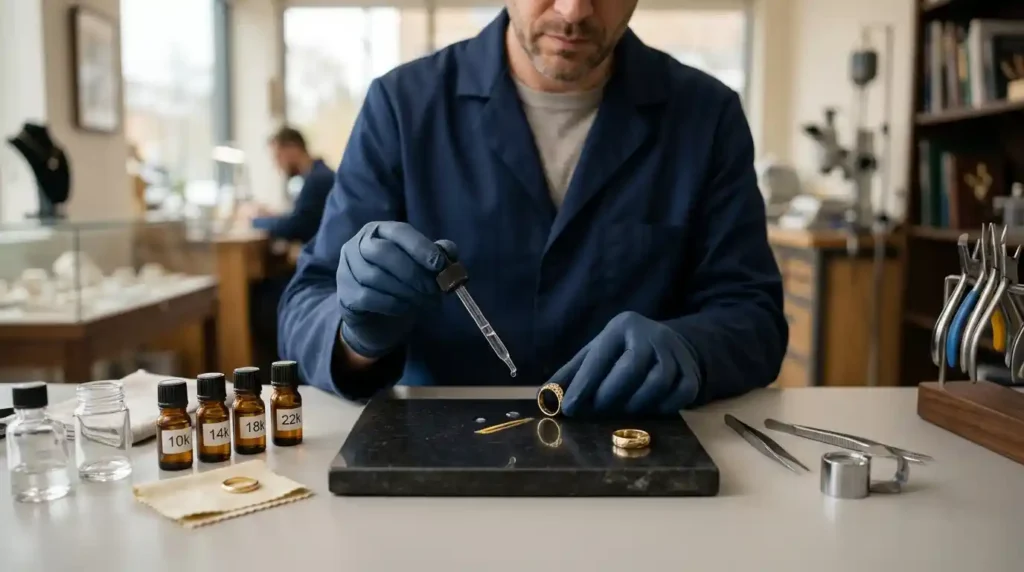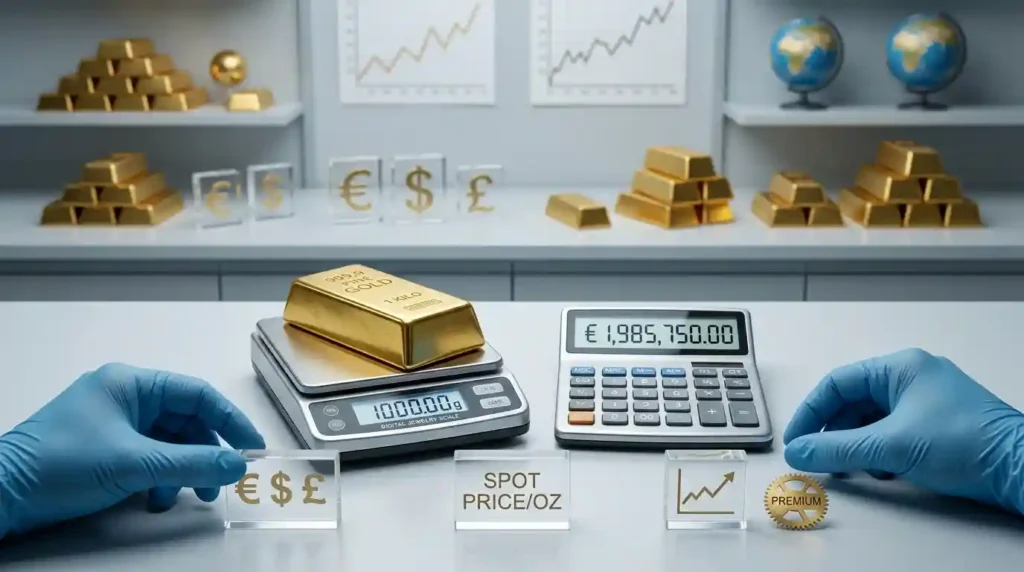

Picture this: you stand in a jewelry store in New York City, and the tag on a gold necklace says 20 grams. The pendant looks big, and small stones sparkle all over it. The price feels high, so one thought hits you: am I paying for 20 grams of gold, or 20 grams of everything? I have heard that question many times over the years. This guide is gross weight vs net gold weight explained in plain words, with real math you can check. You will see how stones change the total and how karat changes the gold inside. My goal is not to make you doubt every jeweler, but to help you ask clear questions.
Here is what we will cover:
- Gross weight versus net metal weight.
- How stones, enamel, and other parts change the weight.
- How karat and the gold inside an alloy work.
- How to find the value of gold by weight.
- What to check on an invoice or dealer quote.
What Is Gross Weight in Gold Jewelry?
Start with the number on the scale. You need to know what it counts. Only then can you find the real gold. A scale does not care what a piece is made of. It just weighs the whole thing. That is all it can do.
Think of a dinner plate with food and a napkin on it. The scale weighs it all. You only want the food. But first, you must see the full plate.
Gross Weight Meaning
Gross weight is the total weight of the full item. Think of a necklace with a pendant, a clasp, and a few stones. Every part counts. So the gross figure is the same as the gold weight, or more. It is never less.
I learned this the hard way. A friend showed me a ring she loved. The tag said 8 grams. She thought she held 8 grams of gold. But the stones and the setting took a good share of that weight.
A box or a pouch is not part of the piece. Do not count it. Skip it unless the tag says “shipping weight.” If you are new to this, read what first-time gold buyers should check before you shop.
Tags use many names for this. You may see “total weight” or “TW.” Some say “GW.” They all point to one idea. The whole piece, all parts, on the scale. If a tag has no label, ask. A plain figure with no label is a weak figure.
What Can Be Included in Gross Jewelry Weight?
Many parts can add to the total. Here is what the scale may count:
- Gold alloy.
- Diamonds and other gemstones.
- Enamel or decorative inserts.
- Non-gold clasps, springs, or fittings.
- Other materials attached to the piece.
Each part has its own weight. A tiny steel spring may weigh close to zero. A big stone can weigh a lot. That is why two pieces with the same gross weight can hold a very different amount of gold. The scale cannot see that gap. You have to look for it.
Some chunky pieces are hollow. A hollow piece looks big but holds less metal than you might think. Ask if the piece is solid or hollow. That small fact can shift the gold weight a lot.
When Is Gross Weight Useful?
Gross weight still has a job. It is a good first step. Use it to:
- Check the total weight of a complete item.
- Compare the weight of similar jewelry pieces.
- Review a product description or invoice.
- Record the weight before an appraisal or sale.
But it has a limit. Gross weight alone cannot set the gold value of a mixed piece. It tells you how heavy the item is. It does not tell you how much gold is in it. For more tips like this, browse our gold buying guides.
I use gross weight as a first scan. Say two bracelets look alike. I compare their gross weights. A big gap tells me to dig deeper. It is a clue, not an answer.
What Is Net Gold Weight?
Net weight is the best figure when you want to know how much metal you own. But check how each seller defines it. Words can change from shop to shop. Do not take a label at face value.
Think of it as the weight of the metal alone. It is the plate without the napkin. It is closer to what you want to know.
Net Gold Weight Meaning
Net gold weight is the weight of the gold metal once the stones and other non-gold parts are taken out. What is left is often still an alloy. It could be 18K or 14K gold. An alloy is gold mixed with other metals.
So net metal weight does not mean pure gold weight. This trips up many buyers.
When a seller says “net weight,” ask one more thing. Does that figure show the gold alloy, or the fine gold inside it? The answer changes the math. To see how online tools treat this, read how gold calculators work.
Some stores say “NW” or “gold weight.” Others write “metal weight.” The words differ, so ask. I keep a short note on my phone with the terms I hear. When a term feels vague, I ask for a line on paper.
Net Metal Weight vs. Pure-Gold Weight
Two terms sound close. They are not the same.
- Net metal weight: The weight of the gold alloy after the right non-gold parts are taken out.
- Pure-gold content: The guessed weight of gold inside that alloy, based on how pure it is.
Here is a simple case. Take 10 grams of 18K gold alloy. It holds about 7.5 grams of gold. The other 2.5 grams are other metals.
These two figures answer two questions. Do not swap one for the other. Marks like 750 or 18K tell you how pure the gold is. You can learn those karat and fineness marks in ten minutes.
Here is another way to see it. Think of a cup of coffee with milk. The full cup is the alloy. The coffee is the gold. The milk is the other metals. You pay for the whole cup, but you only own so much coffee.
Why the Difference Matters
Small gaps in weight can mean big gaps in cost. Keep these points in mind:
- A piece can have a high gross weight because it holds heavy stones.
- A piece with a high net metal weight may still hold less pure gold than an equal weight piece of higher karat.
- Accurate weights help you compare quotes and judge metal value more fairly.
I like to say the tag tells a story, and the math tells the truth. A store price also pays for design and labor. See gold price vs gold jewelry price to learn why those two figures are never the same.
A buyer once told me she paid for a 30 gram bracelet. She felt proud. Later she learned the net gold was much less. She was not upset at the jeweler. She was upset at herself. I told her this is common. The fix is to ask early.
Gross Weight vs Net Gold Weight: Key Differences
This side by side view answers the main question fast. Read each term first. Then we move on to the math. I find this order helps most people. It keeps the big idea in view.
Keep the plate image in mind. The first weight is the full plate. The second is the plate without the napkin. The third is just the food.
Gross Weight vs Net Weight Comparison Table
Jewelry value depends on two things. One is the weight you measure. The other is the stuff inside that weight. The labels on an invoice can vary. So always ask the seller how they define each term. The table below puts all three weights in one view.
| Feature | Gross weight | Net gold-alloy weight | Pure-gold content |
|---|---|---|---|
| Meaning | Weight of the complete item | Weight of the gold-bearing alloy after exclusions | Estimated weight of gold within the alloy |
| Includes gemstones? | Usually yes, if attached | No, if properly excluded | No |
| Includes non-gold fittings? | May include them | Should exclude them | No |
| Adjusted for purity? | No | Not necessarily | Yes |
| Main use | Total item weight | Metal weight for valuation | Estimating gold content value |
| Example | 20 g necklace with stones | 17 g of gold alloy | 12.75 g of gold if alloy is 18K |
Read the table from left to right. Each column peels off one more layer. The first is the whole item. The second is the metal. The third is the real gold. Most of the money question lives in that third column.
Which Weight Should Be Used to Calculate Gold Value?
Follow these steps in order:
- Start with net gold-alloy weight, not gross weight, if non-gold parts are present.
- Apply the right purity fraction.
- Use the spot price for the matching unit and currency.
- Treat the result as an estimated metal value, not a promised resale payment.
Spot price is the live market price for raw gold. It moves all day. You can learn how to calculate the value of gold by weight in a few easy steps. And see gold price data sources to learn where live prices come from.
Why not use gross weight? Because stones are priced in a different way. A stone has its own price. It is not priced like gold. Mix the two, and the math breaks.
How to Calculate Net Gold Weight From Gross Weight
You only need basic subtraction. But the answer is only as good as the numbers you start with. Bad inputs give bad results. I check each input twice. It takes a minute.
The steps are short. You can do them with a pen and a pad. Let us go one step at a time.
Basic Net Weight Formula
Here is the formula:
Net metal weight = Gross weight - Non-gold component weight
Now try an example.
- Gross jewelry weight: 20 grams.
- Stones and other non-gold parts: 3 grams.
- Net gold-alloy weight: 20 minus 3 equals 17 grams.
What if there are many non-gold parts? Add their weights first. Then subtract that total from the gross weight. Keep the units the same the whole time. Do not mix grams with ounces.
I keep this simple. Use a pen and a pad. Write the gross weight first. Write the stone weight below it. Subtract. Circle the answer. Now you have a net weight you can show to anyone.
What If the Stone Weight Is Listed in Carats?
Many stones come with a carat weight. This is a trap for new buyers. Gemstone carats measure weight. They do not measure gold purity.
One metric carat equals 0.2 grams. NIST gives the same value in its precious metals conversion guidance. So 5 carats of stones weigh 1 gram.
Follow this path:
- Turn the total stone carats into grams.
- Subtract that number from the gross weight.
- Check if the listed weight is for all stones or just one stone.
That last check matters. I once saw a tag that listed one center stone. Twenty small stones sat around it. They were not on the tag.
Here is a quick case. A pendant lists 15 carats of stones in total. Multiply 15 by 0.2. That gives 3 grams. Now subtract 3 grams from the gross weight. This is the same 3 grams we used in the necklace example.
Net Weight Calculation Table
The numbers below are made up. They show the steps of the subtraction. They are not a rule for any real piece. Never use them as a standard cut for your own gold. Your piece has its own parts and its own weights.
| Jewelry item | Gross weight | Non-gold parts | Net gold-alloy weight |
|---|---|---|---|
| Plain gold chain | 12 g | 0 g | 12 g |
| Stone-set ring | 8 g | 1.2 g | 6.8 g |
| Pendant necklace | 20 g | 3 g | 17 g |
| Bracelet with non-gold inserts | 25 g | 2.5 g | 22.5 g |
Notice the plain chain. It has no stones, so gross and net match. That is the easy case. Mixed pieces take more care. Do one line of math for each piece.
What If You Don’t Know the Weight of the Stones?
Do not guess and then call the answer exact. A wrong guess leads to a wrong value. It can cost you real money.
Try these steps:
- Ask the jeweler for a part by part breakdown or a written valuation.
- Think about a qualified jeweler or appraiser for high value pieces.
- Know that taking stones out may not be safe or easy for every item.
Some sellers dodge this question. That can be a warning sign. Read about common gold valuation scams so you know what to watch for. A fair seller will give you the facts.
If you own the piece, a local jeweler may be able to weigh the parts. If you plan to buy, ask the seller to put the weights on paper first. A clear paper trail protects both sides.
How Gold Purity Changes the Net Gold Value
Now you know the net metal weight. The next step is how pure the gold is. This is where many people slip. They treat each gram of gold jewelry as a gram of pure gold. It is not. Let us fix that.
Purity is just the share of real gold in the metal. A bigger share means more gold per gram. It also means a higher price per gram of the piece.
Convert Karats to Gold Purity
Use this formula:
Gold purity fraction = Karat rating / 24
The table below shows the common cases. The math is simple. You can read any gold mark in seconds.
| Karat | Math | Purity fraction | Purity percent |
|---|---|---|---|
| 24K | 24 / 24 | 1.00 | 100% on the karat scale |
| 18K | 18 / 24 | 0.75 | 75% |
| 14K | 14 / 24 | 0.5833 | about 58.33% |
| 10K | 10 / 24 | 0.4167 | about 41.67% |
Pure gold items may carry a fineness mark such as 999. That mark can be more exact than a plain karat fraction. When you see both, trust the stated fineness for that product.
Why 24? The karat scale splits a piece into 24 parts. So 18K means 18 parts gold and 6 parts other metals. That is why 18K is 75% gold. Look for the small stamps on a clasp or inside a ring. You may see 14K, 585, or 750. The mark 585 means 58.5% gold, close to 14K. The mark 750 means 75% gold, which is 18K.
Calculate Pure-Gold Content
Here is the formula:
Pure-gold content = Net gold-alloy weight x Purity fraction
Now use our pendant example.
- Net gold-alloy weight: 17 grams.
- Purity: 18K, or 0.75.
- Pure-gold content: 17 x 0.75 equals 12.75 grams.
So the 20 gram necklace holds 12.75 grams of pure gold. That is far less than the tag. When I first ran this math on a real piece, the gap shocked me. Now I run it each time, before I buy.
Let us try 14K too. Say a chain has a net weight of 10 grams. Multiply 10 by 0.5833. You get 5.83 grams of gold. Same weight, less gold than the 18K case. That is why karat can change the price more than size.
Pure-Gold Content Comparison Table
The same net alloy weight can hold a different amount of gold. It all depends on the karat. This table shows how fast the gap grows as weight goes up. Use it as a quick check when you compare two pieces.
| Net alloy weight | 18K gold content | 14K gold content | 24K at 99.9% |
|---|---|---|---|
| 5 g | 3.75 g | 2.92 g | 5.00 g |
| 10 g | 7.50 g | 5.83 g | 9.99 g |
| 15 g | 11.25 g | 8.75 g | 14.99 g |
| 20 g | 15.00 g | 11.67 g | 19.98 g |
Figures are rounded estimates. The 18K and 14K values use their nominal karat fractions. The 24K column assumes 99.9% purity. For per gram math, see how to calculate gold price per gram.
Look at the 10 gram row. 18K holds 7.50 grams. 14K holds 5.83 grams. The gap is 1.67 grams. At our made up $100 per gram, that is $167. Same weight on the scale. Very different value.
How to Calculate the Value of Net Gold Weight
Now we turn weight into a value guess. Keep one thing clear. A spot based value leaves out craft work, stones, dealer extras, and selling costs. It is the raw metal and nothing more.
There are only two steps. First, find the pure gold weight. Second, multiply by the price. Let us start with the formula.
Gold Value Formula
Here is the formula:
Estimated gold value = Pure-gold weight x Spot price per gram
Watch your units. Spot price is often given per troy ounce. If your weight is in grams, turn the price into a per gram price first. NIST lists one troy ounce as 31.1034768 grams. It also lists 20 pennyweights in one troy ounce.
Need help with the switch? Read our guide on grams, ounces, and pennyweights. You can also learn how to find gold value per ounce.
Here is a quick way to switch units. Divide the ounce price by 31.1035. The result is the price per gram. For example, a made up price of $3,110 per troy ounce is about $100 per gram. Now the math flows.
Worked Example: A Stone-Set 18K Necklace
Let us use a made up gold price of $100 per gram. This is not a real price. It just keeps the math clean.
- Gross weight: 20 grams.
- Non-gold component weight: 3 grams.
- Net gold-alloy weight: 17 grams.
- Purity: 18K, or 75%.
- Pure-gold content: 17 x 0.75 equals 12.75 grams.
- Estimated spot based value: 12.75 x $100 equals $1,275.
That $1,275 is not a store offer. It does not predict what a jeweler or scrap buyer will pay. To see how real prices form, read how the price of gold is calculated.
Now play with the numbers. If the spot price is $90, the value is 12.75 x $90, or $1,147.50. If it is $110, the value is $1,402.50. See how small price moves change the answer? That is why you need a fresh price on the day.
Why the Actual Offer May Be Lower
An offer often lands below the math. Here is why:
- The buyer needs room for profit.
- Refining, testing, and business costs add up.
- Stones may have resale value, but do not assume it.
- Retail making charges and design costs are not always paid back.
Prices also move all day. Read why the gold price changes every day to see what drives it. The CFTC says to compare metal weight with the current spot price. It also says to ask about all fees and get costs and terms in writing.
Think of selling a used car. The book value is a guide. The dealer must still earn a profit. Gold works the same way. Do not feel cheated by a lower offer. Just compare a few buyers and ask each to show their math.
How to Use a Gross and Net Gold Weight Calculator
A good calculator saves time. But it only works if you feed it the right facts. Let us look at what to enter and what to expect. A tool is a helper, not a judge.
I like tools that show each step. They teach you as you go. And they make it easy to spot a slip.
Inputs the Calculator Should Include
Look for these fields:
- Gross item weight.
- Unit of weight: grams, troy ounces, or another supported unit.
- Weight of gemstones and other non-gold parts.
- Gold karat or fineness.
- Current gold spot price and currency.
If a tool skips the non-gold weight, it may overstate your gold. Try our free gold calculator to run all five inputs in one place. It takes under a minute.
Your unit choice matters. Some tools use grams. Others use troy ounces or pennyweights. Pick one and stick to it. If you must switch, do it before you type, not after.
Calculator Results to Display
A clear tool shows these results:
- Estimated net gold-alloy weight.
- Estimated pure-gold content.
- Estimated spot based metal value.
- A note that the result leaves out extra jewelry or gem value unless you add it.
- A note that the output is a guess, not an assay or a promised resale offer.
That last note is key. No tool can test your piece. Learn the limits in this guide to how gold calculators work.
A good result page shows each step. You should see net weight, then pure gold, then value. If a tool hides the steps, be careful. I trust tools that show their work.
Calculator Formula Logic
Behind the screen, the steps are simple:
- Subtract the non-gold weight from the gross weight.
- Turn the karat or fineness into a purity fraction.
- Multiply the net alloy weight by that fraction.
- Multiply the pure-gold weight by the matching spot price.
- Show units and rounding clearly.
If you can do these five steps on paper, you can check any tool. I do this often. It builds trust in the result. It also shows me when a tool is off.
Rounding is a small thing, but it adds up. Keep two decimals for grams. Round only at the end. That keeps the final number close to the true one.
Accuracy Tips for Calculator Use
Small habits keep your numbers clean:
- Use a good, calibrated scale.
- Do not mix grams with troy ounces.
- Enter the weight of excluded parts only when you know it.
- Do not subtract stones twice if your input is already net metal weight.
- Confirm purity. Do not rely only on looks.
Also use a fresh price. Check live gold price sources and update times before you trust a number. An old price gives an old answer.
A kitchen scale can give a rough check. A small gold scale is better. Look for one that reads to 0.01 gram. Weigh the piece twice. If the two readings differ, check that the scale is level.
What to Check on a Gold Jewelry Invoice
An invoice should tell you what you bought. If the weight or purity looks unclear, ask the seller to explain it before you pay. A good seller will not mind. A good seller wants you to feel sure.
I treat an invoice like a map. It shows where your money went. If a part of the map is blank, I ask about it.
Check the Weight Breakdown
Scan the invoice for these items:
- Does it list the gross weight?
- Is net gold-alloy weight shown on its own for a stone-set item?
- Are the stone weight and other non-gold parts named?
- Are the units clear?
If any answer is no, ask for a fix in writing. A one line note can save you a long fight later. Keep a copy for your files.
Take a photo of the invoice with your phone. Store it in a safe place. If you ever sell or insure the piece, that record helps.
Check Purity and Price
Next, look at the money side:
- Find a karat mark or a stated fineness.
- Check the gold price basis and the currency.
- Ask how the gold value was found.
- See if making charges, stones, taxes, or other costs are listed apart.
Shop prices often bundle many costs. Our guide on gold price vs gold jewelry price shows what sits inside a tag. And first-time gold buyers can use that list as a checklist.
Look at the price basis too. Is the gold priced per gram or per pennyweight? Is the price from the day of sale? A clear invoice answers these points with no fight.
Questions to Ask the Jeweler
Keep these questions handy:
- “Does this weight include the stones?”
- “What is the net weight of the gold alloy?”
- “What karat or fineness is the gold?”
- “Can you show me the math used for the gold price?”
- “If I sell this later, how is its gold content judged?”
The FTC’s Jewelry Guides warn against unfair or deceptive claims about gold quality and karat fineness. FTC shopper tips also say to ask the jeweler to write on the receipt any detail you relied on, such as a gem’s weight. If answers feel slippery, read how to avoid gold buying scams.
Watch how the jeweler answers. A calm, clear reply is a good sign. A rushed or vague reply is not. You do not need to be rude. Just be steady and ask again.
Common Mistakes When Comparing Gold Weights
These errors can lead to wrong value guesses and confusing quotes. The fixes are easy. Most people I talk to make at least one of these at first. I did too. No one is born knowing this.
Let us walk through each one. I will show you a fast fix for each.
Treating Gross Weight as Pure Gold Weight
Stones and non-gold parts add to the total. So the gross figure runs higher than the gold inside. If you use it as your gold weight, you will overstate the value. Find the net metal weight first. Then adjust for karat. That one habit fixes most errors.
Here is a quick test. Take a ring with a big stone. The scale reads 10 grams. If the stone is 1 gram, the metal is 9 grams. And if the ring is 14K, the gold is about 5.25 grams. Ten sounds much bigger than five.
Forgetting the Purity Adjustment
A 10 gram 18K item does not hold 10 grams of pure gold. Its nominal gold content is about 7.5 grams. And that is before you subtract any separate non-gold parts. Skip this step, and your guess can be off by a lot. Always do the karat math.
Some sellers quote a price for 24K gold only. Then they apply it to 14K gold. Make sure the price matches the karat. Ask which price they used for your piece.
Confusing Gemstone Carats With Gold Karats
The two words sound the same. They are not the same thing.
- Gemstone carat measures weight.
- Gold karat shows purity.
- One gemstone carat equals 0.2 grams.
- Gold purity is a fraction of 24 parts.
Think of it this way. Carat is about how heavy. Karat is about how pure.
I have seen ads mix the two words in one line. Read slowly. A tag that says “2 carat, 14 karat” means two things. The stone weighs 2 carats. The gold is 14K.
Comparing Different Units or Price Bases
Mixed units cause quiet errors. Keep these rules:
- Keep weight units the same.
- Check if the price is per gram or per troy ounce.
- Make sure the price applies to pure gold or to the stated karat.
- Use the same currency and similar quote terms.
Not sure about the switch? See gold price conversions for a clean walk through.
A small slip can be big. A troy ounce is about 31.1 grams. A regular ounce is about 28.35 grams. Mix them, and your result will be off by almost 10%.
Assuming the Calculator Gives the Exact Resale Price
A calculator gives a guess. A real offer depends on purity tests, market prices, buyer rules, and other costs. If you plan to sell, also compare where you sell. Our look at the cheapest place to buy gold in the USA shows how much dealer terms can vary.
Use the result as a starting point. Then ask two or three buyers for quotes. Compare each quote with your math. The gap tells you what the buyer keeps.
Expert Guidance and Trusted References
Good advice needs good sources. Here are three U.S. sources I trust. I did not make up any quotes. Each point below comes from the agency’s own public guidance.
Each source has a clear role. One covers units. One covers how sellers speak. One covers fees. Let us look at each.
NIST Guidance on Precious-Metal Weights
The National Institute of Standards and Technology runs the Office of Weights and Measures. Its page on precious metals conversion says sales by weight should use troy weight or SI units. If a seller uses SI units, a chart that converts to troy units should be on display.
Use NIST to check gram, troy ounce, and pennyweight links. Unit care matters. A mix up between a troy ounce and a regular ounce can bend your math.
NIST also notes that the carat began with the carob seed. It later settled at 0.2 gram. That is a fun fact, and it helps you recall the number.
FTC Guidance on Jewelry Descriptions
The Federal Trade Commission enforces the Jewelry Guides. The final rule is posted in the Federal Register. It helps set how sellers should describe gold and other metals.
The FTC also shares shopping tips for jewelry buyers. One tip says that for simple gold jewelry, you can compare prices using gram weight and the price of gold.
The FTC says it enforces the Jewelry Guides. For you, the takeaway is simple. Ask for clear words on karat and quality. Get key facts on paper.
CFTC Advice Before Selling or Buying Precious Metals
The CFTC and FINRA wrote 10 things to ask before buying physical gold, silver, or other metals. It aims at bullion and gold IRA fraud. But the habits help with jewelry too.
The advice is clear. Multiply the metal weight by the spot price. Compare that to the retail price. Get all fees in writing before you sign. If fees are not in writing, treat it as a red flag. For a deeper look at tricks, see gold valuation scams explained.
The CFTC also warns that a high spread between cost and spot price can make it hard to profit. That rule is for bullion. But the idea fits any gold deal. Know the gap before you pay.
Expert Advice to Include
Use NIST as your guide for unit conversions. Use the FTC as your guide for how jewelry should be described. Use the CFTC for fee and price checks. Together, they cover the three weak spots in most deals.
Here is my own rule after years of looking at quotes. Write down every number. Ask what each number counts. Then do the math yourself. If you plan to hold gold as part of a plan, read how to invest in gold for beginners too.
If a store shares a quote from a named expert, check who that person is. Check the exact words too. Good facts hold up when you check them.
Frequently Asked Questions
These quick answers help if you want a fast fix. Each one points back to the deeper steps above.
Use the list below to jump to your question. Each answer is short on purpose.
What Is the Difference Between Gross Weight and Net Gold Weight?
Gross weight is the weight of the entire jewelry item. Net gold-alloy weight leaves out stones and other non-gold parts. Pure-gold content goes one step further. It adjusts the net alloy weight for karat. In short, each figure peels off one more layer.
Does Net Gold Weight Mean Pure Gold?
Not always. It often means the weight of the gold alloy after non-gold parts are removed. For example, 10 grams of 18K alloy holds about 7.5 grams of gold. Ask the seller which figure they mean. That one question clears up most mix ups.
How Do I Calculate Net Gold Weight?
Subtract the weight of stones and other non-gold parts from the gross weight. If you do not know those weights, ask for a written breakdown or a pro check. Do not guess.
How Do I Calculate Pure-Gold Content?
Multiply the net gold-alloy weight by the purity fraction. For 18K gold, use 18 divided by 24, which is 0.75. So 17 grams of 18K alloy holds 12.75 grams of pure gold.
Are Stones Included in Gold Jewelry Weight?
Stones are usually part of the gross weight when the whole item is weighed. For a gold content guess, remove their weight to find the net metal weight. That leaves just the gold alloy.
Can a Gold Calculator Determine Whether Jewelry Is Real?
No. A calculator turns your inputs into a guess. It cannot check if a piece is real or how pure it is. A qualified pro may need to test it. See how gold calculators work for the limits.
Which Weight Matters When Selling Gold Jewelry?
Net gold-alloy weight and karat matter most for a gold content guess. The offer also depends on how the buyer sets prices, the market price, and any set cuts. Ask for the full math in writing.
Final Recommendation
I have looked at a lot of tags, quotes, and invoices. The same lesson shows up each time. Gross weight vs net gold weight explained simply comes down to one habit: ask what each number counts. Find the net alloy weight, then adjust for karat. Do the math yourself, and keep the spot price in your notes. If you want to know more about me, visit my author page. And for more clear guides, browse the gold blog.
Calculate Your Net Gold Weight
Check your gold’s net weight and estimated value before you buy or sell. Use our gold calculator to enter gross weight, non-gold parts, purity, and the current gold price. It can estimate net metal weight and pure-gold content. It cannot test a piece or promise what a buyer will pay. Use it to understand the numbers and compare quotes with confidence.