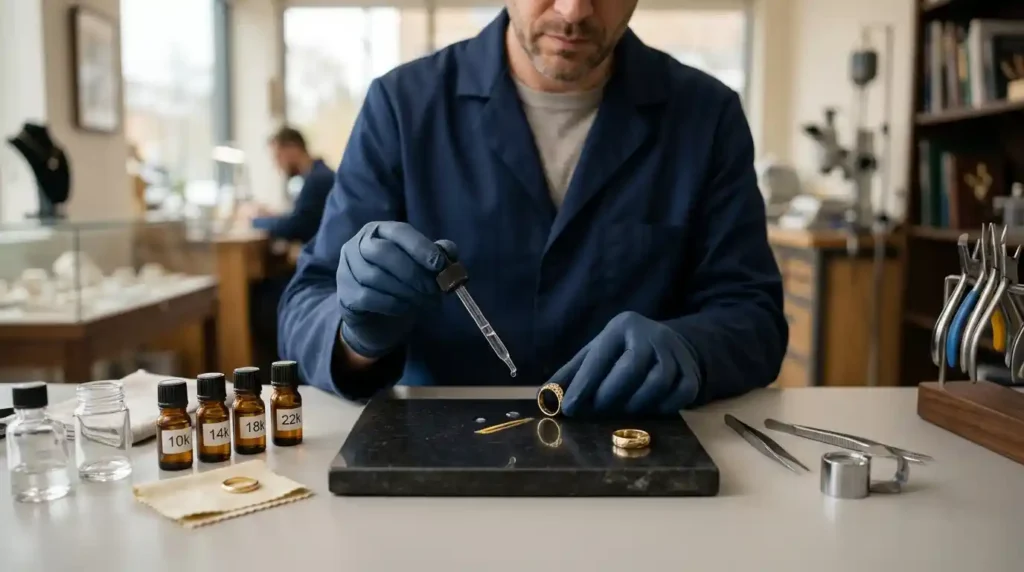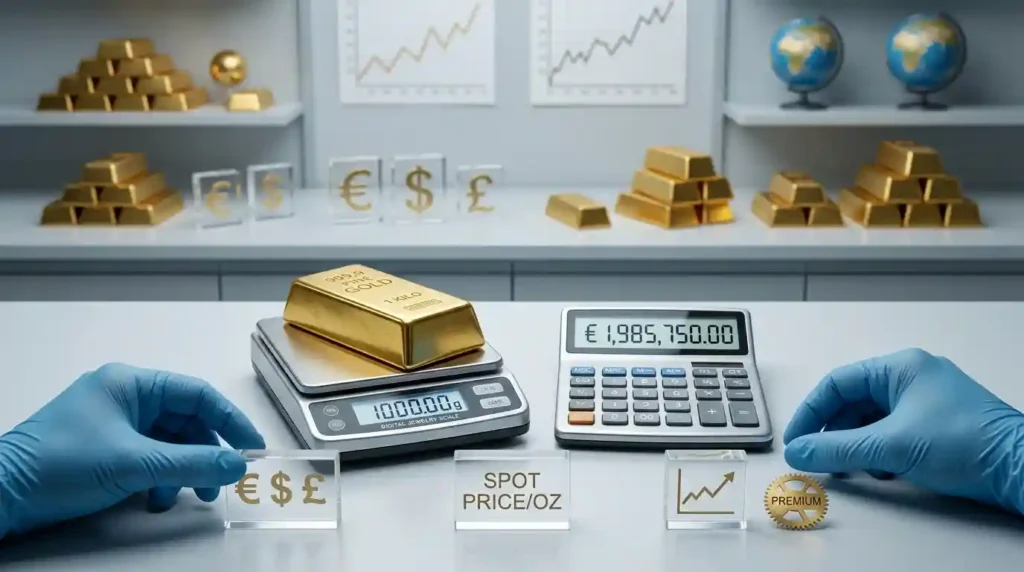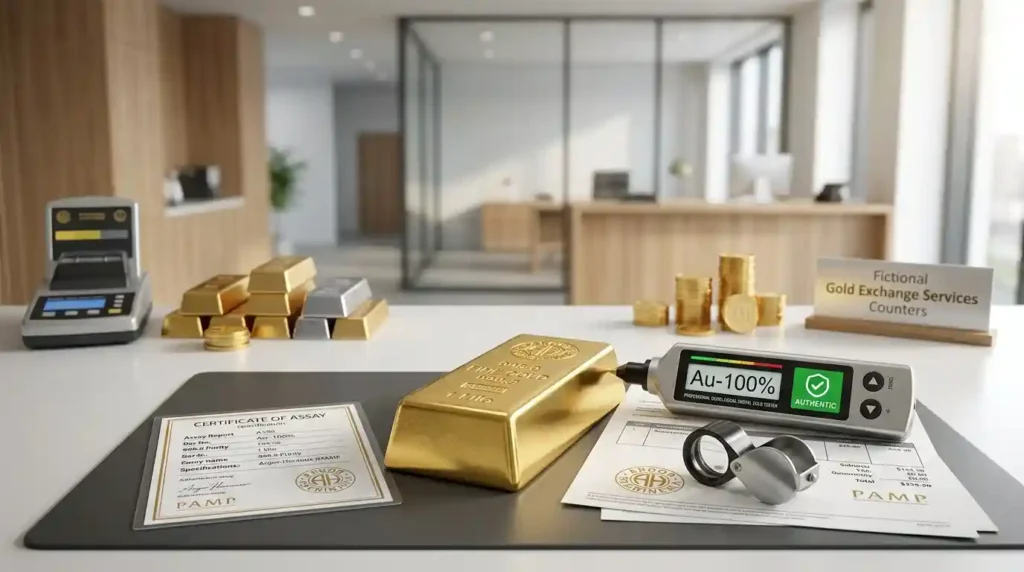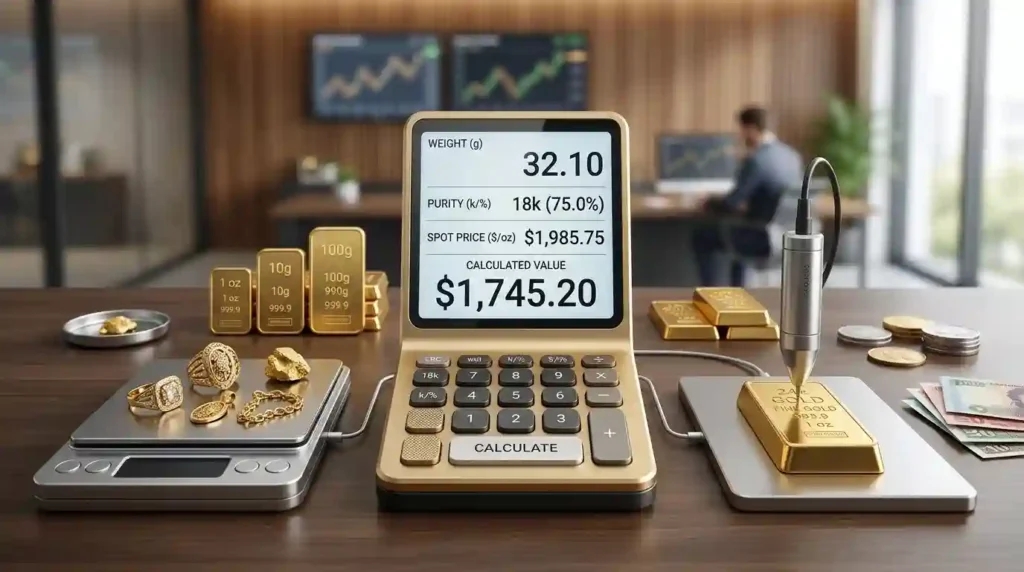
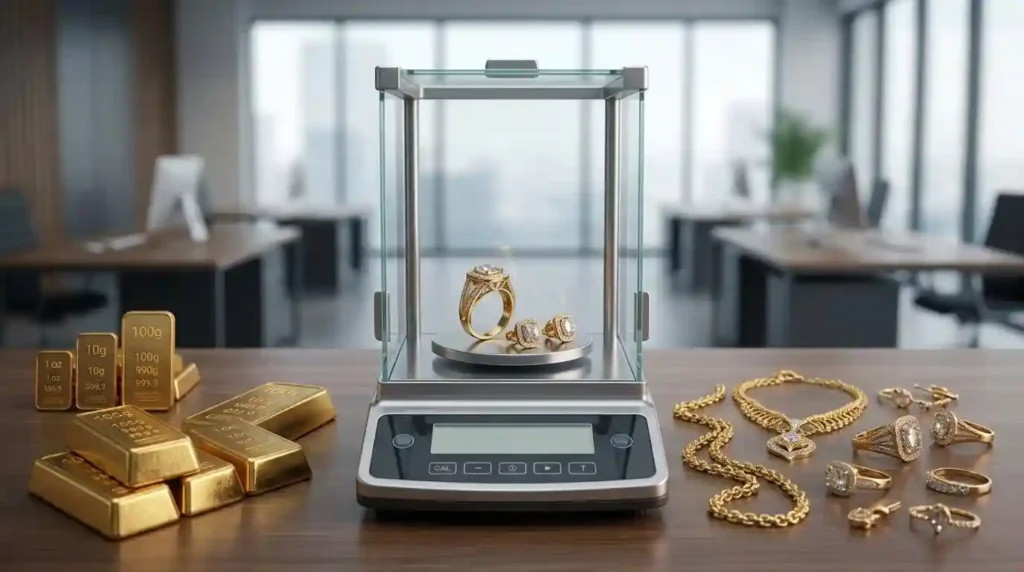
Most shoppers get a small shock at the jewelry counter. On a Saturday afternoon in Minneapolis, I checked the gold price on my phone before I walked into a store. Then I saw a gold ring tagged far above the value I had worked out. I wondered if the store was overcharging me. It was not, and I will show you why. Gold price vs gold jewellery price is not a fair fight, because each number measures something different. The metal has a market value, while a finished piece also pays for craft, design, business costs, and profit.
In this guide, you will learn how to:
- Compare gold spot prices with jewelry prices.
- Calculate the approximate gold value in a piece.
- Understand making charges, markups, and taxes.
- Use a gold price calculator to check a quoted price.
- Ask better questions before you buy.
What Is the Difference Between Gold Price and Gold Jewelry Price?
The gold price usually means the market price of gold as a raw precious metal. The jewelry price is the amount a store charges for a finished item. The two numbers are related, but you cannot swap one for the other. Think of flour and a birthday cake. Flour is part of the cake, yet nobody expects the cake to cost the same as the flour.
Defining the gold spot price
The spot price is the market price of pure gold. It is usually quoted per troy ounce. A troy ounce is about 31.1035 grams, which is heavier than the everyday ounce.
The spot price moves during the trading day. News, currency shifts, interest rates, and demand can all push it up or down. That is why a price you saw this morning may not match the price this afternoon. You can follow the current gold price and learn more about the price of gold to see what moves it.
Here is a key point. The published spot price is not always the price a regular buyer pays a dealer. Dealers add costs and margins on top. So the spot price is a reference, not a shopping price.
Defining the gold jewelry price
The jewelry price is what you pay for a finished ring, chain, bracelet, or necklace. It covers more than the gold inside.
The tag can include the gold content, the labor to shape the piece, the design, the brand, and the store’s overhead. Stones, special finishes, and custom work can add more cost.
Not every piece carries the same markup. A plain gold band may sit close to its metal value. A detailed designer ring may sit much higher. Both can be fair for what they are.
Think of the tag as a story with many chapters. I tell friends to treat it as a bundle. Part of it is metal. Part of it is work. Part of it is the cost of running a store. Once you see the bundle, the gap between the two prices feels less strange.
Why are the two prices different?
The spot price values the metal. A jewelry tag prices a finished product and the services behind it. That one idea explains most of the gap.
Here is a quick comparison. I use this table when I explain the topic to new buyers, because it shows the two prices side by side.
| Gold spot price | Gold jewelry price |
|---|---|
| Market reference for gold | Price of a finished item |
| Commonly quoted per troy ounce | Often quoted per item or gram |
| Reflects the precious metal market | May include labor, design, overhead, and profit |
| Does not include jewelry craftsmanship | May include craftsmanship and brand value |
Expertise note: Only compare the two figures when they use the same currency, weight unit, and purity basis. A price per troy ounce of pure gold cannot be set next to a price per gram of 14K jewelry without conversion. Our gold calculator handles that step for you.
What Makes Gold Jewelry More Expensive Than Gold?
Several costs sit between the raw gold price and the final price tag. Some reflect real work. Others deserve a question. I will walk through each one, so you know what to ask the seller to explain. The World Gold Council discusses retail jewelry pricing factors such as labor and store expenses. I use it as supporting context, not as a universal pricing formula.
Gold purity and karat
Karat tells you how much of a piece is pure gold. A 24K item is pure gold. A 22K item is about 91.67% gold. An 18K item is 75% gold. A 14K item is about 58.33% gold. A 10K item is about 41.67% gold.
So 14K gold holds less pure gold than 18K gold. Two rings of the same weight can have different metal values because of purity. A 10 gram ring in 18K holds more gold than a 10 gram ring in 14K.
Also look at the type of product. Solid gold is an alloy of gold throughout. Gold-plated pieces have a thin gold surface over another metal. Gold-filled pieces have a thicker layer, but they are still not solid gold. If you want to see how testing works, read about how gold purity is calculated.
Making charges and craftsmanship
Making charges pay for turning metal into a finished piece. This includes casting, shaping, polishing, and setting.
Detailed work costs more. Intricate patterns, hand finishing, custom sizing, and detailed settings take extra labor. A simple chain may need less time than a woven bracelet.
Sellers charge in different ways. Some use a flat fee. Some charge per gram. Some use a percentage of the gold value. Pricing methods vary by seller, and there is no single rule across the country.
I always ask whether the making charge is included in the tag. It is a fair question, and a good seller will answer it in plain words. If the answer is vague, I take that as a sign to slow down.
Retail markup and business expenses
A store has bills to pay. Rent, staff, security, insurance, and stock all cost money. Jewelry is small and valuable, so security and insurance can be a big part of the budget.
Retailers add a margin to cover these costs and earn a profit. That is normal for any business. It does not mean every markup is too high.
Be careful with simple rules. No single percentage is standard across the U.S. market. A small family shop and a large mall brand have very different costs. A fair price in one place may not be fair in another.
What I look for is clarity. I want the seller to tell me the weight, the karat, and what the price includes. Clear answers matter more to me than a low tag.
Brand, design, and gemstone value
A designer name can raise the price. So can an exclusive design. Buyers pay for the look, the story, and the maker.
Gold and gemstones are two separate values. A ring with a diamond has the metal value plus the stone value, plus the cost of the setting. Do not assume the stone is worth what you paid for it. Gemstone prices depend on size, cut, color, and clarity, and resale values often differ from retail.
When I shop, I ask for the gold weight and the stone details in writing. Then I can judge each part on its own. This habit helps me see what I am really paying for.
Sales tax and other checkout costs
Sales tax treatment varies by state and locality. Some places tax jewelry the same as other goods. Others may handle it differently. Check the rules where you live.
Compare the final checkout price, not only the shelf price. A low tag can grow after tax and fees. A higher tag with free resizing may be a better deal.
If you shop online, look for delivery charges, insurance fees, and return shipping costs. Reputable sellers disclose these before you pay. Read the full total on the last screen before you confirm.
I once saved a small amount on a tag and lost it all on shipping. Now I always compare the final total. A simple note on your phone with each store’s full price makes the choice much easier.
One more tip. Ask whether resizing, cleaning, or engraving is free. These small services can have real value, and they may tip the balance between two close offers.
How to Calculate the Gold Value Inside Jewelry
This is the core tool for any buyer. A simple formula lets you find the metal value of a piece before you look at the asking price. It takes only a few minutes. You need three numbers: the gold weight, the purity, and the price of pure gold per gram. Let’s go through them in order.
The gold value formula
Use this formula:
Estimated Gold Value = Gold Weight x Purity x Pure Gold Price per Gram
Gold weight is the weight of the gold portion, not always the whole item. A ring with a stone weighs more than its gold alone.
Purity is the fraction of the item that is gold. A 14K piece has a purity of about 0.5833.
Pure gold price per gram is the current price of pure gold, in the same currency as your result.
Keep the units matching. If your weight is in grams, your price must be per gram. Our guide on gold calculators shows how different tools apply this formula.
Convert the spot price to a price per gram
One troy ounce is about 31.1035 grams. So divide the price per troy ounce by that number:
Price per Gram = Price per Troy Ounce / 31.1035
Here is a hypothetical example. Say pure gold is $3,000 per troy ounce. Then $3,000 divided by 31.1035 is about $96.45 per gram.
Please note that this is an example. It is not a live gold quote. Use a trusted source for a current number, and check the time stamp. You can start with our gold price page.
The most common slip I see is using the everyday ounce of 28.35 grams. That gives a wrong gram price by a wide margin. Always use the troy ounce for gold.
Calculate gold value using karat purity
Here is the common approximation:
Purity Fraction = Karat / 24
Let’s work through a 10 gram 14K gold chain.
- Weight: 10 grams
- Purity: 14 divided by 24 is about 0.5833
- Pure gold content: 10 times 0.5833 is about 5.833 grams
- Estimated gold value at $96.45 per gram: about $562.63
So the chain holds about 5.8 grams of pure gold, worth about $562.63 at our made-up price.
Real results can differ. Actual fineness, testing, and the market price all change the estimate. A stamp of 585 means 0.585 purity, which is a touch higher than 0.5833. If you are unsure about the karat, read how gold purity is calculated before you trust the number.
Measure the gold value against the jewelry’s asking price
Start with the metal value. Then subtract it from the retail price. The result is the price difference.
Here is an example. A 14K ring has 5 grams of gold. At $96.45 per gram, the metal value is 5 times 0.5833 times $96.45. That is about $281.31. The store asks $900. The difference is about $618.69. The tag is about 3.2 times the metal value.
Now the important part. That difference is not automatically profit. It may cover labor, stones, overhead, and other costs.
A price several times the metal value does not, by itself, prove fraud or unfair pricing. It is a signal to ask what the price includes. Our guide on gold valuation scams explains which red flags matter more than a high markup.
Comparing Gold Price vs. Gold Jewelry Price by Karat
This table is a fast way to compare the metal value of equal weights. It uses a hypothetical pure gold price of $100 per gram. That keeps the math clean and avoids confusion with current market data. It shows how purity changes the estimate in the gold price vs gold jewellery price debate.
| Gold purity | Approximate gold content | Metal value for 10 g at $100/g |
|---|---|---|
| 24K | 100% for simplified calculation | $1,000.00 |
| 22K | 91.67% | $916.67 |
| 18K | 75% | $750.00 |
| 14K | 58.33% | $583.33 |
| 10K | 41.67% | $416.67 |
18K jewelry can cost more than 14K jewelry
Higher gold content generally means a higher metal value for the same weight. That is the main reason 18K often costs more.
Design, craftsmanship, brand, and gemstones can also change the retail price. A simple 18K band and a gem-set 14K ring may not follow the pattern.
Weight matters too. A lighter 18K piece can contain less gold than a heavier 14K piece. For example, 4 grams of 18K holds 3 grams of pure gold. Six grams of 14K holds about 3.5 grams. At $100 per gram, that is $300 for the 18K piece and about $350 for the 14K piece.
So always check both weight and karat before you compare two pieces.
Karat alone does not set the final price
Purity is only one part of the calculation. A plain chain and a detailed gemstone ring can have very different retail prices, even when their gold content is similar.
Labor, design, stones, and store costs all play a role. A high karat number does not guarantee a high price, and a low karat number does not guarantee a bargain.
Trust note: This table estimates metal value only. It does not estimate a guaranteed retail price or a resale offer. Use it as a starting point, then ask the seller for details.
If you want to see how karat works in a longer guide, read our article on how gold purity is calculated.
Retail Gold Jewelry Price vs. Melt Value vs. Resale Price
You may be comparing a new ring with an old one you already own. These are different kinds of value, and each answers a different question. The table below defines them in plain words. I keep this table in mind any time I help a friend decide whether to buy, keep, or sell a piece.
| Price or value | What it represents | Main factors |
|---|---|---|
| Retail jewelry price | Cost to purchase a finished piece | Metal, labor, design, brand, stones, retail costs |
| Estimated metal value | Gold content valued at a market reference price | Weight, purity, gold price |
| Melt value estimate | Estimated value of recoverable gold content | Purity, weight, refining and recovery considerations |
| Resale or dealer offer | Amount a buyer is willing to pay | Testing, market conditions, resale costs, buyer margin |
New jewelry costs more than its gold content
A new piece starts as metal. Then workers shape, finish, and polish it. Each step adds cost.
Retail costs and business margins add more. The store pays rent, staff, and insurance, and it needs to earn a profit.
A distinctive design may add value beyond the metal. Some buyers happily pay extra for a look they love. That is a personal choice, not a trick.
I like to separate the two questions. First, what is the metal worth? Second, is the design worth the extra to me? Asking both questions keeps me calm at the counter.
A buyer may offer less than the calculated gold value
Buyers often offer less than the metal value. There are real reasons for this.
- The buyer may need to test and process the item.
- The offer may account for refining and business costs.
- The item may include stones or non-gold parts.
- Another dealer’s offer may differ.
None of this means every low offer is unfair. It does mean you should ask questions. Get more than one written offer. Learn how shady deals work in our guide on gold buying scams, and see how gold valuation scams can mislead sellers.
Can branded or antique jewelry be worth more than melt value?
Yes, it can. Collectible, antique, or designer pieces may have a separate resale value above the metal.
Do not assume every old or branded item earns a premium. Many do not. Condition, demand, and proof of origin all matter.
If the design or history may matter, get a specialist appraisal. I have seen families sell a rare piece for scrap because they never asked. A short appraisal can protect you from that mistake. For more reading, browse the gold guides on our blog.
How to Use a Gold Price vs. Jewelry Price Calculator
A calculator helps you compare the gold content with a jewelry item’s quoted price. You can use it right in the store. The steps are simple enough for a first-time buyer. You need the gold price, the weight, and the purity. Optionally, add the asking price to see the gap.
Estimate the gold value before you compare jewelry prices. Try our gold calculator now.
Enter the current gold price
Choose a reliable price source. Confirm the currency and the unit, such as U.S. dollars per troy ounce.
Check the time stamp or update frequency. A price with no time is hard to trust. If the tool uses a stored rate, update it by hand when the market moves. Our gold price guide shows what a clear quote looks like.
Do not mix currencies or units. A euro price will not work in a dollar formula. A per-ounce price will not work in a per-gram field. Convert first, then enter the number.
Enter weight and purity
Enter the gold weight in the unit the tool supports. Grams are the easiest for jewelry.
Select the correct karat or fineness. Look at the stamp on the clasp or inner band.
Avoid counting the weight of stones or non-gold parts as if they were gold. This is a common error that inflates the estimate. If you do not know the gold weight, ask the seller or a jeweler. If you only have the total weight, treat the result as a high estimate. Our guide to gold calculators explains how different tools handle this.
Compare estimated metal value with the asking price
Enter the jewelry price if the calculator supports it. Then review the dollar difference and the percentage difference.
Treat the result as a screening tool. It is not a complete appraisal. It cannot judge craftsmanship, stone quality, or authenticity.
A big gap is a reason to ask questions, not a reason to walk away. Ask what the price includes. A clear answer can make a big gap feel fair. A vague answer can make a small gap feel risky.
I use this step to plan my questions before I speak with a seller.
Features a good gold calculator should display
A good tool should show these items:
- Gold price and time stamp.
- Weight and unit.
- Karat purity or fineness.
- Estimated pure gold weight.
- Estimated metal value.
- A clear note that retail costs and taxes may be excluded.
Showing the formula next to the result helps too. It lets you check the math. A calculator should never feel like a black box. If a tool hides its inputs, I would not trust it for a big purchase.
Telling Whether a Gold Jewelry Price Is Fair
A fair price check takes more than dividing the tag by the gold value. You need to compare like with like. You also need to ask the seller to explain any unclear charges. I use four checks every time. They keep me calm and help me spot a good deal.
Match similar pieces
Match karat, weight, style, and gemstone content as closely as you can. A 14K chain and an 18K chain are not equal. A plain band and a gem-set band are not equal either.
Compare prices from more than one reputable retailer. Two or three stores are enough to see a pattern.
Check the return policy and the warranty terms too. A fair price with a clear return policy beats a low price with none. Write down what each store says. Small notes help when you compare later.
Ask for an itemized price breakdown
Ask the seller these questions:
- What is the item’s gold weight?
- What is its karat or fineness?
- Are making charges included?
- Are gemstones priced separately?
- Is sales tax included in the displayed price?
A good seller can answer in plain language. Write the answers down. If the seller will not share the details, that is worth noting.
I often ask these questions in a friendly way. Most sellers respond well. The answers help me see what the price really covers.
Check gold markings and seller details
Marks such as 14K, 18K, and 750 show karat or fineness. A 750 mark means 75% gold, which is 18K.
A stamp is not a substitute for checking authenticity when you have doubts. Marks can be worn, wrong, or fake.
The Federal Trade Commission (FTC) offers jewelry-buying advice on quality marks and on researching sellers. Read it before you buy. For more on how fakes and false claims work, see our post on gold valuation scams. Also review how gold purity is calculated for more on testing.
Know when to get an independent opinion
Get professional testing or an independent appraisal in three cases. The first is a high-value item. The second is uncertain purity. The third is jewelry that may be antique or collectible.
An independent view costs a little, but it can protect a large purchase. Choose someone who does not gain from the sale.
I once asked for a second opinion on a vintage piece. The appraiser found details the seller never mentioned. That small fee gave me peace of mind. Do the same when the stakes feel high. Bring the tag, the stamp details, and your own estimate of the metal value. A good appraiser will respect that you did your homework, and the talk will be shorter and clearer.
Common Mistakes When Comparing Gold and Jewelry Prices
Some errors make a fair price look suspicious. Others make an expensive piece look like a bargain. I have seen each one many times. Learn these four mistakes, and you will avoid most of the confusion buyers face.
Comparing different units
Do not compare a price per troy ounce directly with a price per gram. The numbers look very far apart.
Convert both to the same unit first. One troy ounce is about 31.1035 grams. Divide the ounce price by that number to get a gram price.
Also watch for pennyweights. Some U.S. sellers use them. One pennyweight is about 1.55517 grams. Convert before you compare. Our gold calculator can do the conversion for you.
Ignoring purity
A gram of 14K gold is not the same as a gram of 24K gold. The 14K gram holds about 58.33% gold.
Apply the purity factor before you estimate metal value. Skip it, and you will overstate the value by a wide margin.
At $100 per gram, 10 grams of 14K is worth $583.33, not $1,000.00. That is a big gap. If you want a refresher, read about how gold purity is calculated.
Assuming all extra cost is profit
Labor, design, stones, and retail costs all add to the price. They are not all profit.
Ask for details instead of guessing what the store earns. A business has real expenses. Some are large.
I have heard buyers say a store made 300% profit. They had no way to know that. The better move is to ask what the price covers. The answer teaches you more than a guess ever will.
Assuming the highest gold content means the best purchase
Higher karat gold is not always better. Pure gold is soft. It may bend or scratch with daily wear.
Think about durability, design, fit, intended use, and budget. A 14K ring may last longer for daily wear than a 22K ring.
Choose a product for what you need, not only for its karat number. Ask yourself how often you will wear it and how much care you can give it. That question often leads to a better pick. A modest piece you wear every day gives more joy than a costly one that stays in a drawer.
U.S. Expert and Consumer Guidance for Gold Jewelry Buyers
Good advice should come from sources you can check. For U.S. buyers, the FTC and the World Gold Council are useful starting points. I do not use made-up quotes. What follows is a plain summary of their guidance. The goal is to help you verify claims, not just trust the price tag or a calculator.
Federal Trade Commission guidance on gold jewelry
The FTC publishes a guide called Buying Platinum, Gold, and Silver Jewelry. It explains karat quality marks, tips for researching sellers, and why you should get return policies in writing.
It also encourages buyers to look for the quality mark and the maker’s registered trademark. These marks help you see who stands behind a claim.
Read the guide before you make an expensive purchase. A mark helps, but it is not a guarantee. Testing may still be needed if you want to be sure. For related reading, see our guide on gold buying scams.
World Gold Council insight on jewelry pricing
The World Gold Council discusses how retail jewelry is priced. It points out that the price of finished jewelry can include labor and store expenses, along with the gold content.
I find this useful because it backs up a simple idea. A tag is more than the metal. It is a mix of materials, work, and business costs.
Use it as context, not as a fixed formula. Different sellers price in different ways. Our price of gold guide can help you see how the metal part changes over time.
Steps to take if a seller’s claims seem misleading
Start by asking for written details about the metal, purity, weight, and price. A real seller can provide them.
Review the return policy before you pay. Know your options if something goes wrong.
If a U.S. purchase looks deceptive, use the FTC’s consumer complaint resources at ReportFraud.ftc.gov. Keep your receipts, photos, and messages.
Do not rush. A pushy seller is a warning sign. Learn more about common tricks in our post on gold valuation scams, and browse our gold blog for more buyer tips.
Frequently Asked Questions About Gold Price vs. Gold Jewelry Price
These short answers match common searches. Each gives the main point first. Use the links to go deeper on any topic. If you want a quick check, try our gold calculator with your own numbers.
Why is gold jewelry more expensive than the gold spot price?
The retail price can include gold content, craftsmanship, design, gemstones, overhead, and profit. The spot price covers only the metal. So the tag will usually sit above the metal value.
Is gold jewelry worth its weight in gold?
Its metal value depends on the actual gold weight and the purity. Its retail or resale value may include other factors, such as design, brand, and stones. So the answer is often no, because most pieces cost more than their metal.
Which steps compare jewelry prices with spot prices?
First, convert the spot price to the same weight unit. Second, adjust for purity. Third, estimate the metal value. Fourth, compare the finished item’s price and features. Our gold price guide can help with the first step.
Do making charges have resale value?
Making charges are generally part of the original purchase cost. They may not be recovered when you sell the item for its metal content. A buyer may pay more for a special design, but you should not count on it. Read about gold buying scams before you sell.
Is 18K gold worth more than 14K gold?
For equal weights and the same pure gold price, 18K generally holds more gold. So its metal value is higher. The final jewelry price also depends on design and other costs. See how gold purity is calculated for more.
Does a higher jewelry price mean better quality?
No. Compare purity, construction, stones, seller reputation, and return terms. Price alone does not prove quality.
Can a gold calculator tell me if jewelry is overpriced?
It can estimate the metal value and help you find questions to ask. It cannot judge craftsmanship, authenticity, gemstone quality, or fair market resale value on its own. Learn what different tools can and cannot do in our overview of gold calculators.
Compare Gold Prices Before You Buy
Check the current gold price first. Then confirm the purity and weight of the piece. Use our gold calculator to estimate the gold content. Compare the final jewelry price with similar products. One calculation cannot prove that an item is overpriced. The goal is to help you ask better questions and make a more informed purchase.
Final Recommendation
I have spent years looking at gold prices and jewelry tags, and one lesson stays with me. Gold price vs gold jewellery price will never match, and they are not meant to. The spot price shows the metal. The tag shows the metal, the work, the design, and the store. Before you buy, check the weight, the karat, and the price per gram. Ask for an itemized breakdown, and compare at least two sellers. If the piece is costly or unusual, get an independent opinion.