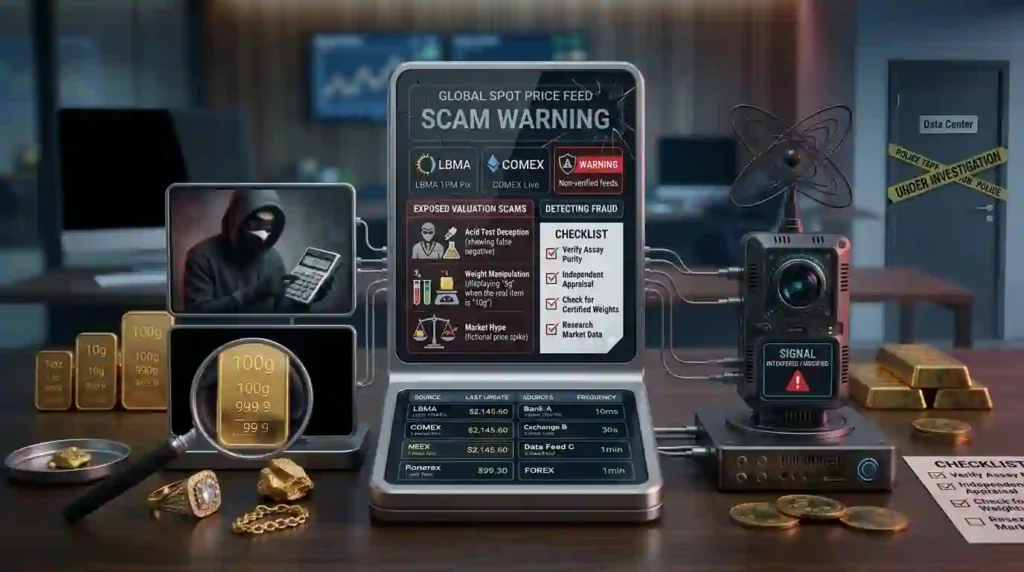
Picture a Saturday morning in Minneapolis. You bring an old gold bracelet to a buyer. You hope for a fair offer. Instead, the buyer names a low number, rushes you, and will not show the math. Is that normal business, a weak appraisal, or a real scam? This guide on common gold valuation scams explained in plain words will help you decide. A gold valuation scam is a deceptive practice. It misstates purity, weight, market value, collector value, fees, or deal terms. I will walk you through the main scam types, the warning signs, and the math checks you can run with a gold calculator. I will also cover seller checks and what to do if money is already lost. One fair note first. A low offer does not prove fraud. Evidence and honest terms matter most.
What Are Gold Valuation Scams?
A gold valuation scam is a deal where someone lies about what your gold is worth or hides the real terms. That is different from a normal price gap. Two honest buyers can give you two different offers. They have different costs, goals, and risks. A scam needs a false claim, a hidden cost, or pressure that stops you from checking. In my experience, one question sorts most cases. Can the buyer explain every number in plain words? If the answer is no, slow down. A fair deal can survive questions.
How a Gold Valuation Should Work
A fair valuation follows a clear path. You should be able to see each step.
- Find the item’s weight and gold purity.
- Check a trusted market price. The current gold price is a good starting point.
- Calculate the estimated metal value.
- Add value for condition, craftsmanship, rarity, or collector appeal, but only when it truly applies.
- Explain any fees, margins, or deductions that change the final offer.
Notice the order. Metal comes first. Extras come second. Fees come last, and they must be named. A buyer who jumps straight to a final number gives you nothing to check. You cannot test a number that has no steps behind it. That is why I always ask for the steps, not just the total.
What Makes a Gold Valuation Misleading?
A valuation turns misleading when facts are false or missing. Here are the usual forms.
- Claiming an item holds less gold than it does, with no sound proof.
- Misstating the weight or the purity.
- Advertising a price that hides major fees or conditions.
- Inventing collector value or promising guaranteed returns.
- Using fake credentials, fake appraisals, or sales pressure.
Each one blocks your ability to check the deal. That is the real harm. Gold is easy to value when the facts are honest. It gets hard only when someone else controls the facts. For a wider list of tricks in this space, read our gold buying scams guide.
Is a Low Gold Offer Always a Scam?
No. A low offer is not proof of fraud. Buyers pay for refining, testing, labor, and risk. They also need a profit. So an offer often lands below the full metal value. What matters is honesty. Did the buyer explain the gap? Did they put it in writing? Did they pressure you?
Many sellers mix up melt value and resale value. Knowing the gap helps you judge an offer calmly. This table gives you a quick guide.
Table 1: Melt Value vs. Resale Value
| Term | What it means | Who usually uses it |
|---|---|---|
| Melt value | The worth of the pure gold inside the item | Scrap and refinery buyers |
| Resale value | The price a shop hopes to get when it sells the piece as jewelry or a collectible | Jewelers and retailers |
| Buyer offer | What the buyer will pay you today, after costs and margin | Dealers and pawn shops |
The real warning signs are different. Watch for false claims, unexplained deductions, pressure, or a refusal to document the deal.
The Most Common Gold Valuation Scams Explained
This is the heart of the guide. I explain each scam in plain English. I show how it works. Then I give you one clear way to protect yourself.
1. The Fake Low-Purity Test
A buyer says your 14K or 18K piece holds far less gold than the stamp claims. They show no clear test. They want you to take quick cash.
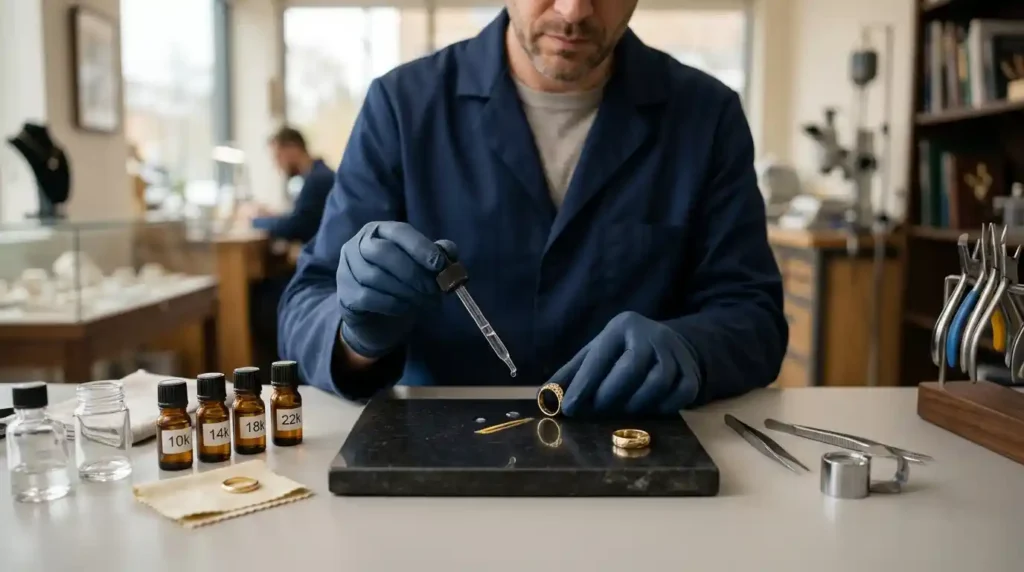
Real testing exists. Acid kits, electronic testers, and X-ray fluorescence (XRF) machines are all used in the trade. But a result means little if nobody explains it. A sudden drop from 18K to 10K is a big claim. It cuts the gold content by more than 40 percent.
How to protect yourself: Ask which method the buyer used and why. Ask for the result in writing. Get an independent second test if the result seems off. Learn how gold purity is calculated before you go, so you know what your stamp should mean.
2. The Underweight Gold Scam
A dishonest buyer may misstate the weight. Or they may use a scale you cannot see. Sometimes they remove stones, clasps, or other parts and give no clear reason.
Some deductions are fair. A diamond is not gold. But the buyer must tell you what came out and how much it weighed. Small errors add up fast. A gram or two off on a heavy chain can cost real money.
How to protect yourself: Ask to see the scale, the weight, and the unit. Ask for every deduction in writing. Keep your own record. Then plug the numbers into a gold calculator to see if the offer makes sense.
3. The Fake Gold Appraisal
Here a seller or buyer shows you a certificate that cannot be verified. It may carry no real name, no method, and no contact details. A so-called expert may use false credentials. Sometimes the paper is shown as proof of a guaranteed resale price.
An appraisal is an opinion of value for a stated purpose. It might be for insurance, an estate, or a sale. It is not a promise that anyone will pay that price.
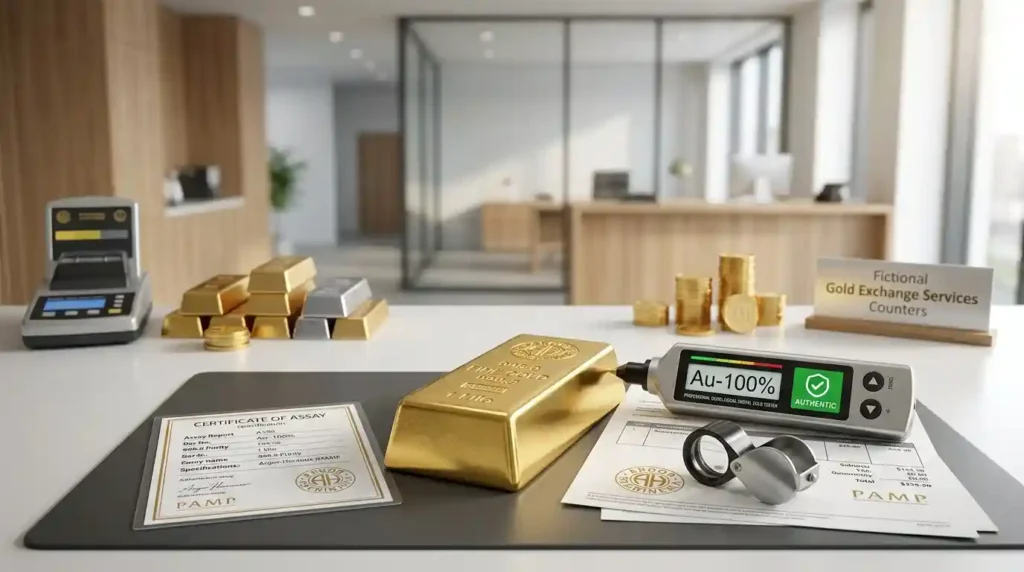
How to protect yourself: Verify the appraiser’s credentials. Ask what the valuation covers and what it does not. Call the appraiser yourself, using contact details you found on your own.
4. The Inflated Gold Value Scam
This scam flips the usual story. The seller claims an item is worth far more than its metal content or fair market value. They use a big number to push you into an instant purchase. They add talk of rarity or future demand, with no proof.
Gold jewelry often sells at retail prices well above melt value. That can be fair, because of craft and brand. But a premium needs a reason you can check.
How to protect yourself: Separate metal value from retail value and collector value. Check the price of gold and do the math. Ask for evidence behind any premium.
5. Hidden Fees and Bait-and-Switch Offers
The offer looks great at first. A bold ad might promise a high payout. Then the final amount drops after fees, commissions, or deductions you never heard about. Sometimes the buyer changes the terms after you have committed.
A big headline number can hide a long list of costs. This trick hurts sellers and buyers alike. Sellers get less than expected. Buyers pay more than expected.
How to protect yourself: Ask for the final net amount in writing before you agree. Compare it with your own estimate from a gold calculator. If the gap is large, ask the buyer to explain each line.
6. Fake Gold Investment and Coin Valuation Scams
A salesperson claims gold or rare coins will bring guaranteed returns. Collector coins are sold at inflated prices using stories of scarcity. Storage, financing, or account fees are hidden or played down.
No honest seller can guarantee a gold return. Prices rise and fall. The CFTC has said that over the past decade it has brought many cases against dealers over overpriced metals. Those cases allege more than $500 million in combined sales. Its guidance also warns about dealers who oversell safety.
How to protect yourself: Compare the total purchase price with a credible market reference. Ask for a full fee schedule. Read our gold buying scams guide for more on pushy sales tactics.
How to Recognize Gold Valuation Scam Warning Signs
You can often spot trouble before you hand anything over. Watch how the buyer behaves. Behavior tells you more than a sales pitch does.
Red Flags During a Gold Appraisal
These signs show up in shops, at pop-up events, and at home visits.
- The buyer will not explain the weight or purity result.
- The scale is hard to see, or it is turned away from you.
- The valuation changes with no clear reason.
- The buyer refuses to give a written offer.
- You are discouraged from getting a second opinion.
One of these may be a bad day. Two or three together are a pattern. If the buyer cannot tell you why the purity result differs from your stamp, review how gold purity is calculated and test again somewhere else.
Red Flags in Online Gold Offers
Online deals add new risks. You cannot see the scale or the shop. Watch for these signs.
- Claims of guaranteed profit or no investment risk.
- Unsolicited calls, texts, or social media messages.
- Fake reviews, false credentials, or company details that do not check out.
- Requests to pay in unusual or hard-to-reverse ways.
- Pressure to act before the offer supposedly vanishes.
The FTC advises that a seller who presses you to wire money is probably running a scam. It also says that “no risk” claims should make you walk away. Real gold investments carry risk. The CFTC adds a simple rule: never buy precious metals because of a cold call, an unsolicited email, a social post, or an infomercial.
When Pressure Becomes a Major Warning Sign
Pressure is a tool. Scammers use it to stop you from thinking. Listen for lines like these.
- “You must decide right now.”
- “You cannot show this offer to anyone.”
- “Gold prices will make you rich with no risk.”
- “Pay this extra fee to unlock your gold or profits.”
Honest buyers can say a price is good only today, because gold prices move. But they will still let you ask questions. One warning sign alone may not prove fraud. Several together are a reason to stop and verify the offer.
Table 2: Gold Valuation Scam Warning Signs
A quick checklist can help when time pressure makes it hard to think. Use it to pause and check. These are warning signs, not proof. Always look at the facts too.
| Warning sign | Why it matters | Safer response |
|---|---|---|
| Unexplained purity result | The valuation may rest on an unsupported claim | Seek an independent test |
| Unclear weight | The metal value cannot be checked reliably | Confirm the reading and the unit |
| Hidden fees | The final payment may be much lower | Request a written breakdown |
| Guaranteed profits | Real gold investments carry risk | Verify the claim and the seller |
| Urgent payment demand | Pressure can block careful checks | Pause and verify on your own |
How to Check Whether a Gold Valuation Is Fair
Here is a repeatable method. It works whether you sell a ring or compare a coin quote. Take it one step at a time.
Step 1: Check the Gold Weight
Ask for the weight in grams or another clear unit. Jewelers may also use pennyweights (dwt) or troy ounces. One troy ounce equals about 31.1 grams. That matters because gold prices are usually quoted per troy ounce, while many scales show grams.
Confirm whether the reading includes stones or other non-gold parts. Ask for a clear reason behind any deduction. If you want to test your own numbers, our guide to gold calculators shows what inputs matter.
Step 2: Verify the Gold Purity
Look for marks such as 10K, 14K, 18K, 585, 750, or 916. These tell you the claimed purity. They are clues, not final proof. Marks can be worn, misread, or faked.
If the purity result affects a big sale, consider an independent test. A second lab or a trusted jeweler can settle a dispute. The gold purity guide explains the math behind each karat.
Common Purity Marks and What They Mean
Karats split pure gold into 24 parts. So 24K is nearly pure. Here is a short list.
- 10K, or 417, means about 41.7 percent gold.
- 14K, or 585, means about 58.5 percent gold.
- 18K, or 750, means 75 percent gold.
- 22K, or 916, means about 91.6 percent gold.
- 24K, or 999, means about 99.9 percent gold.
Watch for marks like GP or GF. They point to plated or filled items, which hold far less gold. Plating can also hide a base metal core. A trusted tester knows how to check for it.
Step 3: Check the Gold Price
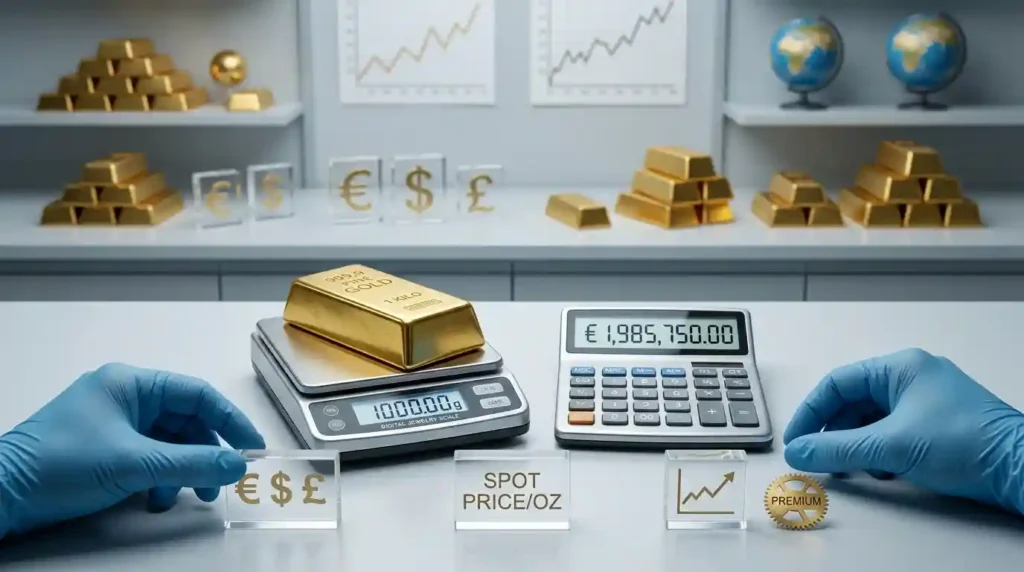
Compare the quoted price with a reputable market reference. Confirm the date, the currency, and the weight unit. A price per ounce is not the same as a price per gram. To convert, divide the ounce price by 31.1035.
Also separate the spot price from the amount a dealer offers. Spot price is the market benchmark for pure gold. Dealers pay less because they must cover costs. Read the gold price guide to see how the benchmark moves.
Step 4: Calculate the Estimated Metal Value
Now do the math. Here is the formula.
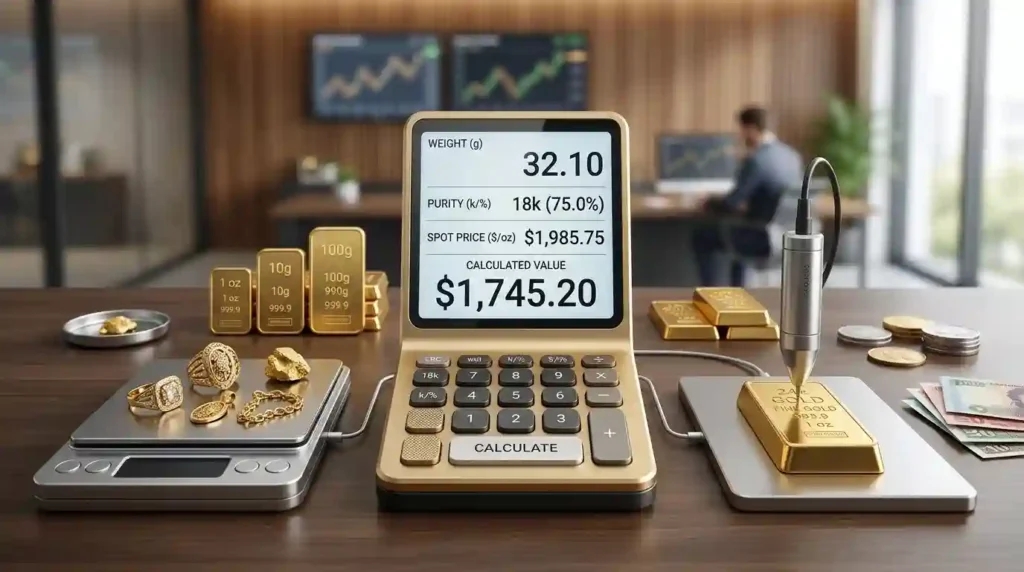
Estimated Metal Value = Weight × Purity Factor × Pure Gold Price per Unit
Here is a hypothetical example. The numbers are made up to keep the math easy.
- Gold item weight: 10 grams.
- Purity: 18K, or 75 percent (0.75).
- Hypothetical pure gold price: $100 per gram.
- Estimated metal value: 10 × 0.75 × $100 = $750.
This is a simplified example. It is not a current price or a guaranteed dealer offer. Our gold calculator can run this math for you with real inputs.
How Buyer Payouts Differ From Melt Value
Your metal value is the top line. A buyer usually pays a share of it. They have refining costs, labor, and risk. They also need a margin.
That is not a scam by itself. The question is whether the buyer is open about it. Ask what percentage of melt value they are paying. Ask which costs they deduct. A fair buyer can answer in one sentence. If you want to know how the market benchmark behind that math moves, check the price of gold.
Step 5: Compare the Final Offers
Get quotes from more than one reputable buyer. Ask each one for fees and deductions in writing. Compare the final amount you would receive, not the advertised rate. A high rate with high fees can lose to a lower rate with no fees.
Keep copies of every valuation and document. Photos help too. If you want more checks like these, browse the Gold Calculator blog for related guides.
Table 3: How to Verify a Gold Valuation
This table shows how each input shapes the final result. It helps you see where a disagreement comes from. The gap may come from the gold, the market price, or the buyer’s terms.
| What to check | Verification method | Why it matters |
|---|---|---|
| Weight | Watch the scale reading | Affects the amount of metal being valued |
| Purity | Review marks and consider testing | Sets the gold content |
| Market price | Check a reputable price reference | Gives you the market benchmark |
| Fees | Request written terms | Explains deductions |
| Final offer | Compare multiple quotes | Shows differences between buyers |
Gold Calculator vs. Professional Appraisal: Which Should You Trust?
Use both, for different jobs. A calculator checks the math. An appraiser checks the item. Each answers a different question.
What a Gold Calculator Can Tell You
A calculator turns weight, purity, and price into an estimated metal value. That is useful for three reasons.
- It estimates the gold-content value from your inputs.
- It helps you compare quotes using the same assumptions.
- It shows whether an offer deserves a closer look.
I rely on calculators for the first pass. If an offer is far below the estimate, I ask why. Sometimes the answer is fair, like a stone deduction. Sometimes it is not. You can start with the gold calculator and then check the market side in the price of gold guide.
What a Gold Calculator Cannot Prove
I use these tools often, so I want to be honest about their limits. A calculator cannot prove any of the following.
- Whether the gold is genuine.
- Whether the stated purity is correct.
- Whether a coin is rare or collectible.
- Whether a dealer’s offer is fair in every way.
A calculator trusts your inputs. If the purity is wrong, the answer is wrong. That is why testing matters. Learn how gold purity is calculated so you know what to check. No online tool can authenticate gold. Only a proper testing process can do that.
When to Seek an Independent Appraisal
Some cases call for a professional. Think about an appraisal in these situations.
- High-value jewelry.
- Antique or designer pieces.
- Disputed purity or weight.
- Items with possible collector or historical value.
- Any deal where a large amount of money is at stake.
An independent appraisal costs money. But it can save far more than it costs on the right item. Pay for it before you sell, not after.
How to Choose an Appraiser
Choose with care. A bad appraiser is just another scam risk.
- Verify training, credentials, and experience. A gemologist credential, such as one from the Gemological Institute of America, is one example.
- Ask how the valuation will be done.
- Ask whether the appraiser has a financial interest in buying the item.
- Request a written report that explains what the valuation covers.
The last two points matter most. An appraiser who also wants to buy your piece has a reason to value it low. A written report gives you proof if a dispute comes up later.
Real Gold Scam Examples and Lessons for Buyers
Real cases show how these tricks work. I use one documented case and one clearly labeled hypothetical. I do not present invented stories as real customer experiences.
Case Study: Overpriced Coins Sold as Safe Investments
In April 2023, the CFTC filed a civil enforcement action in federal court in the Eastern District of New York. The defendants were Fisher Capital LLC and AMS Consulting Solutions LLC, which did business as Fisher Capital. The agency alleged a precious metals fraud aimed at older adults.
According to the CFTC press release, customers were steered toward collectible or “semi-numismatic” coins. The agency alleged prices were often double or triple market value. Reuters reported the CFTC said sales topped $30 million. The company denied the charges and said it would defend itself.
These are allegations. Check the CFTC site for the case’s current status. The lesson is clear. A product can be real while the price or the sales pitch is deceptive. See our gold buying scams guide for more on this pattern.
Hypothetical Example: The Bracelet That Suddenly Lost Its Value
This is a made-up scenario. It shows a good way to respond.
A seller brings an 18K bracelet to a buyer. The buyer says it is only 10K. No clear test is shown. The seller feels uneasy, so the seller pauses. They ask for the result in writing. The buyer hesitates. The seller then gets an independent assessment, which confirms 18K.
The lesson: verify any surprising change in value before you accept an offer. A short delay cost the seller nothing. A rushed yes could have cost hundreds of dollars.
What These Examples Teach Us
Both stories point to the same habits. Keep these in mind.
- Real metal does not guarantee a fair price.
- A professional-looking certificate does not prove the claims are correct.
- A second opinion can uncover errors or deception.
- Written records make disputes easier to prove.
None of these steps needs special skill. They need patience. That is the one thing scammers try to take from you.
How to Avoid Gold Valuation Scams Before You Buy or Sell
Let’s turn the warning signs into a plan. These steps work before you commit to any deal.
Research the Dealer or Seller
Spend ten minutes on research. It is the cheapest protection you have.
- Search the business name with words like “complaint,” “review,” and “scam.”
- Verify its physical address and contact details.
- Check your state’s consumer protection resources. Rules for dealers vary by state.
- Do not rely on social media testimonials alone.
Reviews can be faked. Look for patterns across several sources. Our gold buying scams guide lists more ways to vet a seller.
Get the Terms in Writing
A spoken promise is hard to prove. A written term is not.
- Request the weight, purity, price basis, fees, and final amount.
- Read the return and cancellation policies.
- Keep copies of receipts, emails, messages, and ads.
Check the written weight against your own record. Then run the figures through a free gold calculator. If a buyer refuses to write down the terms, treat that as an answer.
Avoid High-Pressure Decisions
Time is on your side. A real offer will usually survive a day of thought.
- Do not agree just because a seller says the offer ends now.
- Take time to compare prices.
- Ask a trusted person to review an unfamiliar investment offer.
Gold is not a lottery ticket. Waiting a day rarely changes the metal value by much. It can change your whole view of the seller.
Protect Yourself From Gold Investment Scams
Investment pitches deserve extra care. Here is what to remember.
- Avoid claims of guaranteed returns.
- Understand premiums, commissions, storage fees, and buyback terms.
- Verify the seller and any needed registration before you invest.
- Never assume a gold IRA or collector coin is safe just because it involves physical gold.
The FTC urges buyers to research sellers, compare prices, and not let a seller’s urgency drive the decision. The CFTC and FINRA published a bulletin called 10 Things to Ask Before Buying Physical Gold, Silver, or Other Metals. It also notes that only certain bullion can be held in an IRA. A premium is the amount above the market price, so check the price of gold first.
Table 4: Gold Buying Safety Checklist
Use this checklist before you pay or hand over an item. The goal is simple. You should be able to explain the deal in plain English before you agree to it.
| Before the transaction | Done? |
|---|---|
| I checked the seller’s reputation | ☐ |
| I confirmed weight and purity | ☐ |
| I checked a suitable gold price reference | ☐ |
| I understand all fees and deductions | ☐ |
| I received the final offer in writing | ☐ |
| I know the return or cancellation terms | ☐ |
What to Do If You Have Been Scammed
First, take a breath. Scammers are skilled. This can happen to careful people. You do not need to blame yourself. You need a plan.
Step 1: Stop Further Payments
Do not send more money. That includes fees to release funds or recover the gold. Be wary of anyone who promises guaranteed recovery for an upfront fee. If the contact turns threatening or coercive, stop talking to them. You do not owe them a reply.
Step 2: Save Your Evidence
Gather everything now, before details fade. Keep these items.
- Receipts and contracts.
- Appraisal reports and test results.
- Photos of the item and its markings.
- Emails, texts, ads, and payment records.
- Names, business details, and transaction dates.
Back them up in two places. A phone photo of a paper receipt is a good start.
Why Speed and Records Matter
Fast action gives you more options. Banks and card issuers have time limits for disputes. Memories fade. Websites vanish. Ads get deleted.
A clean record also helps investigators. They can see patterns across many reports. Your single report may be the missing piece. So do not wait until you feel ready. Report early, then add details later. Reading our gold buying scams guide can help you name what happened.
Step 3: Contact the Appropriate Organizations
If you are in the United States, start here.
- Report suspected fraud to the FTC at ReportFraud.ftc.gov.
- Contact your state attorney general or consumer protection office.
- For precious metals investment or commodity fraud, use the CFTC’s fraud resources.
- If you paid recently, call your bank, card issuer, or payment service right away.
Each report helps. The FTC adds complaints to a database used by law enforcement. State offices may also have local tools.
Step 4: Be Careful of Recovery Scams
People who lose money can be targeted again. Fake recovery offers are common. Be careful with these.
- Unsolicited messages that claim they found your money.
- Anyone who wants an upfront fee to get your funds back.
- Offers of legal or financial help you did not request.
Verify the identity of anyone who offers help. Never share account passwords or verification codes. The FTC warns that refund and recovery scams often follow the first loss.
Frequently Asked Questions About Gold Valuation Scams
These are the questions I hear most often. I keep each answer short.
What Is the Most Common Gold Valuation Scam?
No single trick wins. Misleading purity claims, wrong weights, hidden charges, and deceptive investment pricing are all major risks. The pattern changes by deal. The shared thread is a buyer or seller who blocks your ability to check the facts.
How Can I Tell if a Gold Appraisal Is Fake?
Verify the appraiser’s credentials. Ask for a written report. Check the method used. If the result seems hard to believe, get an independent opinion. A real appraiser will welcome the check.
Can a Gold Calculator Help Prevent Scams?
Yes. A gold calculator gives you an estimated metal value to compare against an offer. But it cannot authenticate the item. It also cannot promise a fair offer. Think of it as a flashlight, not a verdict.
Is It a Scam if a Gold Buyer Offers Less Than Spot Price?
Not necessarily. Buyers have costs and margins. The better questions are about openness. Are the terms clear? Are any claims false? Learn how the spot price works so you can judge the gap.
Should I Trust a Gold Purity Stamp?
Treat it as useful evidence, not absolute proof. Stamps can be worn or faked. If purity is disputed, or the deal is large, get a proper test. You can also read how gold purity is calculated before you do.
Are Gold Coins Always a Safe Investment?
No. Gold prices rise and fall. Collector coins can carry high premiums, fees, and resale risks. A coin can be real and still be a bad deal at the price you pay.
Where Can I Report a Gold Scam in the United States?
The FTC accepts fraud reports at ReportFraud.ftc.gov. Investment-related precious metals complaints may also be relevant to the CFTC and your state regulators. If you paid recently, contact your bank or card issuer too.
Protect Your Gold With a Simple Valuation Check
Before you sell or buy, check three things. Confirm the weight. Confirm the purity. Check the market price. Our gold calculator can help you estimate the metal value. Then compare it with a written offer from the buyer. Remember, the calculator estimates metal value. It does not prove authenticity or promise a sale price. For more, read about gold purity, gold price calculation, and avoiding gold buying scams.
Final Recommendation
Working with gold tools and buyer offers has taught me one rule. Never let anyone rush you past the math. The common gold valuation scams explained here all share one trick. They take away your ability to check. So ask for the weight, purity, price basis, fees, and final amount in writing. Run your own estimate, and get a second opinion on any large deal. If something feels wrong, pause and verify. A fair buyer will wait. You can learn more about my background on my author page, or start fresh from the home page. This guide is for education and is not legal or financial advice.