You check a gold price chart over breakfast in Minneapolis. After work, you check it again, and the number has moved. What happened? I get this question from readers all the time, so let me explain why the gold price changes every day. Gold trades in global markets. Buyers and sellers react to new facts all day long. The main pushes come from interest rates, the U.S. dollar, inflation hopes, economic reports, world events, central bank buying, and investor demand. Also, the spot price is not the same as the final price of a ring or a coin. In this guide, I will show you how to read price moves, use a calculator, and avoid reacting to every small change. Daily movement is normal. A new number does not mean something dramatic has happened.
Why Does Gold Price Change Every Day?
Here is the short answer. For the full picture on pricing, see our gold price guide. Gold prices change because market players keep judging supply, demand, the economy, and risk. New facts change what buyers will pay and what sellers will accept. So the price shifts, sometimes by a little and sometimes by a lot.
Here is a small story from my own routine. I check the price in the morning and again in the evening. In the early days, a move of a few dollars made me nervous. I thought I had missed something. Over time I learned that small swings are normal. Gold can move a percent or two in a day without any big reason. That calm view came from learning the causes, and I want to share it with you.
Think of it like a busy auction that never really closes. Each bid and each offer tells the market something. When the mix of bids and offers changes, the price changes with it. If you want the basics of how that price is built, read our guide on how the price of gold is calculated.
Gold is traded in global markets
Gold is bought and sold in major money centers around the world. Trading happens in different time zones. Each session adds new buyers and sellers to the mix. So the market never sits still for long.
Why does this matter to you? If you shop for gold, the timing of a quote matters. A price you saw at lunch may not hold at dinner. If you sell, the buyer may update the rate during your visit. Knowing that gold trades across time zones helps you ask better questions. You can ask when the quote was set and how long it will hold.
Trading activity, fund flows, and shifting hopes can all move the price. A new economic report or big news story can start a wave of buying or selling. Here is a point that surprises many readers. Gold does not have to move from vault to vault each time the quote changes. The quote is a price signal. The metal can stay where it is.
Buyers and sellers keep changing their expectations
Traders do not only react to what is happening now. They react to new data, and they compare it with what they expected. This idea is key. Prices often move on the gap between hope and result.
Here is an example. A report comes out that looks good for gold. If it is better than traders expected, gold may rise. But if the market already priced in a strong result, the same report may push gold down. The news is the same. The surprise is different. That is why a headline alone rarely explains a move.
A simple way to picture this is a weather forecast. If rain was expected and it rains, no one is surprised. If rain was not expected and a storm hits, people react. Markets work the same way. News that matches the forecast barely moves the price. News that surprises can move it fast. That is the core of daily gold price changes.
Gold prices can move several times in one day
An intraday price is the price during the trading day. It can change many times. A benchmark is different. It is set at fixed times. The LBMA Gold Price, run by the LBMA, is set through auctions at 10:30 a.m. and 3:00 p.m. London time. Other market prices can move all through trading sessions.
That is why two sites may show slightly different prices. One may update faster. Another may use a different data source. A third may show an older time stamp. Our post on gold price data sources and update times explains these gaps in more detail.
When I compare sources, I do three things. I check the time stamp. I check the unit. And I check the currency. If all three match, any gap is small and normal. If one does not match, I fix it before I draw any conclusion. This habit has saved me from many false alarms.
The Main Factors That Affect Daily Gold Prices
Now let us look at the big drivers in plain words. Several forces often act at once. So a single headline rarely explains every move. I like to think of these forces as a tug of war. Some pull the price up. Some pull it down. The winner changes through the day. The World Gold Council, at gold.org, publishes research on these gold market drivers.
Interest rates and Federal Reserve decisions
Gold does not pay interest. When rates on bonds and savings rise, those assets can look better. Some investors may then sell gold or skip buying it. When rates are expected to fall, holding gold costs less in lost income. That can support demand.
But this link is not automatic. Investors also look at inflation, economic risk, and currency moves.
A real-life example helps. Imagine rates are high but investors fear a bank crisis. Gold may rise even with high rates, because safety matters more. Now imagine rates fall but the economy looks strong. Gold may not rise much, since fear is low. The link between rates and gold is real, but it bends with the mood of the market. Federal Reserve news can shake the market. A change in rate hopes can move gold even before any rate change. I always read the official statement on the Federal Reserve site, not just a social media summary.
The strength of the U.S. dollar
Gold is often priced in U.S. dollars around the world. When the dollar gets stronger, gold costs more for buyers who use other money. That can cool demand. When the dollar gets weaker, gold may cost less for those buyers. That can help demand.
Still, gold and the dollar do not always move in opposite ways. Some days they rise together. Other forces can outweigh the dollar. So treat this link as a clue, not a rule.
Currency effects also matter for buyers outside the U.S. A buyer in another country sees the gold price in two steps. First, the dollar price. Second, the exchange rate. If their money falls against the dollar, gold may cost more for them even when the dollar price is flat. That can change local demand and local prices. So a local price can move when the world price does not.
Inflation and purchasing power
Some people buy gold when they fear that money will lose buying power. That is the classic idea. But there is a key split. Actual inflation is one thing. Inflation expectations are another. The market often moves on the second.
A high inflation report does not guarantee that gold will rise. Traders may think the report will push rates higher. That could hurt gold. Picture a shopper who sees higher grocery bills. That shopper feels inflation. Yet that personal view cannot predict the next gold price. The market weighs many things at once. Our guide on the value of gold shows how to think about worth over time.
I also tell readers to be careful with old rules of thumb. A rule like gold beats inflation may hold over many years. But it may fail over a few weeks. Short windows have noise. Long windows show trends. When you read a claim, ask about the time frame. A claim without a time frame is hard to trust.
Geopolitical tension and economic uncertainty
Wars, political crises, trade fights, and money stress can raise interest in gold. Many see it as a possible safe haven. They want an asset that holds value when other things feel shaky. So demand may rise.
But prices can also fall after a first jump. If fears ease, buyers may leave. Others may take profits. And not every crisis lifts gold. So do not assume that bad news always means a higher price.
It helps to look at the shape of a move. A sharp jump that fades in a day often reflects fear that eased. A steady rise over weeks may reflect a deeper shift in demand. Charts can show you which one you are seeing. Look at both a one-day view and a one-year view. The two views can tell very different stories.
Central-bank buying and selling
Central banks hold gold as part of their reserves. When they buy more, it can shape market hopes and demand. When they sell, it can do the opposite.
Still, this is one factor among many. It does not set the price alone. The World Gold Council tracks official sector buying and explains how it fits with other drivers.
Central banks buy for many reasons. Some want to spread their reserves. Some want to reduce reliance on one currency. Others follow long plans that do not change with the daily price. So their buying is often slow and steady. It rarely causes a sharp one-day jump on its own. But a trend over many months can shift the mood of the market. I use that research when I want a calm, fact-based view.
One note on research. Read widely, and favor sources that show their data. Be wary of sites that promise a sure call on gold. Honest sources explain the ranges and the risks. They do not hide the ways a view can be wrong. That kind of humility is a good sign in any gold writer.
Investor demand, momentum, and profit-taking
Funds, futures traders, and other investors can add buying or selling pressure. Some use momentum trading. In simple terms, they buy when prices rise and sell when prices fall. That can push moves further.
After a strong rally, some investors take profits. They sell to lock in gains. That can pull the price down, even if the news has not changed. Short-term trading can make moves bigger than the news alone would justify.
Computers also play a role. Many trades are placed by programs that follow set rules. When a price crosses a level, the program may buy or sell. This can speed up a move. It can also cause a quick snap back. If you see a sharp spike with no news, this may be the reason. It is another reason to stay calm.
The table below shows how the same event can have different effects. It all depends on what the market expected first. Use it as a starting point, not a trading signal. I keep a version of it on my desk.
One more point on this table. Notice the word may. It appears in every row. That is on purpose. None of these links is a law. They are tendencies. Real markets mix many forces at once. If you remember only one thing from the table, remember that the same event can push gold either way.
Table 1: What can push gold prices up or down?
| Factor | May support gold when… | May pressure gold when… |
|---|---|---|
| Interest rates | Expected rates or real yields fall | Expected yields rise |
| U.S. dollar | The dollar weakens | The dollar strengthens |
| Inflation | Inflation fears increase without a matching rise in yields | Higher yields outweigh inflation concerns |
| Geopolitical risk | Investors seek perceived safe havens | Tensions ease or investors take profits |
| Central-bank demand | Purchases increase | Buying slows or selling increases |
| Investor momentum | Buying flows strengthen | Selling and profit-taking accelerate |
How U.S. Economic News Can Move Gold Prices
U.S. reports matter because they can change hopes for rates, inflation, and the dollar. Those three things feed into gold. So the market may react within minutes of a release. Let me show you which reports to watch and why.
Federal Reserve announcements
Rate decisions and policy statements can move gold. But the big move often comes from the path ahead, not the decision itself. If the Fed hints at fewer cuts, gold may fall. If it hints at more cuts, gold may rise.
So read the statement itself. Do not stop at a headline. Check the official Federal Reserve release. Then see how gold, the dollar, and bond yields moved after it.
If you are new, start with one report. Pick the next Fed meeting. Write down the gold price an hour before. Write it again an hour after. Add the dollar and the bond yield. After a few events, you will start to see patterns. You will also see how often the move is not what you expected. That lesson is worth a lot.
Inflation reports such as CPI and PCE
The Consumer Price Index, or CPI, tracks the change in prices that consumers pay. The Personal Consumption Expenditures price index, or PCE, is a related gauge that the Fed watches closely. Both can shift hopes about rates.
A higher or lower number than expected can move gold. But the reaction depends on the whole picture. A hot report may raise fears of higher rates. That may weigh on gold. In another case, it may raise inflation fears and help gold. This is why I never trade on one number.
A good habit is to read the revision too. Reports often get revised later. A first number can change. Traders know this. So the first reaction may fade as new data arrives. If you act on the first spike, you may act on a number that later changes. Patience is a quiet edge.
Jobs reports and economic growth
Jobs numbers, wage growth, and GDP reports can shape rate hopes. Strong data may lift yields and pressure gold. Weak data may raise hopes for rate cuts and support gold.
Do not assume every strong report hurts gold. The reaction depends on the surprise and on other forces that day. I have seen gold rise on a strong report when other fears were louder.
Wages matter too. Rising wages can raise inflation worries. They can also lift rate hopes. Gold may feel both pulls at once. That is why a jobs day can look messy on a chart. The price may jump up, then down, then up again as traders sort out the news.
How to follow the economic calendar
A simple routine can keep you calm.
- Check the release date and time before you read a price spike.
- Compare the actual number with the forecast and the prior reading.
- Look at the dollar and Treasury yields next to gold.
- Avoid making an investment choice from a headline alone.
This routine takes five minutes. It keeps you from chasing noise. And if you plan to buy, read our guide on what first-time gold buyers should check before you act.
Why Gold Prices Can Rise Even When Inflation Falls
Many people expect a simple rule. Inflation rises, so gold rises. Inflation falls, so gold falls. Real markets are not that tidy. Expectations, yields, and investor demand all play a part.
Real interest rates can matter more than inflation alone
A real yield is the return on a bond after you subtract expected inflation. It shows what you earn in buying power. When real yields rise, gold can struggle. That is true even if inflation stays high.
When real yields fall, gold may get support, all else equal. The reason is simple. Gold pays nothing. So when other assets pay less in real terms, gold looks better by comparison.
Markets react to surprises
Here is a hypothetical case. Inflation falls, but not as much as investors hoped. The dollar or bond yields might rise on that news. Gold might then fall, even though inflation went down.
This can feel unfair. You see good news on inflation. You expect gold to rise. Instead it falls. But the market is not judging the news alone. It is judging the news against hopes. If hopes were higher than the result, the price falls. That is the rule of surprise at work.
Now flip it. Inflation falls more than expected. Rate cut hopes rise. Gold might jump. The same trend can give two results. The surprise decides. That is why it is so hard to guess the next move.
Gold has more than one price driver
The World Gold Council describes gold as responding to growth, risk, opportunity cost, and momentum. These forces interact. No single sign can reliably predict gold’s next move.
So I do not trust any person who says they know where gold goes next. Our gold valuation scams guide shows how such claims are used to sell. If you want a base for your own view, learn how the price is built first. Our guide to how gold calculators work shows how market data turns into an estimate.
Why Gold Prices Differ Between Websites and Jewelry Stores
Sometimes a price change is not a real market move. A late quote, a currency switch, or a store markup can make two prices look different. Let me sort out the main types. Once you can name each price, the confusion fades.
Spot price vs. benchmark price
The spot price is the market price used as a reference for near-term delivery. It changes with trading. The LBMA Gold Price is a respected benchmark set at fixed times. It is not a constant live quote.
So check what a site shows. Is it live, delayed, or a benchmark? A good site tells you. If it does not, be careful. Do not compare a live quote with an old benchmark without noting the gap.
Dealer premiums and buy-sell spreads
Bullion dealers add premiums to the metal value. They also set a spread. That is the gap between what they charge you and what they pay you. A store can change its sell price even when the benchmark looks flat.
So compare final prices and fees, not just the spot number. For a closer look, read about how to compare gold prices using different units so each quote is on the same basis.
Gold jewelry includes extra costs
Jewelry prices often include labor, design, brand markup, stones, and taxes. That is why a 22K necklace price per gram cannot be compared with a 24K bullion price per gram. The purity differs. The costs differ.
For a deeper view, see our posts on gold price vs. gold jewelry price and how to calculate gold price per gram.
Each price below has a different job. Before you decide that gold got cheaper or dearer, find out which price you are reading. I use this table when I teach new buyers.
Table 2: Understanding different gold prices
| Price type | What it tells you | Why it may differ |
|---|---|---|
| Spot price | Current market reference | Changes with market trading |
| LBMA Gold Price | Published benchmark at set times | Auction-based benchmark |
| Bullion retail price | Cost to buy a bar or coin | Includes dealer premium and possible fees |
| Dealer buyback price | Amount offered when selling gold | Includes dealer spread and market conditions |
| Jewelry price | Cost of a finished item | Includes purity, labor, design, and markup |
How to Track Daily Gold Price Changes With a Calculator
This is the hands-on part. I will show you how to check a quote, convert units, and estimate the value of your gold. You will not confuse a market price with a retail offer. All numbers here are hypothetical. They are not live prices or a forecast.
First, check the price source and timestamp
Use a source that names the currency and the unit, like those in our gold price sources post. Check if the price is per troy ounce or per gram. Write down the time of the quote.
Do not compare a live quote with an older benchmark unless you note the difference.
A fix like this is easy. Write the source name and the time next to every number. When you compare two quotes, make sure they share a time. If not, wait for the next update. This tiny step gives you cleaner comparisons than any fancy tool. A mismatch in time can look like a big move when nothing changed. I log each quote in a simple note on my phone.
Next, convert the price into the unit you need
Use this formula to turn a price per troy ounce into a price per gram.
[ \text{Price per gram} = \frac{\text{Price per troy ounce}}{31.1034768} ]
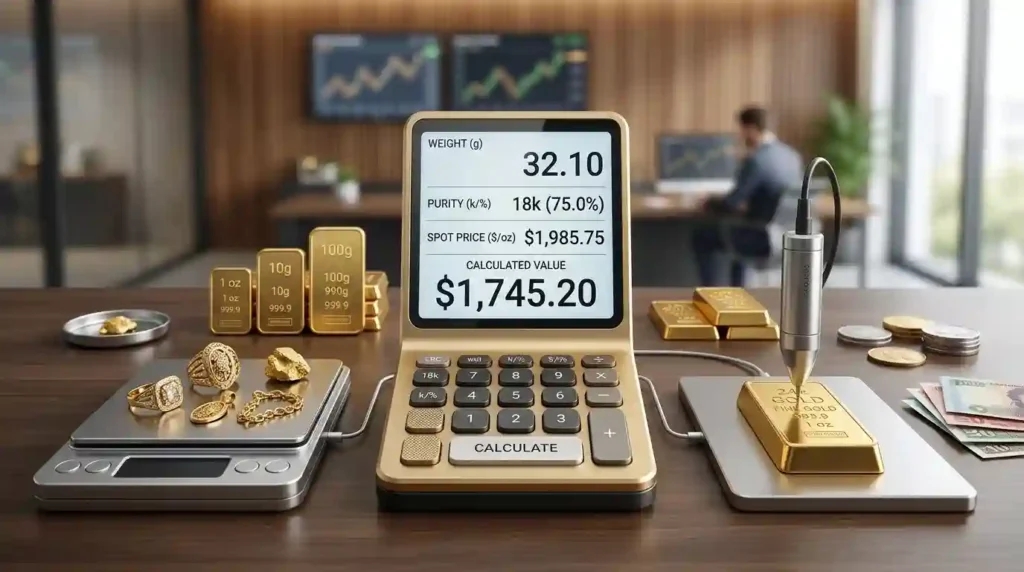
One troy ounce is about 31.1035 grams. If you want the value of jewelry, adjust for purity before you multiply by the weight. You can do this fast with our gold price calculator. To see how such tools work, read about gold calculators.
Then compare the change over time
Compare the current price with the previous close or an earlier time stamp. Work out the dollar change. Then work out the percentage change.
[ \text{Percentage change} = \frac{\text{New price}-\text{Old price}} {\text{Old price}} \times 100 ]
The result depends on the time window you pick. A one-hour change tells a different story from a one-week change. So always state the window.
Finally, check whether the retail price also changed
Compare the market price with the seller’s current quote. Check for a change in premium, shipping, or payment fees. Do not assume the retail price will move by the same percent as spot gold.
Sellers may update prices at a different pace. Some adjust by the minute. Others adjust less often. See our guide on comparing gold prices in one unit for a simple method.
The table below is a hypothetical example. It shows the math with a 1% move. It is not a current price or a forecast.
Table 3: Example of calculating a daily gold price change
| Measurement | Example |
|---|---|
| Previous reference price | $2,400 per troy ounce |
| New reference price | $2,424 per troy ounce |
| Dollar change | +$24 |
| Percentage change | +1% |
| Approximate previous price per gram | $77.16 |
| Approximate new price per gram | $77.93 |
In this example, the price per troy ounce rose by 1%. The per gram figures are rounded, so you may see tiny gaps if you use rounded numbers in your own math. Use the same source and time rule for each check. That keeps your comparison fair.
You can also track a longer window. Record the price at the same time each day for a week. Work out each day’s percent change. You will see that most days are small. A move of a few tenths of a percent is common. Large moves are rarer. This view helps you judge whether a day is truly unusual.
When Do Gold Prices Change During the Day?
Gold trades in a global market. So the moves do not start and stop with the U.S. workday. There is a difference between active trading and set benchmark times. Knowing it helps you read charts with less stress.
London and New York trading activity
London is a major center for the global gold market. New York is another big hub. When both are open, activity can overlap. This can add more buyers and sellers.
News and order flow can move prices at different times of day. So a spike at noon in the U.S. may have started with news in Europe. That is why I check the time stamp and the news before I react.
Why prices may move around major announcements
Fed statements, inflation reports, jobs data, and sudden world news can all shake the market. Prices may start to move before the news if traders adjust ahead of time. They may also swing hard just after.
Do not trust a claim that one hour is always the best time to buy. Learn the basics in our first-time buyer checklist instead. No hour wins every time. A calm plan beats a lucky guess.
If you want to buy, you can also spread purchases over time. Some buyers split a purchase into a few parts. This can smooth out the price. It does not guarantee a better result. But it can reduce the stress of picking one day. Whatever plan you choose, set it before the market moves, not during it.
Do gold prices change on weekends?
Some gold sites show the same price when markets are closed or when data feeds pause. That is a displayed quote, not a new trade. So a flat number on Sunday does not mean gold stopped being traded in the world.
The LBMA benchmark is not published on weekends or on set UK bank holidays. That is one more reason to read the label on any price you see.
Should You Buy Gold When the Price Drops?
Many readers want to act the moment gold falls. I understand the urge. But I do not give personal investment advice. What I can do is help you think it through with care.
Understand why the price fell
Look at the cause. Did rate hopes change? Did the dollar rise? Did fears ease? Or did traders take profits? Each cause tells a different story.
Do not assume a one-day drop means gold is now cheap over the long run. Compare the current price with your planned cost and your budget. A drop is a data point, not a signal.
Ask yourself why you want to buy. Is it for jewelry, for a gift, or for a long-term hold? Your goal sets your plan. A buyer of jewelry cares about design and fit. A buyer of bullion cares about premium and buyback. Gold is not one thing. So the right time to buy depends on what you want it for.
Compare the total cost before buying
Calculate the premium over spot. Include shipping, insurance, payment fees, and any taxes. Check the dealer’s buyback price and spread. Our price of gold guide explains how spot value and premium fit together.
A lower spot price can still come with a high premium. For more on this, see our guide on the cheapest place to buy gold in the USA. And read our post on gold buying scams so a low price does not lure you into a bad deal.
Avoid reacting to hype or panic
Be careful with claims that gold is sure to rise or that it protects against every loss. Neither is true. Physical gold can also carry large costs to buy and sell.
The U.S. Commodity Futures Trading Commission, or CFTC, offers consumer guidance on the risks of buying precious metals and on misleading sales claims. Read it before a large purchase.
The CFTC advice is simple. Compare costs. Ask for fees in writing. Be careful of pushy sales claims. Be wary of promises of sure gains. These tips protect you in any market, up or down. If a seller uses a price drop to rush you, slow down. A real deal does not need a countdown clock. Also, our guide on gold valuation scams shows how sellers can misuse price swings.
Frequently Asked Questions About Daily Gold Price Changes
Here are short answers to common questions. They clear up the most common mix-ups. For more reading, visit our gold blog.
Why does gold price change every day?
Gold prices change because buyers and sellers react to economic data, interest rates, the U.S. dollar, world risks, and investment demand. New facts change what players will pay.
Does gold price change every minute?
The market price can change often during active trading. But some sites show delayed prices or benchmarks set at fixed times. So not every number you see updates each minute.
Why does gold rise when the dollar falls?
A weaker dollar can make dollar-priced gold cheaper for buyers who use other money. That may support demand. But the link is not sure, since rates, risk, and other forces matter too.
Does inflation always make gold prices rise?
No. Inflation can support gold demand at times. But the market may focus more on rates, real yields, or whether inflation came in above or below hopes.
Why is gold cheaper on one website than another?
The sites may use different update times, sources, currencies, or units. For physical gold, premiums and fees can also explain the gap. Our post on gold price conversions can help you line them up.
Do gold prices change on U.S. holidays?
They can. It depends on which global markets are open and how a data provider updates quotes. A site may keep showing an older price when its source is not updating.
Can anyone predict the daily gold price accurately?
No. No one can predict every daily move. Economic data can explain possible influences, but it cannot promise a result.
Final Recommendation
I have spent years watching gold quotes and helping readers make sense of them. My advice on why the gold price changes every day is simple. Expect movement, and do not panic over it. Learn the main drivers: rates, the dollar, inflation hopes, news, and demand. Always check the source and time of a quote. Remember that a retail price is not the same as spot. You can learn more about me on my author page. No one can predict the next move, so plan with facts and not with fear.
Track Gold Prices and Calculate Your Gold’s Value
Now put this to use. Check a current quote, understand the change, and work out the value of the gold you own or plan to buy. A small habit like this builds real confidence.
Use the gold price calculator
Follow these steps with our gold calculator.
- Enter the current price and select the right unit.
- Convert the price per troy ounce to a price per gram when needed.
- Add the gold weight and purity to estimate metal value.
- Check the quote time stamp before you compare results.
Explore related gold guides
Here are guides that connect with this topic.