Standing at a jewelry counter in Minneapolis one Saturday afternoon, I watched a shopper get talked into a gold chain because the seller kept repeating that it was a special price, today only. She wanted to know two simple things. Is this really gold, and am I really getting a fair deal? Learning how to avoid gold buying scams starts with understanding that fraud is not always about fake metal. A deal can be deceptive through inflated premiums, misleading purity claims, hidden fees, fake credentials, pressure tactics, counterfeit bars or coins, nonexistent storage, or outright impersonation. The safest approach combines seller verification, price comparison, purity verification, physical testing, written documentation, and payment protection. US agencies including the FTC and CFTC specifically warn consumers about precious metal fraud and high pressure sales tactics.
What Are Gold Buying Scams?
A gold scam can involve the seller, the product, the price, the payment method, or several of these at once. The goal is always the same. Get the buyer to hand over money before checking the important details.
What counts as a gold buying scam?
Fake or counterfeit gold. Misrepresented karat or fineness. Gold plated items sold as solid gold. Overpriced bullion or coins. Hidden commissions and fees. Fake gold investment opportunities. Fake gold storage programs. Non delivery after payment. Fake online stores. Government or bank impersonation. Urgent gold buying schemes built entirely on manufactured panic.
Why gold attracts scammers
Gold packs high dollar value into a small physical object, which makes it easy to move and hard to trace once it leaves your hands. It is simple to market using fear and economic uncertainty, especially during shaky financial news cycles. Many buyers do not fully understand how purity and premiums work, which leaves room for creative pricing. Gold can also look convincing even when it is not genuine at all, since a well made fake fools the eye easily.
The three questions to ask before paying
Is the seller legitimate? Is the gold actually what they claim it is? Is the price reasonable for what I am receiving? If you cannot answer all three with confidence, you are not ready to pay yet.
What Are the Most Common Gold Buying Scams?
The biggest mistake buyers make is assuming every scam looks like a fake gold bar. Some of the most expensive scams involve perfectly real gold sold under deceptive terms.
Fake gold and counterfeit gold
Counterfeit bars, counterfeit coins, tungsten core construction, gold plated base metals, fake hallmarks, altered packaging, and fake certificates or assay cards all show up in this category. Sophisticated fakes can carry convincing serial numbers and sealed packaging that looks factory fresh. Tungsten is a favorite among counterfeiters because its density sits close to gold, which means a basic weight check alone may not catch it.
Fake gold plated jewelry sold as solid gold
Terms like gold plated, gold filled, gold overlay, gold electroplate, gold flashed, and solid gold all mean different things, and the wording matters enormously. FTC guidance distinguishes these terms and advises consumers to understand exactly what a seller means before buying. A piece described loosely as gold jewelry might contain only a microscopic surface layer of actual gold.
Fake limited time gold deals
Phrases like today only, liquidation sale, below market price, dealer cost, emergency pricing, and one last bar available all serve the same purpose. Urgency prevents comparison shopping, and comparison shopping is exactly what protects you.
Overpriced gold and coin scams
Here the gold itself may be completely genuine. The problem is the price. Compare the spot price, the product weight, the actual gold content, the premium, the dealer spread, shipping costs, storage costs, and any commissions. The CFTC specifically advises consumers to compare costs and premiums rather than accepting a sales pitch at face value.
Gold IRA and precious metal investment scams
High pressure retirement account pitches, guaranteed return claims, fear based sales calls, excessive commissions, fake storage arrangements, hidden fees, and claims that gold is risk free all belong in this bucket. Buying physical gold you take home is very different from buying into a managed investment arrangement. The CFTC warns about precious metals schemes involving inflated prices, high commissions, financing arrangements, and questionable storage claims.
How to Check if a Gold Seller Is Legitimate
Before testing the metal, test the seller. A trustworthy transaction should easily survive five minutes of basic research on your phone.
Research the business before visiting or ordering
Search the business name alongside words like complaint, scam, review, and lawsuit. Check the physical address, phone number, years in business, return policy, shipping policy, buyback policy, and written terms. The FTC recommends researching sellers, checking complaints and reviews, and getting return policies in writing before money changes hands.
Verify the seller’s identity
Confirm the business actually exists as a registered entity. Do not rely only on an Instagram page, a Facebook profile, a TikTok account, a marketplace listing, or caller ID. Verify contact information independently through a source the seller did not hand you.
Be careful with pop up and traveling gold dealers
Hotel room sales, temporary storefronts, door to door sellers, we buy gold vans, sellers who insist on meeting somewhere unusual, and social media sellers demanding quick payment all deserve extra caution. The CFTC specifically warns consumers about pop up dealers, unsolicited offers, and sellers operating from temporary locations.
Check credentials when the seller claims to be a financial professional
Look into registration status, disciplinary history, state regulator records, and CFTC or NFA resources where applicable. Never assume that a title like gold specialist means someone holds a government license.
How to Check Gold Purity Before You Buy
A hallmark is genuinely useful, but it should not automatically end your investigation. Treat it as your first clue rather than your final answer.
Understand karat markings
24K sits at approximately pure gold. Below that come 22K, 18K, 14K, and 10K in descending order of gold content. The basic formula is simple: gold purity equals karat divided by 24. That gives you 18K at 75% gold, 14K at roughly 58.3% gold, and 10K at about 41.7% gold. The FTC explains that karat markings indicate the proportion of pure gold in jewelry and recommends looking for both the karat mark and the responsible company’s name or registered trademark.
Learn common gold markings
Beyond karat stamps, watch for fineness numbers including 999, 999.9, 916, 750, 585, and 417. These appear frequently on imported jewelry and bullion products.
Don’t confuse solid gold with pure gold
Solid gold does not necessarily mean 24K at all. Solid describes construction, meaning the piece is not hollow or plated. Pure describes gold content. Alloy means gold blended with other metals. Plated means a thin surface coating over a different base metal entirely.
Use hallmarks as one clue, not the entire test
Consider the hallmark, the maker’s mark, the weight, the dimensions, the packaging, any assay information, and independent testing together as a package. The World Gold Council explains that hallmarks historically identify purity or fineness along with maker or assayer information, giving buyers a traceable chain back to whoever made the piece.
Which Tools Can Help You Detect Fake Gold?
Tools reduce uncertainty, but no single inexpensive test proves everything on its own. Here is what each one actually does.
Digital jewelry scale
Use a scale with appropriate precision, often 0.01 g for small items. Place it on a clean, stable surface. Calibrate before use. Weigh the item without any packaging attached.
Jewelry loupe
A loupe reveals hallmarks, engravings, serial numbers, surface wear, suspicious seams, signs of plating, and small manufacturing details that the naked eye simply misses.
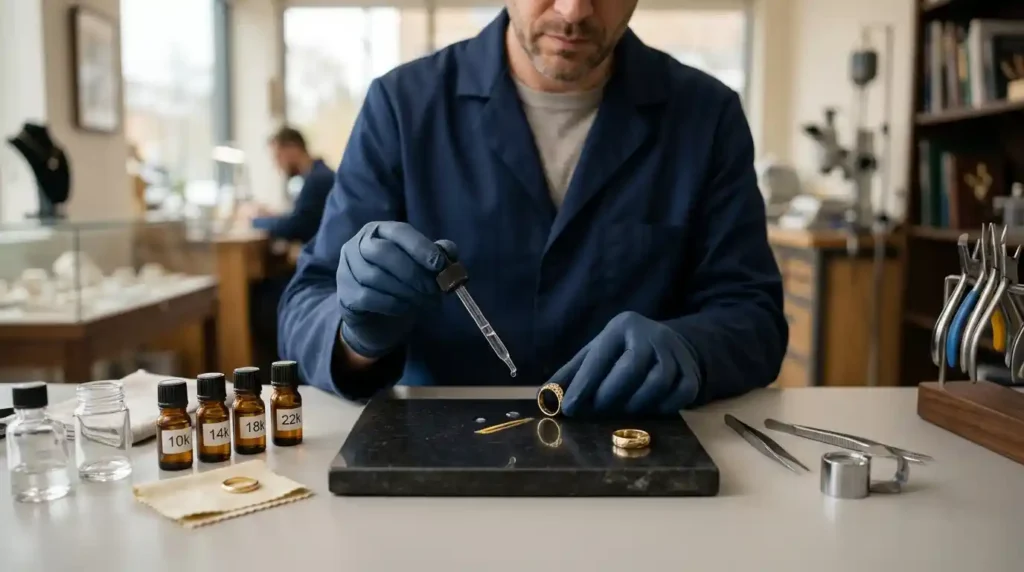
Gold acid testing kit
Acid testing can reveal approximate surface purity, though surface testing carries real limitations on plated or layered items. Different acids match different karat ranges. Scratching the piece for testing can damage jewelry, so handle acids safely and follow kit instructions closely, especially as a beginner. Gloves, eye protection, and good ventilation are not optional extras here.
Electronic gold tester
These use conductivity and electrical measurements for quick screening. They are fast and convenient, though calibration matters enormously and unusual alloys can throw off results. Most shops recalibrate against a known reference sample regularly to keep readings trustworthy.
XRF gold analyzer
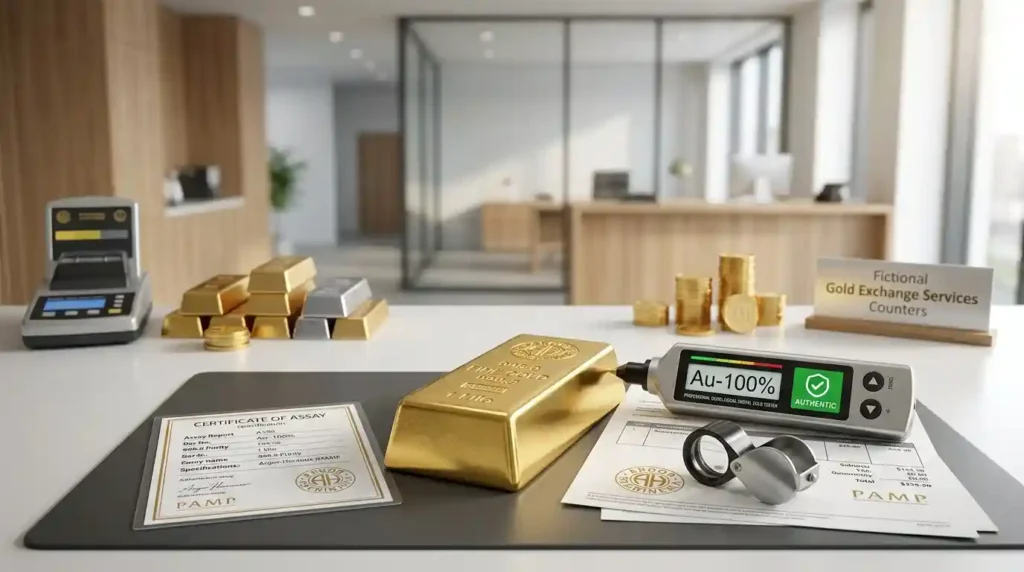
XRF provides non destructive elemental analysis and can identify actual metal composition. It is standard equipment for professional jewelers and dealers, costs far more than home tools, and still requires professional judgment since it primarily reads the surface.
Gold calculator or spreadsheet
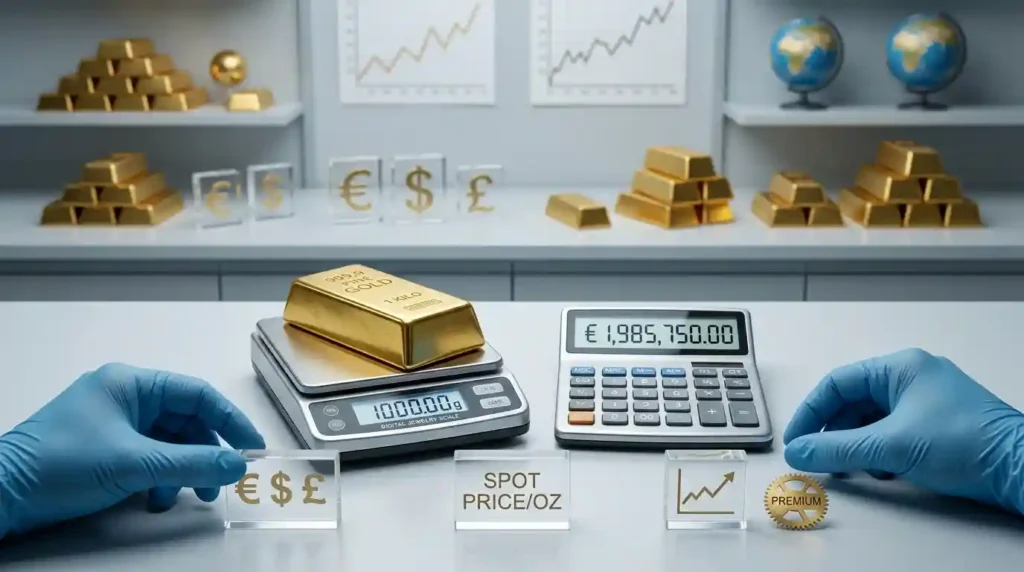
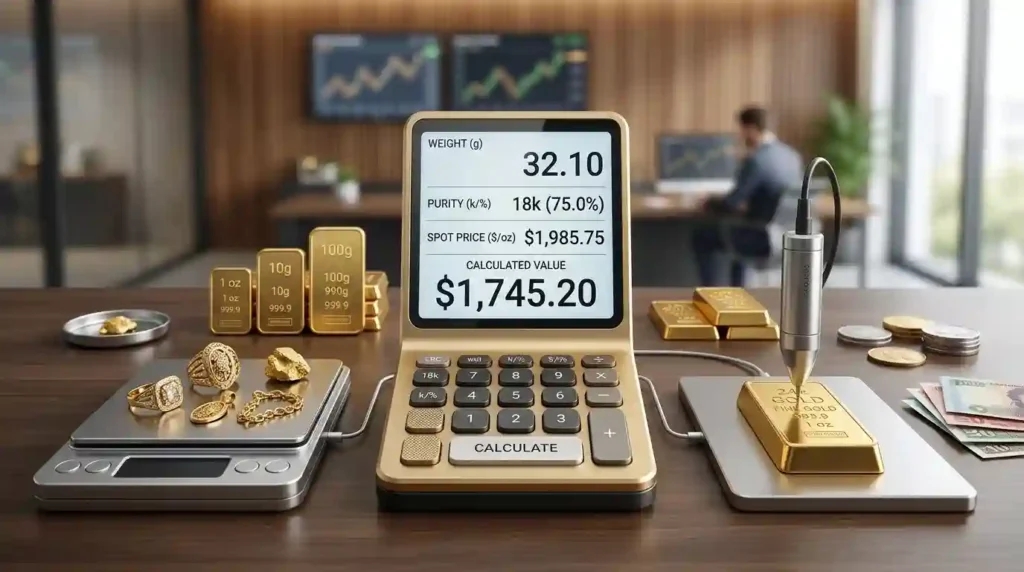
A simple calculator lets you work out gold content, melt value, premium, price per gram, and effective markup in seconds. Running these numbers before you buy catches pricing scams faster than any physical test.
How to Calculate the Fair Price of Gold
Knowing the math makes many pricing scams far easier to spot. You do not need a finance degree, just a calculator and five minutes.
Start with the market gold price
Spot price, benchmark price, dealer quote, and retail price are four different numbers. Treating them as identical is how buyers end up confused about whether a price is fair.
Convert the gold price to price per gram
Price per gram = Gold price per troy ounce ÷ 31.1034768
A troy ounce differs from the everyday ounce used for household measurements, and mixing them up throws off every calculation that follows.
Calculate the gold content
Fine gold weight = Total weight × purity
Take 10 grams of 18K gold. Its purity is 75%, so the fine gold weight equals 10 × 0.75, which comes to 7.5 grams.
Calculate theoretical gold value
Gold value = Fine gold weight × gold price per gram
Then add the costs that actually affect retail price
Dealer premium, fabrication, labor, design, gemstones, packaging, shipping, insurance, taxes, and retail margin all sit on top of that base metal value. A higher retail price is not automatically a scam. An unexplained premium, though, absolutely deserves questions.
How to Compare Gold Prices Without Getting Fooled
A low advertised price can hide a high final cost. Compare the complete transaction, not the giant number painted on the sign.
Compare price per gram
Ask the seller four direct questions. What is the item’s total weight? What is the purity? How much fine gold does it contain? What is the final price including everything?
Calculate the premium
Premium % = (Sales price − Spot value) ÷ Spot value × 100
The CFTC specifically recommends comparing premiums against the spot price when evaluating physical precious metals, since an outsized premium is often the clearest warning sign in an otherwise legitimate looking deal.
Compare at least three sellers
Line up the gold price, weight, purity, premium, shipping, insurance, payment fees, return policy, and buyback policy side by side. Three quotes reveal patterns that one quote never will. If one seller sits far outside the range of the other two in either direction, that gap is worth a direct question before you buy anything.
Watch for the cheap gold trap
A seller can advertise a low headline price while making money through oversized premiums on a different product, inflated shipping, financing charges, storage fees, commissions, or restrictive buyback terms that trap you later.
What Are the Biggest Red Flags When Buying Gold?
This is the section worth bookmarking. These phrases and behaviors should stop a transaction cold.
Red flags that should make you stop
Act right now. Guaranteed return. Risk free gold. Government approved investment. You cannot lose. Don’t tell anyone. Only today. Send cash immediately. Buy gold and give it to our courier. We will store it for you, but you cannot inspect it. Add to that list: no written fees, no physical address, no return policy, refusal to let you compare prices, and a seller who becomes visibly angry when you ask reasonable questions.
The government impersonation gold scam
A caller claims to be from the government, a bank, the police, Social Security, or another trusted organization. They say your money is at risk. They tell you to buy gold bars. A courier supposedly arrives to collect the gold for safekeeping. The FTC states plainly that it will never tell consumers to move money to protect it, never send anyone to a Bitcoin ATM, and never instruct anyone to buy gold bars or hand cash to a person. The FBI has also reported cases involving criminals persuading victims to buy gold or liquidate assets before sending couriers to collect it, with FBI Boston alone documenting 103 courier pickups of cash or gold between 2023 and May 2025 and losses exceeding $26 million, roughly 98% of it reported by people over 60.
Why urgency works
Fear reduces careful comparison. A countdown discourages research. Authority claims create false trust. Isolation prevents a second opinion. None of this reflects poorly on the victim. These tactics are engineered specifically to short circuit normal caution.
USA Expert Advice on Avoiding Gold Scams
Rather than invented expert quotes, here are named, attributable sources you can verify yourself.
CFTC advice from Ian McGinley
Ian McGinley served as CFTC Director of Enforcement during a wave of precious metals fraud cases. In one CFTC action against Red Rock Secured, the order found that defendants convinced at least 950 people to pay over $69 million for gold and silver coins worth only about $30 million, reflecting markups between roughly 92% and 130% over the dealer’s own acquisition cost. McGinley described the defendants as preying on elderly victims to liquidate retirement savings for a precious metals scam. That single case explains why price comparison matters more than almost any other safeguard.
FTC consumer guidance
Research sellers. Check complaints. Understand gold terminology. Get return policies in writing. Verify karat markings. Report deceptive transactions promptly so others get warned.
Jewelers Vigilance Committee perspective
The Jewelers Vigilance Committee, or JVC, serves the jewelry industry as a legal and compliance organization, handling industry guidance and consumer dispute mediation. Importantly, JVC does not certify individual gold products, and its own materials say so directly. Any seller claiming JVC certification for a specific item is misrepresenting what the organization does.
Gold Buying Scam Warning Signs by Purchase Type
Different products invite different tricks, so here is what to watch in each situation.
How to avoid scams when buying gold jewelry
Check the karat mark. Check the maker or trademark stamp. Ask directly whether the piece is solid, plated, filled, or overlay. Weigh it yourself. Compare similar pieces at other stores. Get a detailed receipt. Understand the return terms before you pay.
How to avoid scams when buying gold bars
Verify the refinery or mint. Inspect the packaging closely. Check the serial number where applicable. Confirm weight and dimensions against published specifications. Consider professional testing for larger purchases. Treat any unexplained discount as a warning rather than a win.
How to avoid scams when buying gold coins
Identify the exact coin, not just a general description. Confirm weight and purity. Compare bullion value against claimed collectible value. Ask for a complete price breakdown. Be especially careful with rare or exclusive claims, since that framing is exactly how overpriced coins get sold.
How to avoid scams when buying gold online
Verify the domain carefully. Check business history. Do not rely only on social media reviews. Confirm the return policy. Use a payment method with real consumer protections. Be wary of any pressure toward cryptocurrency, wire transfers, or other irreversible payment methods.
A Gold Buyer’s Tool Kit for Safer Purchases
Here is how the tools stack up by level, so you can match your kit to how much you are spending.
Basic home toolkit
A digital gram scale, a 10x jewelry loupe, your smartphone camera, a gold purity chart, a calculator, and a notebook or spreadsheet cover most everyday situations.
Intermediate testing toolkit
Add a gold acid test kit, an electronic gold tester, a set of calipers, and a magnet for preliminary screening. One important caution: a magnet test is only a basic screening step. It cannot prove an item is genuine gold, since plenty of non magnetic metals are not gold at all.
Professional toolkit
An XRF analyzer, a precision balance, density testing equipment, and access to professional assay services round out what a serious dealer or appraiser uses.
What each tool can and cannot prove
Table 1: Gold Purity Quick Reference
Understanding purity is one of the simplest ways to catch misleading gold claims before they cost you money. Keep this chart on your phone when shopping.
| Marking | Approx. gold content |
|---|---|
| 24K | 99.9%+ depending on fineness |
| 22K | 91.7% |
| 18K | 75.0% |
| 14K | 58.3% |
| 10K | 41.7% |
US jewelry terminology follows FTC guidance, which ties each karat mark to a specific proportion of pure gold.
Table 2: Gold Testing Tools
Use this table to choose the right level of verification for what you are actually spending. A cheap ring and a one ounce bar do not need the same scrutiny.
| Tool | Best use | Skill level | Limitation |
|---|---|---|---|
| Loupe | Inspect marks | Beginner | Doesn’t prove purity |
| Digital scale | Check weight | Beginner | Doesn’t prove composition |
| Magnet | Basic screening | Beginner | Not definitive |
| Acid kit | Surface purity test | Intermediate | Can damage item |
| Electronic tester | Fast screening | Intermediate | Needs proper use |
| XRF analyzer | Composition testing | Professional | Expensive |
Tools complement seller research and documentation. They never replace basic due diligence.
A Simple 10 Step Gold Buying Safety Checklist
Screenshot this one. It walks through the whole process from research to receipt.
Before you shop
Check the current gold market price. Decide what type of gold you actually want. Learn the expected purity for that product. Research several sellers rather than just the closest one.
At the point of purchase
Inspect the markings with a loupe. Confirm weight on a scale. Ask for the exact purity. Calculate the approximate metal value. Ask for every fee in writing. Read the return and buyback terms before paying anything.
Use the pause test
If a seller tells you that you have to decide right this second, the correct response is simple. Then I will decide later. Any deal that cannot survive a night of thinking was never a deal worth taking.
How to Avoid Gold Buying Scams Online
Online buying deserves its own section because you often cannot touch, weigh, or test the product before paying for it.
Check the website
Look for HTTPS, a real business address, a working phone number, clear policies, verifiable business history, and independent complaints or reviews from outside the site itself.
Check the product listing
A legitimate listing states exact weight, purity, manufacturer or refiner, product type, premium, shipping cost, delivery estimate, and return conditions. Vague listings are vague on purpose.
Avoid suspicious payment demands
Wire transfers, cryptocurrency, gift cards, cash couriers, unusual payment apps, and payments directed to unrelated individuals all share one trait. Once the money leaves, getting it back is extremely difficult.
Save your evidence
Screenshot the listing before buying. Save the invoice, emails, and product description. Keep tracking information. Photograph the package when it arrives, before opening it if possible.
What to Do If You Think You Bought Fake Gold
Do not panic, and do not throw away the evidence in frustration. What you keep now determines what you can prove later.
Stop further payments
Do not send additional verification, release, or storage fees. Do not send more gold. Do not accept a new story from the same salesperson, no matter how reasonable it sounds.
Preserve the evidence
Keep the receipt, invoice, emails, texts, seller information, packaging, assay card, serial numbers, photos, and any testing results you have collected. Investigators often build cases from exactly this kind of paper trail, so nothing should go in the trash yet.
Get an independent opinion
Take the item to a reputable jeweler, a professional appraiser, a precious metals testing service, or an appropriate laboratory. Choose someone with no connection to the original seller, and ask for the result in writing where possible.
Report suspected fraud
US buyers can report to the FTC, their state attorney general, the appropriate financial regulator, and local law enforcement when relevant. The CFTC handles precious metals investment and futures matters specifically, and the FBI’s Internet Crime Complaint Center accepts reports on courier and impersonation schemes.
What If Someone Tells You to Buy Gold to Protect Your Money?
This pattern deserves its own section because it has cost Americans enormous sums, and it targets older adults relentlessly.
The basic script
Your bank account has been compromised. Your Social Security number is being used. A government investigation is underway. Move your savings. Buy gold. A courier will collect it. Scammers sometimes provide a code word or serial number so the courier seems officially authorized.
What to do
Stop the conversation immediately. Do not buy the gold. Do not withdraw cash. Do not hand anything to a courier. Contact the organization independently using a phone number you looked up yourself. Tell someone you trust before acting. Report the scam to the FTC and the FBI. Legitimate government agents simply do not operate this way, and the FTC has said so repeatedly and publicly.
Gold Buying Scam Comparison Table
Table 3: Gold Scam Red Flags
The point is not to memorize every scam variation. The point is recognizing the underlying pattern before money changes hands, because the patterns repeat far more than the specific stories do.
| Red flag | Why it matters | Safer response |
|---|---|---|
| Guaranteed return | Investment risk is being minimized | Walk away and research |
| Urgent payment | Discourages due diligence | Take time |
| No written fees | Final price may change | Request documentation |
| Unknown seller | Harder to verify accountability | Research business |
| Courier collecting gold | Classic impersonation pattern | Do not hand over gold |
| Refuses testing | Seller may fear verification | Use another seller |
How to Tell a Real Gold Bargain From a Scam
Not every low price is fraudulent, and not every high price is legitimate. The key is understanding exactly why a price differs from market value.
Questions to ask about a bargain
Why is it discounted? What is the exact weight? What is the purity? Is it new or used? Is it bullion or jewelry? Are there gemstones involved? What fees get added at checkout? What is the return policy? What is the seller’s buyback price if you come back in a year?
When a bargain deserves extra testing
An unusually low price, missing paperwork, an unknown seller, suspicious markings, damaged packaging, refusal to allow inspection, or pressure to pay immediately each justify slowing down and testing before committing.
Gold Buying Terms You Should Know Before You Shop
A quick glossary clears up most of the confusion sellers rely on.
Gold spot price
The current market reference price for gold, quoted continuously during trading hours.
Troy ounce
The standard unit used for precious metal pricing, equal to about 31.1 grams.
Karat
A measure of gold purity in jewelry, based on 24 parts.
Fineness
Gold purity expressed in parts per thousand, such as 750 or 999.
Melt value
The theoretical value of the raw metal based on weight, purity, and current market price.
Premium
The amount paid above the underlying metal value, covering fabrication, distribution, and dealer margin.
Assay
Testing or verification of precious metal content, often performed in a laboratory setting.
Bullion
Gold valued primarily for its metal content rather than collectible or artistic value.
Hallmark
A mark indicating information such as purity, maker, or assayer, depending on the marking system in use.
Common Mistakes People Make When Buying Gold
These six trip up far more buyers than elaborate counterfeits ever do.
Mistake 1: Looking only at the price
A low sticker price means almost nothing without knowing weight and purity first.
Mistake 2: Trusting a hallmark blindly
Markings are useful evidence, not a complete authentication process on their own.
Mistake 3: Forgetting the premium
Always compare the final price against the underlying gold value before deciding.
Mistake 4: Buying because of pressure
Today only should never replace due diligence, and a real seller will still be there tomorrow.
Mistake 5: Paying before reading the terms
Check return, refund, shipping, insurance, storage, and buyback terms in writing first.
Mistake 6: Using one test as proof
A magnet, loupe, acid test, or electronic tester each has clear limits, so combine at least two for anything expensive.
Frequently Asked Questions About Avoiding Gold Buying Scams
Short answers to the questions buyers ask most often right before they pay.
How can I tell if a gold seller is legitimate?
Research the business, check complaints, verify its physical address, review policies, compare prices with two other sellers, and walk away from any pressure sales tactic.
How can I tell if gold is real?
Use markings as a starting point, then confirm with appropriate physical testing or professional verification, especially for anything valuable.
Is buying gold online safe?
It can be. Verify the seller, product specifications, payment terms, shipping details, and return policy before paying anything.
What is the biggest red flag when buying gold?
Pressure to act immediately, combined with guaranteed returns, vague fees, or refusal to provide documentation.
Can a gold hallmark be fake?
Yes. Hallmarks can be forged or added after the fact, so treat a mark as one piece of evidence rather than the entire authentication process.
Is 24K gold always better?
Not necessarily. 24K contains more gold, while jewelry alloys are often chosen for durability and design. Purity alone is not an automatic measure of value or quality.
How do I avoid overpriced gold?
Calculate the underlying metal value yourself, then compare the seller’s premium and total fees against several alternatives before committing.
Can a magnet prove gold is real?
No. A magnet provides limited screening information only, since many non magnetic metals are not gold.
What should I do if someone tells me to buy gold to protect my money?
Stop immediately. The FTC has stated that legitimate government agents will never instruct you to buy gold and hand it to someone for safekeeping.
Where should I report a gold scam?
Report consumer fraud to the FTC and your state attorney general, investment fraud to the CFTC, and impersonation or courier schemes to the FBI’s Internet Crime Complaint Center and local police.
Gold Buying Safety Checklist You Can Save
Table 4: What to Check Before Buying Gold
Use this as a desk reference rather than a conclusion. Running through these ten checks takes a few minutes and prevents nearly every common gold buying scam.
| Check | Question |
|---|---|
| Seller | Who am I buying from? |
| Purity | How much gold is actually present? |
| Weight | How many grams or troy ounces? |
| Price | How does it compare with market value? |
| Premium | How much am I paying above metal value? |
| Testing | Can the item be independently tested? |
| Fees | What else will I pay? |
| Returns | Can I return it? |
| Buyback | What happens if I sell it later? |
| Payment | Is the payment method appropriate and traceable? |
Before buying
Research the seller. Check complaints. Compare three prices. Check the current gold price. Confirm weight. Confirm purity. Inspect markings. Calculate approximate gold value. Ask about premiums. Ask about all fees. Read the return policy. Decide how the item will be tested.
Before handing over money
No pressure. No guaranteed returns. No unexplained fees. No suspicious payment request. No government impersonation story. Documentation received. Seller identity verified.
Final Recommendation
After years of watching gold transactions play out at counters, online listings, and the occasional too good to be true phone pitch, my honest recommendation is to slow everything down. Knowing how to avoid gold buying scams really comes down to three habits: verify the seller before you verify the metal, run the price math yourself instead of trusting a sales pitch, and never let urgency replace research. Get every fee in writing, compare at least three sellers, and treat any hallmark as a clue rather than proof. Above all, remember that no government agency will ever ask you to buy gold and hand it to a courier. That single fact protects more savings than any testing tool ever could.