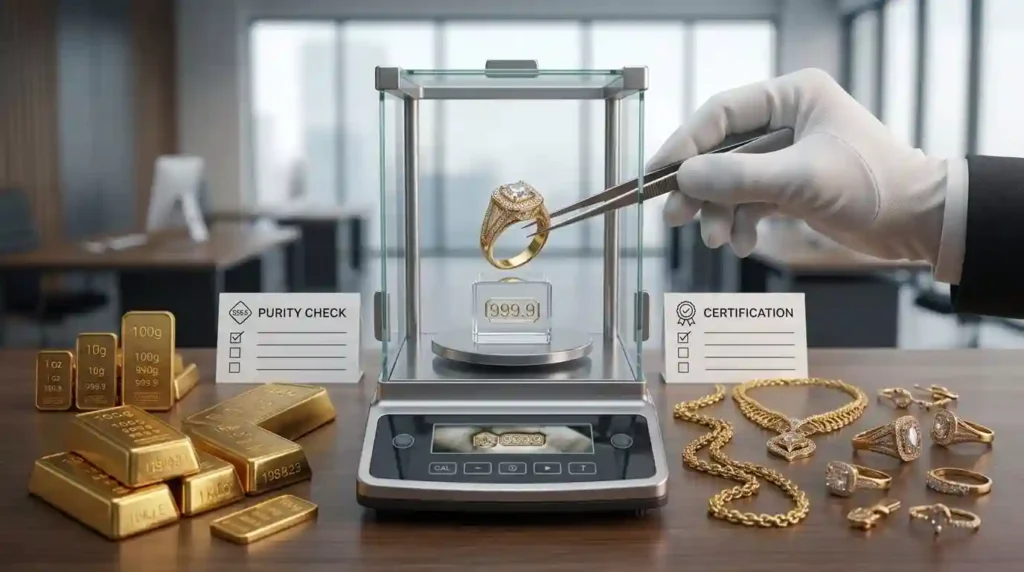
It is Saturday afternoon in Minneapolis, and the ring in the glass case looks perfect. The seller smiles. The price sounds fair. But you stop and ask one small question. Do you know what you are paying for? I have helped many new buyers in this exact spot, so I wrote this guide. Here is what first-time gold buyers should check before they pay. You will learn to check purity, weight, the market price, fees, the seller, and the papers. I will also show how the steps change for jewelry and for coins and bars. Follow the list, and you will shop with a calm mind.
1. Decide What Type of Gold You Want to Buy
Start with one simple question. Why do you want this gold? I ask this first when a reader writes to me. The answer shapes every step that follows. Jewelry, bullion, and rare coins are three different products. Each one has its own price rules. Each one sells back in its own way.
Many new buyers skip this step. They walk into a shop with no plan. Then the seller picks the plan for them. That is how people end up with a coin when they wanted a ring. Take two minutes to decide first. It saves money and stress. If you want a quick refresher on the basics, our gold buying blog has simple guides for new buyers.
Gold jewelry for everyday wear or gifts
Jewelry is gold you can enjoy each day. Think of rings, chains, bracelets, earrings, and necklaces. Looks matter here. So do comfort and strength. A thin chain that tangles will annoy you. A soft ring that bends will let you down.
The price of jewelry has more than gold in it. It pays for labor and design. It pays for gemstones. It also pays for the store’s rent and staff. That is normal. You just need to know it.
Ask yourself how often you will wear the piece. A daily ring must be tough. A gift for a special day can be more delicate. I tell friends to hold the piece in hand first. Feel the weight. Check the clasp. Try it on. A piece that feels right is often the one you will keep for years.
Think about your skin too. Some people react to metals mixed with gold. Lower karat pieces have more of these metals. If your skin gets red or itchy, a higher karat may suit you better. Ask the seller about this before you buy, not after.
Gold bars and bullion coins for investment
Bullion is valued mostly by its gold content. The main facts are weight, purity, and a premium over the market price. Common choices are gold bars and coins like the American Eagle and the American Buffalo. The U.S. Mint explains how its bullion coins work and how they are priced.
Premiums matter a great deal. So do the dealer’s buyback terms. So does your plan for storage. A low sticker price means little if the dealer will not buy the coin back at a fair rate. Before you buy, learn what moves the price of gold. Then the numbers on the screen will make sense.
Collectible and rare gold coins
Some coins are worth more than their gold. These are called numismatic coins. Rarity, condition, age, and collector demand all push the value up or down.
Many beginners think a rare coin beats a plain coin. That is not always true. Collector prices are hard to judge. Resale can be slow. A coin may look old and special but sell for little. In my experience, rare coins are best for people who enjoy the hobby. They are not a good first step for most new buyers.
Actionable tip: Decide whether your main goal is to wear the gold, hold physical gold as an investment, or collect coins. That choice should guide the rest of your checklist.
Here is a quick view of how the three types differ. I use a table like this when I teach new buyers. The key facts are easy to forget in a busy shop. Look at what drives the price and what costs come next.
| Gold type | What drives the price | Extra costs to expect | Resale note |
|---|---|---|---|
| Jewelry | Gold content, design, labor, stones | Making charges, retail markup | Offers are often below retail |
| Bullion coins and bars | Weight, purity, market price | Dealer premium, shipping, storage | Buyback terms vary by dealer |
| Collectible coins | Rarity, condition, demand | Grading fees, collector premium | Depends on collector interest |
2. Check Gold Purity and Karat Before Paying
Purity tells you how much of an item is real gold. The rest is other metal. This is one of the most vital checks you can make. Two pieces can weigh the same. Yet they can hold very different amounts of gold. That gap is where buyers lose money. For the full math, read our guide on how gold purity is calculated.
I always check purity before I talk price. Why? Because price means nothing until I know what I am getting. A cheap price on a low karat piece is not cheap at all. It just hides a weak deal.
Understand common gold purity marks
Karat tells you the share of gold in an alloy. Fineness says the same thing in parts per thousand. Pure gold is 24 karat. Each karat below that has some other metal mixed in. Metals like copper and silver add strength. The table below shows the marks you will see most in the United States. Keep these numbers in your head when you shop.
| Marking | Approximate gold content | What buyers should know |
|---|---|---|
| 24K | 99% to 100%, depending on stated fineness | Very high purity, often softer for jewelry |
| 22K | 91.67% | High gold content |
| 18K | 75% | Common in fine jewelry |
| 14K | 58.33% | A common balance of gold content and strength in the U.S. |
| 10K | 41.67% | Lower gold content, still a recognized U.S. standard |
This table uses the usual karat math. You divide the karat number by 24. So 14 divided by 24 gives 58.33%. Some items carry an exact fineness mark instead, such as 999.9. Always read what is stamped.
Look for the karat mark and maker’s trademark
Look for marks like 14K, 18K, 750, and 585. The number 750 means 75% gold. The number 585 means 58.5% gold. The Federal Trade Commission has guidance on gold jewelry quality marks. In general, a karat mark should come with the maker’s trademark.
A stamp is a clue. It is not proof. Treat it as evidence to look at, and then keep checking. A bad seller can fake a stamp. So can a bad factory.
This is why I never rely on one clue. I look at the stamp, the weight, the feel, the papers, and the seller. When all five agree, I feel safe. When one looks off, I slow down. That habit has kept me out of trouble many times.
Understand solid gold, gold-filled, and gold-plated items
Solid gold means gold all the way through. A solid gold piece can still be hollow in how it is built. That is a style choice, and it changes the weight.
Gold-filled, gold overlay, and gold-plated items are not the same. They have a layer of gold over another metal. The layer can be thick or very thin. Gold-filled items have more gold than plated ones, but they are still not solid gold. Ask the seller what each word on the label means. Then get the answer in writing.
What if the gold purity is uncertain?
Do not guess. Ask for papers or a professional purity test. Color is not enough. Weight is not enough. A seller’s promise is not enough either.
For a big purchase, I suggest a trusted jeweler who does not work for the seller. A qualified testing service also works. A small test fee costs far less than a big mistake.
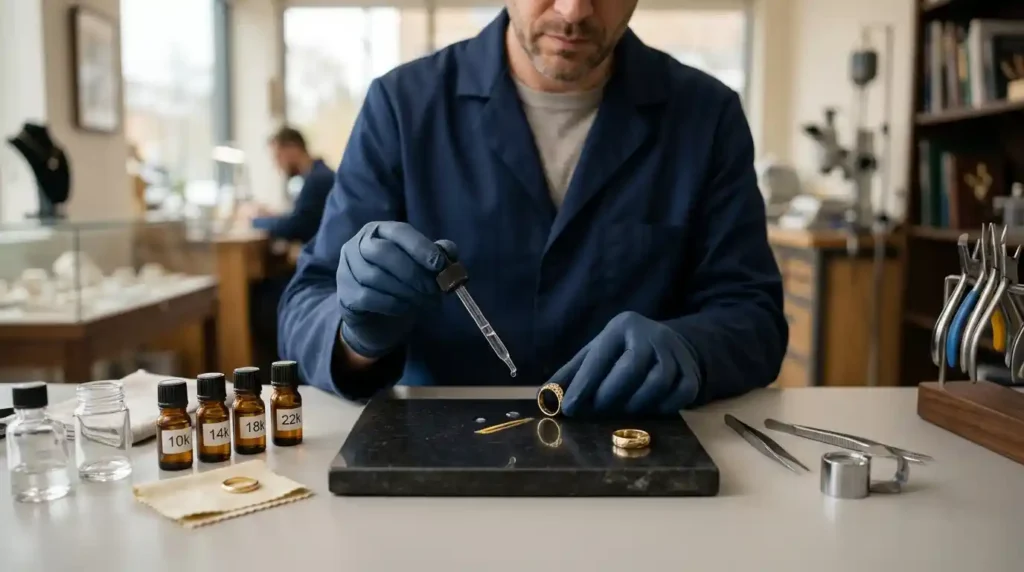
Many jewelers test gold with a small kit or a handheld scanner. These tools are fast and give a good first answer. Labs use deeper methods for high-value pieces. Ask which tool is used and what it can and cannot show. You can read more about the main methods in our simple gold testing guide. I once heard from a reader who skipped testing on a gift. The piece turned out to be plated. A quick test would have saved the day.
3. Check the Current Gold Price Before Shopping
Gold prices move all day. So a quote only makes sense next to a clear market reference. A price can look nice and still be high once you add the seller’s premium or fees. I check the market before I walk into any shop. I tell every buyer to do the same. Our gold price guide shows how to read the number on your screen.
Understand the spot price
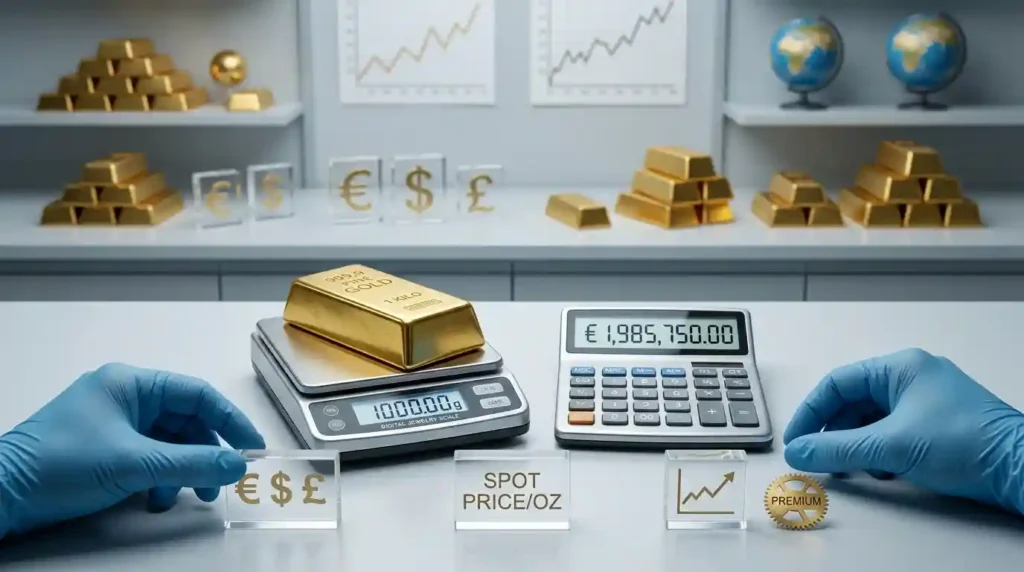
The spot price is a market reference for gold. It is usually quoted in U.S. dollars per troy ounce. Think of it as the base cost of the metal. It is not the price you pay for a ring or a coin.
Retail prices sit above spot. Sellers add costs and profit. Spot also changes during the day. So note the date and time of the quote you use. A quote from last week is not useful today. If you want a plain view of how prices shift, see our notes on the gold price today.
I like to watch the price for a week before I buy. This gives me a feel for the normal range. If the price jumps in one day, I may wait. If it drops, I may act. I do not try to guess the future. I only try to avoid buying at a sudden spike. This simple habit takes a few minutes a day.
Convert the gold price to a price per gram
A troy ounce is about 31.1035 grams. Jewelry is often sold by the gram, so this step helps. Here is the formula.
[ \text{Price per Gram}= \frac{\text{Price per Troy Ounce}}{31.1035} ]
Here is a hypothetical example. Say gold is $3,000 per troy ounce. Divide $3,000 by 31.1035. The answer is about $96.45 per gram of pure gold. This is only an example. Use the live price on the day you shop, and check a live gold rate source.
Compare the quoted price with the market reference
Check that the money and the weight unit match. Some sites use dollars per ounce. Others use dollars per gram. Confirm if the price is for pure gold or a lower-purity item. A 14K ring is not 24K gold.
For bullion, compare the seller’s premium over spot. For jewelry, think about making charges, design, and retail costs. A good seller can explain each part of the price in plain words. If they cannot, that tells you something.
Try this at the counter. Ask the seller to write the gold weight, the karat, and the price on one slip of paper. Then do the math yourself with your phone. Use the formula above. If your number and theirs are far apart, ask why. Good sellers enjoy this talk. It shows them you care about quality.
U.S. expert reference: The U.S. Mint advises bullion buyers to research current market prices and understand coin premiums before they buy.
4. Understand the Total Cost, Not Just the Price Tag
The tag is only the start. The real cost is what leaves your wallet at checkout. That includes premiums, fees, taxes, and delivery. I once watched a buyer love a low price. Then fees ate the savings at the last step. Add it all up before you commit. A good gold calculator makes the math simple and fast.
Check making charges on gold jewelry
Making charges pay for the work of building the piece. Ask how they are set. They may be a flat fee. They may be a charge per gram. They may be a share of the gold value.
Do not judge a charge alone. Compare it with similar items in other shops. Also ask if gem or setting costs are listed apart. A simple chain has lower labor than a fine, carved bracelet. So the charge should differ too.
Check premiums on bullion coins and bars
A premium is the amount you pay above the metal value. It can change by product, size, dealer, and market mood. Small coins often carry a higher premium per ounce than large bars. That is because small items cost more to make for the amount of gold inside.
Compare the total price for the same weight and type of bullion. Then ask about the dealer’s buyback terms before you pay. A fair buyback matters as much as a fair price.
I like to ask one test question. I say, “If I bring this back next month, what would you pay?” The answer tells me a lot. A clear number is a good sign. A vague answer is not. Write down what you hear, and compare it across two or three dealers. For more on how the market sets that number, see our page on the gold price per ounce.
Ask about taxes, shipping, and other fees
Look at the final checkout total. Confirm shipping, insurance, handling, and payment fees. Sales tax rules differ by state and by city. So check your local rules.
Read the terms before you click the buy button. Take a screenshot if you buy online. I keep a folder for every gold purchase. It helps if I ever need to prove what I paid.
Fees can hide in small print. Look for words like handling, processing, and service. Each can add a few dollars. Together they can add up. Ask for the full out-the-door price in writing. That one step removes most surprises at checkout.
Calculate the real cost per gram
Price per gram is a handy way to compare items. It only works when the pieces hold the same share of gold and include the same kinds of costs. I use it as a first filter, not a final answer. The numbers below are hypothetical.
| Item | Total price | Gold weight | Price per gram |
|---|---|---|---|
| Example A | $700 | 10 g | $70/g |
| Example B | $900 | 12 g | $75/g |
| Example C | $1,000 | 10 g | $100/g |
These figures are made up. You cannot compare them fairly without the purity, the stones, the design, and what each price includes. Example C may be a finer piece with more labor. Example A may be a lower karat. Always ask why one price is higher than another.
5. Verify the Seller’s Reputation and Business Details
A good seller answers fair questions and shows clear terms. A shiny site or a warm smile is not enough. I trust sellers who are patient with beginners. I walk away from sellers who rush me. Many tricks start with pressure, so learn the signs in our guide to gold buying scams.
Research reviews and complaints
Search the seller’s name with words like “complaint,” “review,” or “return policy.” Look for patterns. One bad review may be noise. Ten similar ones are a signal.
Ask friends and family for tips too. People you trust often know a good local shop. Be careful if a seller pushes you to pay right now. A real deal will still be there tomorrow.
Check the seller’s contact and return information
Verify the business name, address, and contact details. Call the phone number if you can. Read the return and refund policy before you buy. Ask if you can have the item tested or looked at by someone else.
Keep a copy of the seller’s terms. A screenshot or printout works well. If the seller will not share terms, that is a red flag.
Local shops are not always safer than online ones. Online sellers are not always riskier either. What matters is how open the seller is. I have met honest sellers in small shops and large sites. I have also met pushy ones in both. Judge the person and the terms, not the size of the sign.
Check bullion dealer information
Research the dealer’s name and its buyback policy. Where it matters, check if the coin is sold through a recognized channel. A listing with a known group is a good sign. But it does not guarantee every deal or any profit.
Authority reference: The FTC suggests that you research jewelry sellers and get return policies in writing. If you plan to sell gold later, read about gold valuation scams too, since low offers are common.
6. Inspect the Gold and Ask for Proof of Authenticity
Looking closely helps you check what the seller says. But your eyes cannot prove purity. The goal is to collect evidence. It is also to know when an expert should step in. Think of yourself as a careful detective, not a quick judge.
Inspect jewelry details
Look at the marks, clasps, joints, and any signs of wear. Ask if stones, hollow parts, or other materials change the weight you were told. Ask for a receipt that names the item and its purity.
Do not think a bright shine means solid gold. Many plated pieces shine just as well. Worn spots near the edges or clasp may show a different metal below. That is a clue worth noting.
Check bullion specifications
Confirm the stated weight, fineness, maker, and product type. For coins, compare size and other details with reliable official sources. The U.S. Mint lists specs for its own coins.
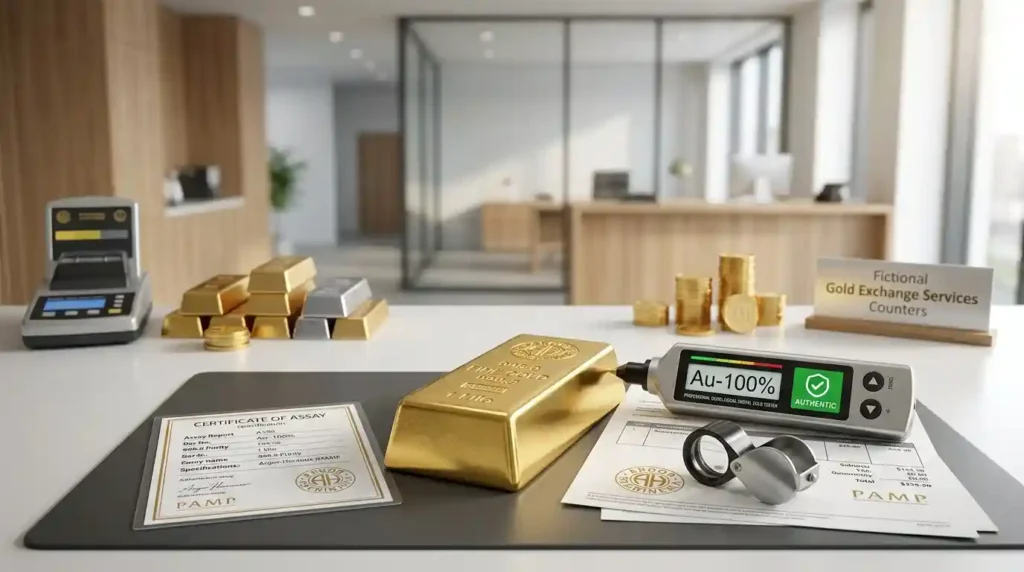
Ask if the item has a third-party certificate or a seller guarantee. Learn what that guarantee covers. A box or a certificate alone is not final proof. Keep the item in its original pack if it came sealed.
Sealed packs matter for bullion. A broken seal can make a dealer doubt the item. It may also cut the buyback price. So keep the pack closed until you are sure you will keep the item. Store the pack and the receipt together.
Know when to get independent testing
Seek expert testing for high-value items or unclear marks. Ask which method will be used. Ask if it can change the item. Say no to harsh tests unless you understand the risk and agree to it. You can learn how the main tests work in our guide on testing gold purity.
My rule is simple. If the price would hurt to lose, test the gold.
7. Check the Receipt, Certificate, and Return Policy
Paper is your memory. It shows what the seller promised on the day you paid. It also helps if you need to return, insure, appraise, or resell the item later. A good seller will not mind giving you clear papers. A weak seller often will.
What the receipt should include
A good receipt lists these points.
- The seller’s business details
- A clear item description and the type of gold
- The weight and the karat or fineness, where stated
- The item price and a list of extra charges
- The purchase date and payment details
Check each line before you leave the shop. Fix any error on the spot. It is much harder to fix later.
If you buy jewelry with stones, ask for the stone details on the receipt too. List the type, the size, and any grade. This keeps the story clear if you insure or sell the piece later.
Understand certificates and appraisals
A certificate may describe features or test results. What it says depends on who issued it. A certificate is not the same as an independent appraisal of value.
For gemstones, confirm what the grading report covers. It may speak about one stone only. Also remember that no certificate can promise a future resale price. Gold prices change, and so do buyer tastes.
An appraisal is different. It is a written estimate of value, often for insurance. It comes from a trained person, and it is not a sales tool. If you want an appraisal, choose someone who does not plan to buy the item from you. That keeps the advice fair.
Read the return and warranty terms
Check the return window and any restocking fee. Learn what the warranty covers and what it leaves out. Ask if the item must be unworn or in its original box.
Save the receipt and any digital files. Store them in a safe place you can find later. I scan mine and keep a copy in the cloud.
8. Watch for Gold-Buying Scams and Red Flags
Some situations call for extra care. A low price is not always a bargain. A pushy pitch is not proof of a good deal. Our guide to gold scams covers more tricks, and our notes on fake gold valuations show how sellers get lowballed.
The table below sums up the red flags I watch for most. I added a simple action next to each one. A warning sign helps only if you know what to do next.
| Red flag | Why it matters | What to do |
|---|---|---|
| Price far below market | The item may be fake, plated, or a bait deal | Compare with the live market reference |
| Deal ends in minutes | Pressure stops you from checking facts | Walk away and think it over |
| Refuses written details | A real seller can describe the product | Ask in writing or shop elsewhere |
| Wants a hard-to-reverse payment | Hard to recover money if it goes wrong | Use a payment method with dispute help |
Prices that seem too good to be true
Compare every offer with the current market price. For bullion, question a quote far below the reference. Research the seller with care. For jewelry, check if the piece is plated, filled, hollow, or a lower karat than the ad says.
If a deal feels too good, trust that feeling. Slow down and check the facts.
Pressure tactics and vague claims
Be careful if a seller says the deal ends soon. Ask for a written note of the gold content. Do not pay if the seller will not answer simple questions or show clear papers. Learn the common gold scam warning signs so you spot them early.
Vague words are a warning too. Phrases like “fine gold look” or “gold tone” say nothing about content. Ask for the karat and the weight.
Fake urgency is another trick. A seller may say that only one piece is left. Or that the price jumps at noon. I never buy under that kind of clock. I step outside, check the market, and think. If the deal is real, it can wait an hour.
Unsafe payment requests
Be careful with payment types that cannot be reversed, especially with a seller you do not know. Where you can, use a method with dispute protection. Share only the personal and money details that are needed.
Be careful with sellers who ask you to move the talk to a private chat app. That is a common move in online scams. Keep messages on the site or in email, so you have a record. Also be careful with links sent by text or email. Go to the seller’s site on your own instead.
What to do if you suspect fraud
Save the listing, the messages, the receipt, and the payment record. Contact the seller and your payment provider fast. For U.S. consumer concerns, use the FTC’s official reporting tools at consumer.ftc.gov.
9. Use a Gold Calculator Before You Buy
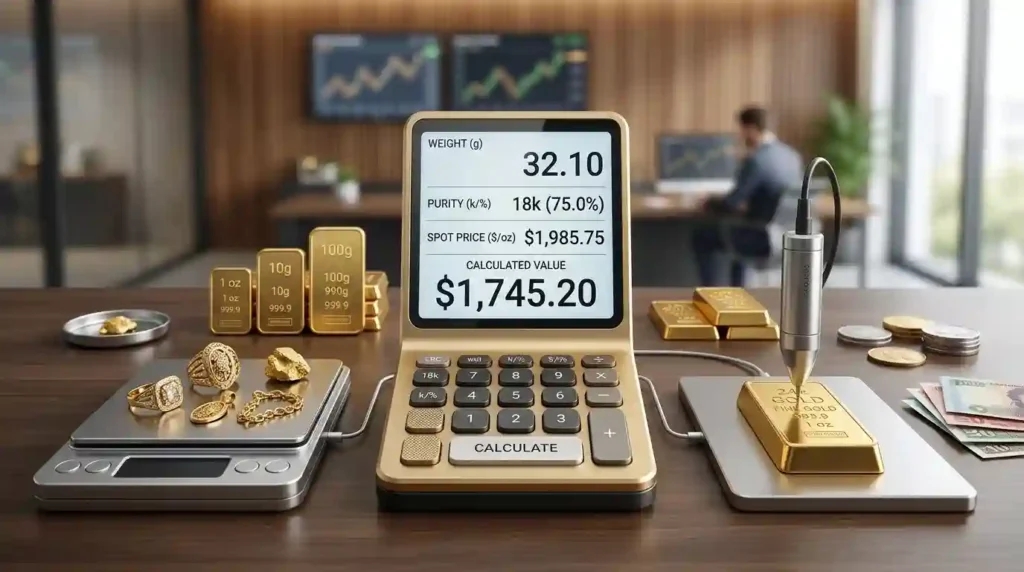
A calculator gives you a fast estimate of metal value. You can compare it with the seller’s quote. It supports your choice. It does not replace testing or a full appraisal. Try our gold value calculator on any quote you get. To see how the tools compare, read our review of the best gold calculators.
Enter the current gold price
Use a clear, named source. Check the time stamp, the currency, and the unit. Confirm if the price is per troy ounce or per gram. Mixing these up is the most common mistake I see.
Enter the weight and purity
Use the weight that is stated or checked. Pick the right karat or fineness. If you know the weight of stones or other non-gold parts, take it out.
A kitchen scale will not do. Use a jeweler’s scale if you can. Small errors in weight add up fast at today’s prices.
Weigh in grams, not ounces, when you can. A regular ounce is not the same as a troy ounce. This trips up many new buyers. A troy ounce is heavier, at about 31.1 grams. A regular ounce is about 28.35 grams. Mixing them up can throw your math off by a lot.
Review the estimated metal value
Here is the formula.
[ \text{Estimated Gold Value}= \text{Weight}\times\text{Purity Fraction}\times\text{Price per Gram} ]
Try a hypothetical example. Say you hold a 10 gram 14K chain. Say pure gold is $96.45 per gram. The purity fraction for 14K is 0.5833. So 10 times 0.5833 times 96.45 gives about $562.60 in metal value. If the seller asks $900, the gap pays for labor, design, and profit. Ask yourself if that gap feels fair.
For bullion, work out the premium above metal value. For jewelry, remember that design and labor can make up part of the price.
Know what the calculator cannot tell you
A calculator cannot tell you these things.
- If an item is genuine
- If a stamp is accurate
- If a gemstone is natural or treated
- If a collectible has extra market value
- If the seller will buy it back at the same price
Tool tip: Estimate the gold value first, then compare the seller’s total price.
10. Set Your Budget and Think About Resale
The right purchase fits your budget and your goal. Gold can be a joy to own. But it is not a sure way to make money. I say this to every new buyer. It keeps hopes honest.
Set a firm spending limit
Pick your top total cost before you shop. Leave room for taxes and listed fees. Do not borrow more than you can repay with ease for a purchase you do not need.
Write the limit down. Stick to it at the counter. Sellers are good at making one more upgrade sound small.
I also keep a small buffer in my plan. Prices can move between the day I decide and the day I pay. A buffer of a few percent keeps me calm. If the price rises past my limit, I wait or pick a smaller piece.
Understand resale costs and price risk
Resale offers are often lower than the first retail price. Market prices can rise or fall. So gold can lose value as well as gain it.
With jewelry, making charges and brand premiums may not come back when you sell. With bullion, compare dealer buyback terms and premiums. Keep up with the current gold price before you sell. Also know how to spot a low offer, as our guide on gold valuation scams explains.
Think about storage and insurance
Plan a safe place for physical gold. Check if your current insurance covers jewelry or bullion, and under what rules. Many home plans cap what they pay for jewelry. Ask your agent.
Some people add a separate policy for high-value pieces. This is called a rider or a floater. It may cover loss, theft, and damage. Rules differ by company, so read the terms. An appraisal often helps when you set one up.
Keep receipts and papers in a secure spot. They matter most on the day you need them.
First-Time Gold Buyer Checklist: What to Check Before Paying
Print this list or save it on your phone, then pair it with our gold calculator. I use a short list like this at every purchase. It has saved me from rushed choices more than once.
Before-you-buy checklist
- [ ] I know whether I am buying jewelry, bullion, or a collectible coin.
- [ ] I checked the karat or fineness and understand what it means.
- [ ] I compared the price with a current market reference.
- [ ] I understand making charges, premiums, taxes, and other fees.
- [ ] I researched the seller and read the return policy.
- [ ] I checked the item’s markings, specifications, or available testing.
- [ ] I know what the receipt and certificate actually confirm.
- [ ] I reviewed the total cost, storage needs, and possible resale limits.
Frequently Asked Questions About Buying Gold for the First Time
New buyers ask me the same questions again and again. Here are short, clear answers. You can find more in our gold guides.
What should I check before buying gold?
Check the product type, purity, weight, current price, extra charges, seller reputation, papers, and return policy. Each one protects you in a different way.
Is 24K gold always the best choice?
No. It has very high gold content, but it is soft. That can make it a poor fit for some jewelry. The best choice depends on your goal.
How can I tell if gold is real?
Look at the marks and papers, but do not trust looks or stamps alone. Think about professional testing for costly or unclear items. Our guide to gold purity testing explains the common methods.
Is buying gold jewelry the same as buying gold for investment?
No. Jewelry includes design and labor costs. Bullion is usually priced near metal value plus a premium. Collectible coins add other factors.
Why does a gold coin cost more than its spot value?
The price may include a premium for minting, distribution, dealer costs, and market demand.
Should first-time buyers buy gold online?
Online buying can be handy. But research the seller, confirm the specs, learn the payment protections, and read the return policy before you pay. Read about common online gold scams first.
Can a gold calculator tell me whether a deal is good?
It can estimate metal value and help you compare prices. It cannot confirm that gold is real, judge craft, or promise resale value. Our gold calculator tool is a good place to start.
Final Recommendation
I have spent years helping people understand gold prices, purity, and fair deals. My advice for first-time buyers is simple. Know what you are buying, and know why. Then check purity, compare the price with the market, and read every fee. Test the gold if the stakes are high. Never rush. You can learn more about me on my author page. Gold is a fine thing to own, but it is not a sure win. A calm buyer with a good checklist almost always does better than a hurried one.
Make Your First Gold Purchase With Confidence
Before you pay, check the purity, compare the price, review the seller, and read the papers. Then run the numbers through the gold calculator to see the metal value. After that, weigh the other costs and risks. Gold is not always a safe investment, and one calculator result cannot promise a good deal. Take your time, ask questions, and buy with a clear head.