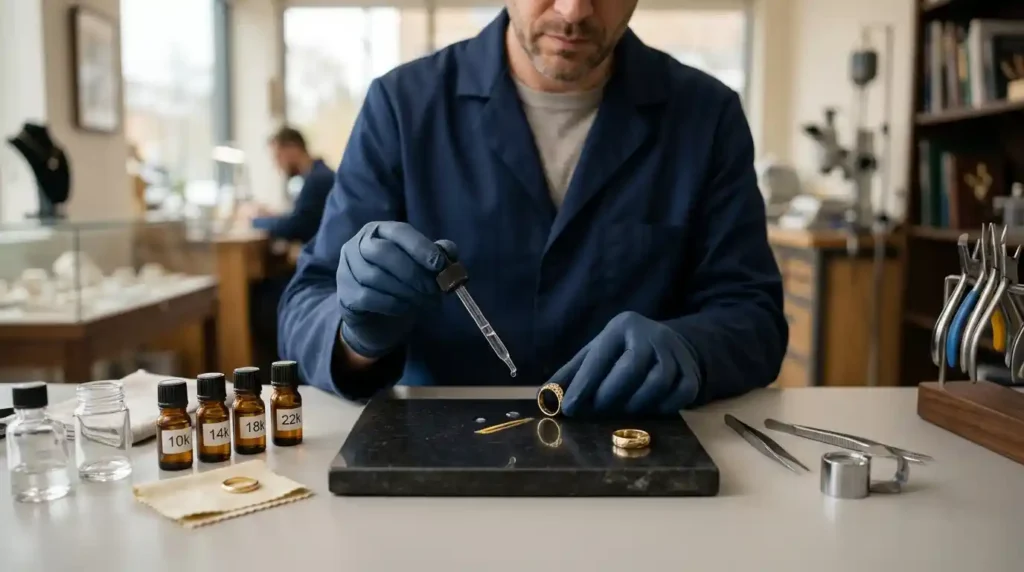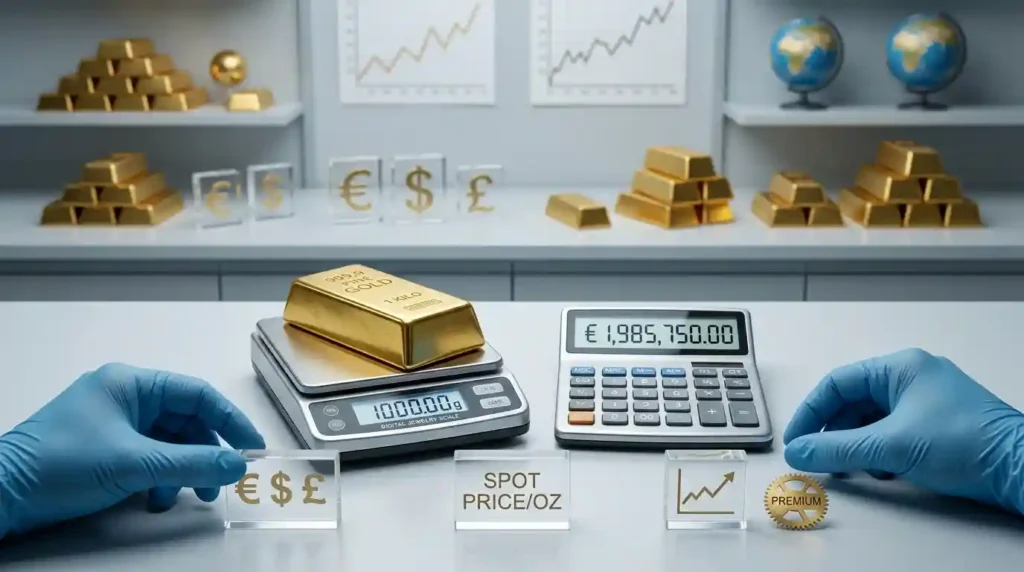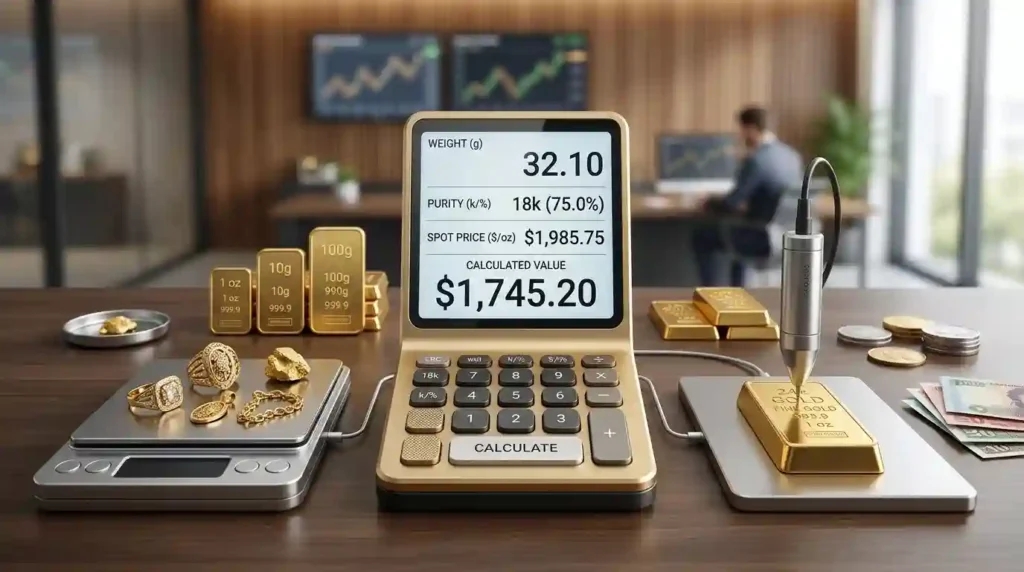
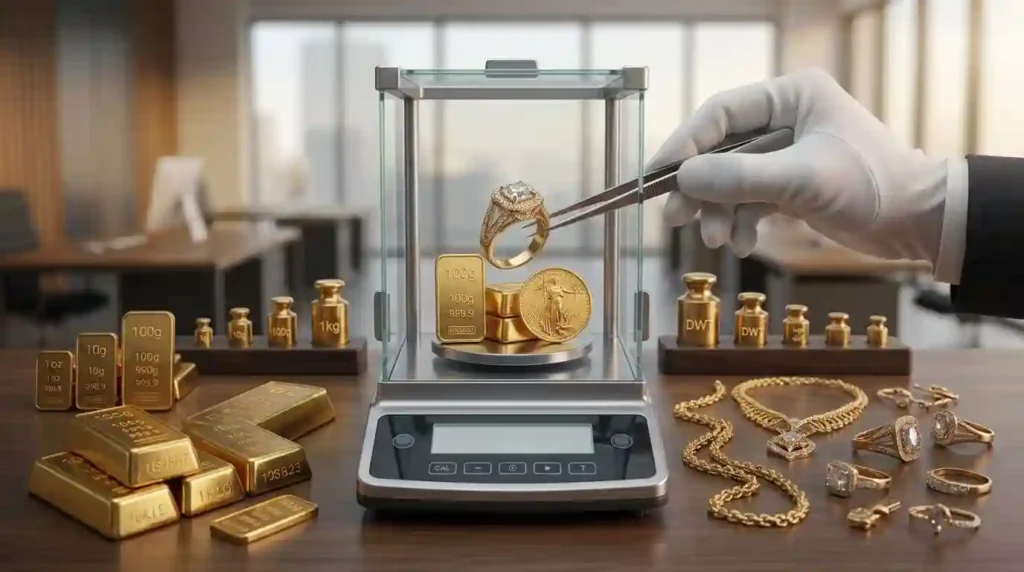
It is lunch break in Seattle, and you are checking the gold price on your phone. One site shows dollars per troy ounce. A jewelry store quotes dollars per gram. A gold buyer offers a rate per pennyweight. Which price is really better? Our gold price guide is a good place to start. I have been in this spot, and the numbers can feel like a puzzle. Comparing gold prices using different units is easier than it looks. You only need to convert the units, adjust for purity, and check for fees. In this guide, I will show you how to compare grams, ounces, and pennyweights. You will also learn simple formulas, quick karat math, and how to check your work with a gold calculator.
Why Are Gold Prices Quoted in Different Units?
Gold is sold in many places. A bank, a jeweler, and a scrap buyer all work in different ways. So each one picks the unit that suits its job. A finance site may use the troy ounce. A jeweler may use grams. A scrap buyer may use pennyweights.
The gold itself does not change. Only the way people write the price changes. Think of it like miles and kilometers. The road is the same length. The number on the sign is not. If you want the big picture first, read our guide on how the price of gold is calculated.
Why gold prices are often quoted per troy ounce
The troy ounce is a standard unit in precious metals markets. It is not the same as the ordinary U.S. ounce you use in the kitchen. A troy ounce is heavier. We will look at the exact numbers soon.
A market quote also names a currency and a weight of gold. It is most often in U.S. dollars. It also has a time. Gold prices change through the day, so the time stamp matters. A price from this morning may not match the price this afternoon. Our post on gold price data sources explains how often those numbers update.
Many beginners ask which quote is the real one. The answer is that each source is real in its own setting. A market quote shows a benchmark. A store shows what it will charge or pay. So never treat the headline number as the price you will get. Treat it as a starting point for your own math.
Jewelers often use grams
Grams are small and easy to read on a scale. That makes them a good fit for rings, chains, and earrings. A jeweler can weigh a piece in seconds.
Jewelry prices come in different forms. Some are per gram. Some are per piece. Some are one total price. The weight of the whole item may also include stones or other parts that are not gold. So ask what weight the seller means. It helps to know the gap between a gold price and a gold jewelry price.
A simple test can help. Ask the seller to list the gold weight, the karat, and the price on one slip. Then divide the price by the gold weight. This gives you a price per gram that includes labor and profit. Now you can compare it with the market rate you converted earlier. The gap shows you what you pay for design and service.
Pennyweights in some U.S. gold shops
A pennyweight is a small, old unit. People write it as dwt. Some jewelers and scrap buyers in the U.S. still use it. You may see a sign that says “paying $150 per dwt.”
Not every dealer uses this unit. If you do not see it, do not worry. You can still convert any quote to grams or ounces. That is all you need.
If a buyer quotes you in dwt, ask them to confirm the unit out loud. Some people say “penny” as a short form. Make sure you both mean the same thing. A short check can prevent a long argument later. I also ask for the rate to be written on the receipt.
The unit alone does not tell you which price is better
A price per gram and a price per troy ounce can describe the same rate. The unit is just a label. So a bigger number does not always mean a bigger price.
Purity also matters. So do fees, and so does the type of gold product. Always turn every quote into one common unit before you compare. That one habit solves most of the confusion.
Here is a quick story. A reader once told me a store offered her $60 per gram for her old ring. She thought it was low, since a website showed about $96 per gram. She did not know the ring was 14K. Once we ran the karat math, the offer made more sense. It was still low, but not as shocking. Units and purity explain most of the gaps people notice.
Authority reference: The National Institute of Standards and Technology, or NIST, publishes conversion factors for precious metals. These help buyers and sellers compare weight-based prices.
What Are the Main Gold Weight Units?
Before we do any math, let us meet the units. Each one measures weight. Each one shows up in a different place. Once you know them, the conversions feel natural.
I like to keep a small card in my wallet with these numbers. It sounds silly, but it works. When a seller quotes a price in a unit I do not use, I can check it in a minute.
Gram (g)
The gram is a metric unit of mass. It is common for jewelry and small gold items. Most jewelers have a scale that reads in grams.
Grams are useful when you compare similar pieces. If two chains have the same style, the price per gram is a quick test. It shows which one costs more for the same weight.
Troy ounce (ozt)
The troy ounce is the unit used in many gold market quotes. One troy ounce is about 31.1034768 grams. That is a long number, so I round it to 31.1 in my head for quick checks.
A troy ounce is not the same as the regular U.S. ounce. That ounce, called avoirdupois, is about 28.35 grams. This is a very common mix-up. I see it in reader emails often.
The word ounce causes most of the trouble. In a store, an ounce of flour is the regular kind. In gold, the market means the troy kind. If you ever see a gold weight in ounces without the word troy, ask which one is meant. For jewelry, the weight is almost always in grams, so there is little risk. For coins, the label usually names the troy ounce.
Pennyweight (dwt)
The pennyweight is a traditional unit in some U.S. jewelry deals. One pennyweight equals 1.55517384 grams. There are 20 pennyweights in one troy ounce.
This link gives you a handy shortcut. To turn a troy ounce price into a pennyweight price, you divide by 20. That is much easier than most conversions.
Kilogram (kg)
One kilogram equals 1,000 grams. You may see it in large bullion deals or wholesale pricing. It is rare in normal jewelry shopping.
Still, it is good to know. If a site shows a price per kilogram, just divide by 1,000 to get a price per gram.
Let me give you a quick memory aid. One gram is about one thirty-first of a troy ounce. One pennyweight is about one and a half grams. One kilogram is a thousand grams. With these three facts, you can do rough checks in your head. A rough check is a great way to spot a number that looks wrong.
Gold weight conversion table
The table below shows standard unit conversions. These are not gold price quotes. They simply show how the units relate to each other. I use these numbers to compare quotes without changing the amount of gold behind them.
| Unit | Equivalent weight | Common use |
|---|---|---|
| 1 gram | 1 g | Jewelry and small gold items |
| 1 pennyweight | 1.55517384 g | Some U.S. gold buyers |
| 1 troy ounce | 31.1034768 g | Precious-metal market quotes |
| 1 troy ounce | 20 dwt | Pennyweight conversion |
| 1 kilogram | 1,000 g | Larger quantities of gold |
Source: NIST precious metals conversion information.
How to Convert Gold Prices Between Different Units
This is the heart of the guide. We will convert the price, not just the weight. That is what lets you compare two quotes fairly. Take your time with each formula. Try the examples with your own numbers.
All examples use a hypothetical price. It is for teaching only, and it is not a live quote. For a live number, check a current source or read about today’s gold price.
Convert gold price per troy ounce to price per gram
Use this formula.
[ \text{Price per Gram}= \frac{\text{Price per Troy Ounce}}{31.1034768} ]
Here is an example. Say the hypothetical price is $3,000 per troy ounce.
[ $3{,}000\div31.1034768\approx$96.45 ]
So the price is about $96.45 per gram. Remember, this number is for demonstration only. It is not a live quote.
Turn a price per gram into a price per troy ounce
Use this formula.
[ \text{Price per Troy Ounce}= \text{Price per Gram}\times31.1034768 ]
Multiply the per-gram price by the number of grams in a troy ounce. Keep the same currency. Keep the same purity basis too.
Try it with $96.45 per gram. Multiply by 31.1034768. You get about $2,999.93. That is a little under $3,000. Why? Because we rounded $96.45 earlier. This is a good reminder to round only at the end.
Rounding error is a good thing to understand. The exact per-gram price is $96.4506 and more. We cut it to $96.45. That tiny cut was multiplied by 31. So the result slipped by seven cents. On a single coin, seven cents is nothing. On a big order, it adds up. Pros keep extra decimals for this reason.
Change a troy ounce price into a price per pennyweight
Use this formula.
[ \text{Price per dwt}= \frac{\text{Price per Troy Ounce}}{20} ]
For the hypothetical $3,000 price, the math is simple.
[ $3{,}000\div20=$150\text{ per dwt} ]
That is the easiest conversion in the guide. If a buyer quotes you a rate near $150 per dwt, you can tell right away it matches this example. That works only if the gold is pure, so keep purity in mind.
Pennyweights are handy for a quick sanity check. A rate of $150 per dwt sounds like a lot. But it is just $3,000 per troy ounce divided by 20. So the same rate may feel less scary once you convert it. If a buyer offers $90 per dwt for 14K scrap, you can test it. Ask what pure gold would be per dwt, then multiply by 0.5833. You can also learn the karat math in our purity guide.
Switch from price per gram to price per pennyweight
Use this formula.
[ \text{Price per dwt}= \text{Price per Gram}\times1.55517384 ]
Try a sample. Take $96.45 per gram. Multiply by 1.55517384. The answer is about $150.00 per dwt. It matches the earlier result, and that is how you know the math works.
I like to check my work by going in a circle. Start with a price per ounce. Convert to grams. Convert to dwt. Then convert back to ounces. If you land near your start, the math is sound. If not, look for a slipped decimal or a wrong unit. This trick takes one minute and saves many errors.
Small gaps may appear because of rounding. Do not worry about a few cents. Just make sure you compare the same type of price. A market reference, a retail price, and a dealer offer are three different things.
Gold Price Conversion Examples: Compare the Same Price in Different Units
Let us use one hypothetical price all the way through. This shows that changing the unit does not change the value. The example assumes the same purity. It also leaves out premiums, fees, and other changes.
I like this kind of table because it calms people down. Once you see the same price written four ways, the fear goes away. You can test it yourself with our gold calculator.
Tables also help you spot patterns. Notice that the per-gram price is about one thirty-first of the per-ounce price. Notice that the dwt price is exactly one twentieth. These patterns let you guess a result before you calculate it. If your answer is far from the guess, you know something is off.
Example conversion table
Assume a hypothetical gold price of $3,000 per troy ounce.
| Price unit | Calculation | Equivalent price |
|---|---|---|
| Per troy ounce | Given example price | $3,000.00 |
| Per gram | $3,000 ÷ 31.1034768 | About $96.45 |
| Per pennyweight | $3,000 ÷ 20 | $150.00 |
| Per kilogram | $96.45 × 1,000, using rounded rate | About $96,450 |
The per-kilogram figure is approximate. It uses a rounded per-gram rate. For a more exact result, keep the unrounded number through the whole calculation. The exact figure is about $96,450.60.
How to compare two gold quotes
Let us say one site shows $2,950 per troy ounce. A shop quotes $95 per gram. Which is higher? Follow these steps.
- Convert both prices to dollars per gram or another common unit (our gold price page can help).
- Confirm that the quotes refer to the same purity.
- Check whether one price includes dealer premiums or other fees.
- Compare the final amount payable, not just the headline price.
Here is the math. Divide $2,950 by 31.1034768. You get about $94.84 per gram. The shop’s $95 per gram is a bit higher. The gap is small, but now you can see it clearly.
| Quote | Original price | Converted to price per gram |
|---|---|---|
| Quote A | $2,950 per troy ounce | About $94.84 |
| Quote B | $95 per gram | $95.00 |
| Quote C | $145 per pennyweight | About $93.24 |
These numbers are hypothetical. Still, they show the idea. Quote C looks like the lowest rate. But a buyer’s rate is often a payout, not a sale price. So think about which side of the deal you are on. A lower buy rate may be worse for a seller.
Why rounding can create small differences
If you round at every step, small errors pile up. A few cents here and there may become a few dollars on a big deal. I learned this the hard way when I added up a long list of quotes.
Keep more decimal places while you calculate. Round only the final answer. A practical level is cents. That keeps your result clean and honest.
Some tools round to two decimals at every step. Others keep many decimals inside and show two. The second kind is better. If you use a spreadsheet, keep the full cell value and use number formatting to show cents. That way the hidden digits stay in the math. I use this method for every gold sheet I build.
How Gold Purity Changes the Price Comparison
Converting units is only half the job. Imagine one quote is for pure gold. Another is for a 14K chain. They are not the same thing. You must adjust for the real gold content first. For a deeper look, read our guide on how gold purity is calculated.
I have seen buyers compare a 24K coin price with a 10K ring price. The ring seemed cheap. In truth, it held far less gold. Purity explains the gap.
The same logic applies to resale. A buyer who tests your item will pay for the gold content, not the shine. So a 10K piece brings less than a 14K piece of the same weight. Knowing your karat before you walk in gives you power. You can check the offer with your own math.
Understand karat and fineness
Karat tells you the share of gold in an alloy. For simple math, 24K counts as pure gold. Lower karats have other metals mixed in.
- 22K holds about 91.67% gold.
- 18K holds 75% gold.
- 14K holds about 58.33% gold.
- 10K holds about 41.67% gold.
Fineness says the same thing in parts per thousand. For example, 750 means 75% gold. It is the same as 18K.
Common fineness marks include 417, 585, 750, 916, and 999. They match 10K, 14K, 18K, 22K, and 24K in turn. The number 916 means 91.6% gold, which is close to 22K. Some coins carry 999.9, which is very close to pure. If you see a mark you do not know, look it up before you buy.
Calculate the gold content in a jewelry item
Use this formula.
[ \text{Pure Gold Weight}= \text{Item Weight}\times\frac{\text{Karat}}{24} ]
Here is an example. A 10 gram 14K item holds about this much gold.
[ 10\times\frac{14}{24}=5.833\text{ g of gold} ]
This assumes the karat mark is right. It also assumes the stated weight is the weight of the gold alloy. If the piece has stones, take their weight out first. Our guide for first-time gold buyers explains how to check marks and papers.
Calculate the estimated metal value
Use this formula.
[ \text{Estimated Gold Value}= \text{Pure Gold Weight}\times\text{Pure Gold Price per Gram} ]
Use the hypothetical pure gold price of about $96.45 per gram.
[ 5.833\times$96.45\approx$562.63 ]
This is a rough metal value. It is not a retail price. It is not a resale price either. Think of it as a floor, not the full story.
Why call it a floor? Because a seller rarely pays full metal value for scrap. And a store rarely sells jewelry at metal value. The real prices sit above or below, based on which side of the deal you are on. Metal value is the anchor that keeps both sides honest. To learn more about what gold is worth, see our page on the value of gold.
Purity comparison table
The table below compares equal 10 gram items. It assumes a hypothetical pure gold price of $100 per gram. That round number keeps the math easy. It shows how purity changes metal value before any other cost.
| Karat | Approximate gold content | Estimated metal value for 10 g |
|---|---|---|
| 24K | 100% for simplified calculation | $1,000.00 |
| 22K | 91.67% | $916.67 |
| 18K | 75% | $750.00 |
| 14K | 58.33% | $583.33 |
| 10K | 41.67% | $416.67 |
Look at the gap between 24K and 10K. It is more than $580 for the same weight. That is why a gram is not always a gram when it comes to gold.
Try your own version. Pick a ring weight from your drawer. Choose its karat. Use the formula, then multiply by a current per-gram price. You will get a good guess of its metal value. Our guide on the value of gold shows more ways to think about what a piece is worth.
How to Compare Gold Dealer Quotes Fairly
Once the unit and purity match, you can compare offers. But you will still see differences. A dealer’s quote may not match the market price you saw online. That is normal. Dealers have costs, and they need to earn a profit. The trick is to know what each quote includes.
Check what the quote represents
Ask a few simple questions about each quote.
- Is it a market reference price?
- Is it a retail price for a finished gold product?
- Is it a dealer’s purchase offer for scrap gold?
- Does it include a premium, a commission, or a fee?
These four answers can change everything. A market reference is a benchmark. A retail price adds costs. A scrap offer subtracts costs. They are three different numbers for the same metal.
Compare dealer offers using the same unit
Convert each offer to dollars per gram or dollars per pennyweight. Confirm that both offers use the same karat or fineness. Ask if the quoted weight leaves out stones and non-gold parts.
I like to put each offer on paper in a short list. Then I can see all the numbers side by side. If one offer looks far off, I ask why. A good dealer will explain it with ease. Learn how to read a fair offer in our first-time buyer checklist.
Ask three more questions. How is the rate set each day? Is the rate locked once I agree? Do you charge any fee to test or melt the item? A clear answer to each means a fair shop. A fuzzy answer means you should compare other buyers. Taking ten extra minutes can protect hundreds of dollars.
Understand premiums and deductions
Bullion often costs more than the metal’s spot value. That extra amount is the premium. Scrap gold offers are often lower than the estimated metal value. Retail jewelry prices may include making charges and design costs.
Different business models lead to different quotes. A shop with a big store has higher costs than an online buyer. That does not make one honest and the other not. It just means you should ask.
Here is a fair way to think about it. A dealer who pays 80% of metal value may still be honest, if the costs are real. A dealer who pays 40% may be taking too much. There is no single right number. But with your math in hand, you will know when a number feels off. That is half the battle. If you plan to sell, read about gold valuation scams so you can spot a lowball offer.
U.S. reference: The U.S. Mint advises bullion buyers to research current market prices, understand premiums, and look into dealers before they buy.
Common Mistakes When Comparing Gold Prices
Small slips can make a good deal look bad. They can also make a bad deal look good. I have made a few of these myself. Here are the ones I see most. Each one is easy to avoid once you know about it.
Confusing a regular ounce with a troy ounce
A regular U.S. ounce and a troy ounce do not weigh the same. The troy ounce is heavier. Use 31.1034768 grams for one troy ounce. Use about 28.35 grams for a regular ounce.
If you mix them up, your price per gram will be off by about 10%. That is a big error on a large deal.
Let me show how big. Say you think a one-ounce coin is 28.35 grams. At $96.45 per gram, you would value it at about $2,734. The real value, at 31.1 grams, is about $3,000. You would be off by more than $260 from one small slip. That is why I stress this point so much.
Comparing different purity levels
A gram of 14K gold does not hold as much gold as a gram of 24K gold. So adjust for purity before you compare metal values. Use the karat formula from earlier.
Mixing currencies or price timestamps
Convert currencies before you compare international quotes. A price in euros is not a price in dollars. Use prices from similar times when you can. Gold can move a lot in one day.
Write down the time stamp when you use a price that updates often. Our guide on gold price sources can help you pick a good one.
Ignoring fees and dealer premiums
Compare the total cost, or the net offer. Check shipping, taxes, processing charges, and other listed fees. Do not assume the lowest headline price is the best deal. Our guide to gold buying scams shows how low prices can hide high fees.
Taxes and shipping matter too. Rules differ by state, so check your own. For online orders, add the shipping and insurance to the price before you compare. A coin that looks cheaper may cost more once the box arrives at your door. The final amount is the only number that counts.
Rounding too early
Keep the full conversion factor during the middle steps. Round only the final figure. This one habit protects you from most small math errors.
How to Use a Gold Price Unit Converter or Calculator
A good calculator cuts down errors and saves time. But you should still know what it does. The best tools show their steps. That way you can check the result. I never trust a number I cannot trace. See how different tools work in our review of gold calculators.
Choose the original price unit
Pick per gram, per troy ounce, or per pennyweight. Enter the quoted price and the currency. Check that the input matches the unit on the quote.
A common slip is to type a per-ounce price into a per-gram box. The result will look odd, and you may not notice. Always double-check the unit label.
Some tools hide the unit in a small drop-down. Others show it only in a tiny gray label. Slow down and read it. I once converted a whole list in the wrong direction. The results looked fine until I did a rough check. Since then, I always test a tool with a known value, like $3,000 per ounce, before I trust it.
Select the target unit
Convert the price into the unit used by the second quote. A good tool shows the conversion factor it used. It also shows a clear result, such as dollars per gram.
Add purity when comparing jewelry
Select the karat or fineness. The tool will estimate the pure gold content. Keep the metal value separate from the finished jewelry price. The two are not the same.
If you are shopping for a piece, a gold value calculator gives you a quick estimate. Then you can compare it with the seller’s price.
Keep in mind that a calculator is only as good as its inputs. If you type the wrong karat, you get the wrong answer. If you use an old price, you get an old answer. So treat each result as an estimate. Then confirm the details with the seller and, for big deals, with a tester.
Features a reliable gold price calculator should include
Look for these features.
- Clearly labeled units.
- Accurate conversion factors.
- Price source and time stamp when a market price is supplied.
- Purity adjustment for jewelry.
- Open formulas.
- A note that dealer offers and retail prices may include extra costs.
Tool tip: Convert your gold quote to a common unit before you decide which offer is better.
U.S. Expert Guidance and Trusted Gold-Price References
I never rely on my own word alone. Good advice rests on official sources, and our guide to the price of gold uses them too. Below are three U.S. sources I trust. Please note that a conversion chart cannot prove that a product is real. It only helps you compare weights and prices.
What NIST says about precious-metal conversions
NIST offers Precious Metals Conversion Information. Its official factors cover grams, troy ounces, and pennyweights. Use them when you need exact numbers.
Correct units help buyers and sellers compare weight-based prices. When both sides use the same factors, there is less room for confusion.
I like NIST because it is neutral. It does not sell gold, and it does not take a side. Its numbers are the same for everyone. When you share a calculation with a buyer, you can point to these factors. That makes the talk calmer and more fair.
How the U.S. Mint advises bullion buyers
The U.S. Mint shares Bullion Consumer Awareness guidance. It encourages you to check current market prices and premiums. It also advises you to research the seller and confirm the product’s published specifications.
For coins, you can match the weight and size to the Mint’s published specs. If a coin feels off, ask the seller to explain. Honest dealers will not mind. They know that trust is part of the sale.
FTC advice on gold jewelry
The Federal Trade Commission has a guide called Buying Platinum, Gold, and Silver Jewelry. It explains that karat marks help show gold content. It also urges you to research sellers and get return policies in writing. Find more at consumer.ftc.gov.
A karat mark is a good clue, but it is not proof. Pair it with papers, a clear receipt, and a fair return window. If the piece is costly, add a test by a trusted jeweler. These steps work together. No single one is enough on its own.
For a full checklist, see our guide on what first-time gold buyers should check.
Frequently Asked Questions About Comparing Gold Prices
Readers ask me the same questions often. Here are short, clear answers. For more, browse our gold blog.
How do I compare gold prices per gram and per ounce?
Divide the price per troy ounce by about 31.1034768. That gives you the price per gram. Confirm that both prices use the same currency and purity basis.
How many grams are in a troy ounce of gold?
One troy ounce equals about 31.1034768 grams.
What is the number of pennyweights in a troy ounce?
One troy ounce equals 20 pennyweights.
Is the gold price per gram the same for 14K and 24K gold?
No. A quoted price for pure gold must be adjusted for the gold content of lower karat jewelry. Only then can you estimate its metal value. Our post on gold jewelry prices explains more.
Why does a gold buyer offer less than the spot price?
A buyer may account for purity, testing, processing, refining, running costs, and profit. Ask how the offer was figured. You can also compare it with an estimate from the value of gold guide.
Which unit is best for comparing gold prices?
Any unit works if you convert all quotes to the same one. Grams are handy for jewelry. Troy ounces are common for market quotes. Some U.S. buyers use pennyweights.
Can a gold price calculator tell me the best deal?
It can help you compare converted prices. But it cannot verify purity, authenticity, seller trust, or every cost in a deal. Use it as a helper, not a judge, and read our notes on how gold calculators work. Our gold calculators guide explains its limits.
One last tip before the recommendation. Keep a small log of every quote you get. Write the date, the unit, the karat, and the price. Add the converted per-gram rate next to it. After a few weeks, you will see a pattern. You will know what a fair offer looks like in your area. That record is worth more than any single calculator.
Final Recommendation
I have spent years helping people read gold quotes and avoid costly mix-ups. My advice on comparing gold prices using different units is simple. Convert every quote to one unit first. Then adjust for karat. Then look at fees and premiums. Keep your decimals until the end. Use a trusted source for the market price, such as the ones in our gold price sources post. You can learn more about me on my author page. Units are just labels. The real value lives in the weight, the purity, and the terms of the deal.
Compare Gold Prices With Confidence
Next time you see a gold price, do three things. Convert it to the same unit as the other quote. Check the purity. Then compare the final price or the net offer. Use the gold price calculator to avoid unit errors before you buy or sell. No unit is cheaper than another. The value depends on the true price, the purity, and the deal terms, not on how the price is written.