Picture a Tuesday morning in Seattle. You plan to sell an old gold chain before lunch. You open a gold calculator and see one price. Then you check a second website, and the number is a little different. Which one should you trust?
In my experience reviewing gold tools, gold price data sources and update frequency explain most of that gap. A calculator does not make up the price. It pulls the quote from a market-data provider, an exchange, a benchmark, or another financial data service. A price can be right for its timestamp and still miss the latest move.
In this guide, we will look at the main sources, update schedules, delayed quotes, live gold prices, and historical data. We will also cover simple checks you can use today. Keep one point in mind. A market price is not a jewelry price, and it is not a dealer offer.
Where Does Gold Price Data Come From?
Before you judge a price, you need to know where it began. A number on a calculator has a short trip behind it. It starts in the gold market, passes through a data provider, and lands on your screen.
Each stop on that trip can add a delay. That is why the source matters as much as the number itself.
Gold Exchanges and Trading Markets
Gold futures trade on organized exchanges. One well-known example is COMEX gold futures, which are part of CME Group.
A futures price belongs to a contract. The contract has a set delivery date. So it is not the same thing as the spot price, which is the price for gold right now.
The two prices often sit close together. They can still differ. If you see a small gap between two sites, this may be the reason.
Benchmark Administrators for Gold Prices
A benchmark is a reference price. The best known one is the LBMA Gold Price. ICE Benchmark Administration, or IBA, runs the auctions that set it.
Banks and other firms use this benchmark in contracts and in valuation work. It gives them a fair, shared reference point.
But a benchmark is not always the latest quote. It is set at set times. Between those times, the market keeps moving.
Market Data Providers and Financial Websites
Most people do not read prices from an exchange. They read them on a website or in an app. Data providers collect the prices and pass them along.
You may know names such as CME Group, Kitco, and the World Gold Council. Each plays a different role. One shows futures data. One offers a public price page. One focuses on research and history.
Websites may use different providers. They may also use different methods and refresh times. A familiar brand name does not prove the quote is real-time.
The Path From Market to Online Calculator
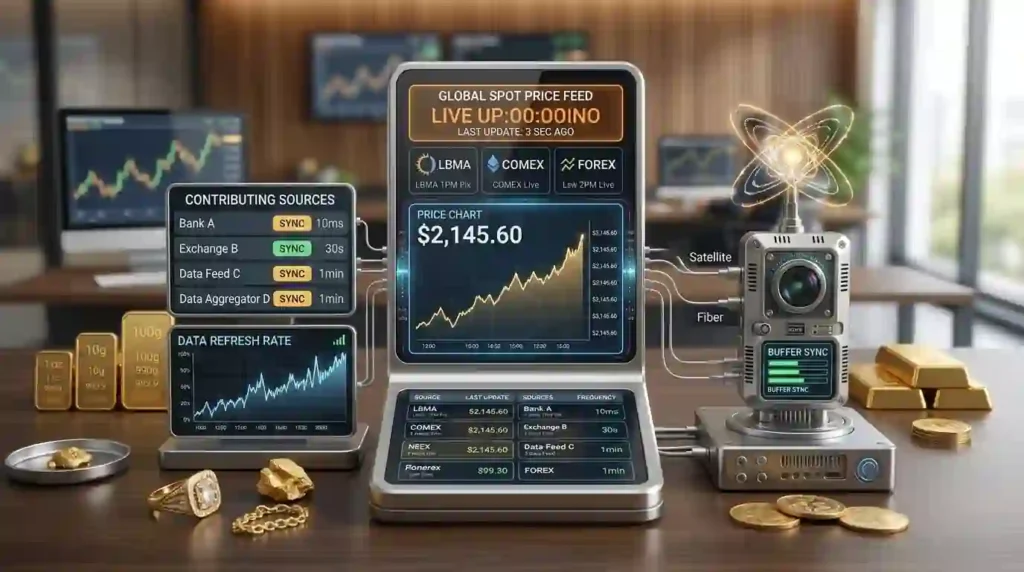
Here is how a price usually reaches a gold calculator.
- A market or benchmark creates the price.
- A provider sends it through a feed, an API, or another method.
- The calculator changes it to your currency and weight unit.
- The tool applies your weight and purity to estimate value.
- A cache or refresh timer may hold the number for a while.
That last step is easy to miss. A tool can show a price that is a few minutes old, even if the source is fresh. Think of it as a simple chain: Gold market, then Data provider, then Website or API, then Gold calculator, then Estimated value.
Most Reliable Gold Price Data Sources
No single source is best for every job. A jewelry seller needs a quick market reference. A researcher needs clean history. A bank needs a defined method.
So I compare sources by what they actually give you. Then I match the source to the task.
LBMA Gold Price
The LBMA Gold Price is a respected global benchmark. It is set in two auctions each day. These are the AM and PM prices.
The price forms in U.S. dollars per troy ounce. IBA also publishes it in British pounds and euros. Those two are not traded directly in the auction.
Real-time and detailed history may need a license from IBA. The LBMA website posts prices with a delay. This source suits benchmark checks and valuation work that needs a clear method. It is less useful when you need the price this very minute.
CME Group Gold Market Data
CME Group is a leading source for gold futures. Its gold contract covers 100 troy ounces and is quoted in U.S. dollars per troy ounce.
The public CME pages show quotes that are delayed by at least 10 minutes. Licensed real-time data is a different product with its own terms.
This data helps you follow futures prices and market activity. Just remember that a futures price may differ from a spot price. Check which one your calculator uses.
Kitco Gold Prices
Kitco is a well-known public site for precious metal prices. Many people use it as a quick reference.
I like to read the page labels. Look at the quote type, the unit, the currency, and any update note. Do not assume every number on a page is live.
A public price page is a good second opinion. It is not a promise that your calculator uses the same feed.
World Gold Council Price Data
The World Gold Council is a strong place for research. It shares historical gold price data that helps you study trends.
Historical reference data is not a live trading screen. It records what happened. It does not tell you the price right now.
The update schedule depends on the dataset. The council notes that its referenced historical gold price data updates weekly. Check the data page for the current schedule before you rely on it.
Choosing the Right Source
Pick the source that fits your goal.
- For a recognized benchmark, look at LBMA Gold Price data.
- For futures activity, use CME Group gold futures data.
- For a quick consumer reference, check the timestamp and method on a reputable price site.
- For history, use a dataset with a clear frequency and date range.
This table compares the main sources. A reliable source is one that fits the job. A source made for research may not suit a calculator that claims to show the current price.
| Source | Main use | Frequency or timing |
|---|---|---|
| LBMA Gold Price | Benchmark pricing | Twice-daily auctions |
| CME Group gold futures | Futures-market pricing | Trading-session data; public delayed quotes may lag |
| Kitco | Consumer-facing precious metal price reference | Check the displayed quote and timestamp |
| World Gold Council | Historical gold price analysis | Historical reference data updated weekly |
The LBMA schedule and the CME delay notice come from those providers. Confirm the World Gold Council schedule on its own data page.
Update Frequency for Gold Prices
Now to the question many readers ask first. How often do gold prices update? The honest answer is that it depends on what you mean by update.
A market can trade. A benchmark can publish. A website can refresh. These are three different events.
Market Movement Through the Day
The gold market can move many times in a busy session. Orders come in. Traders react to economic reports. Interest rate hopes, currency moves, and world events all play a part.
CME Globex, for example, trades gold from Sunday evening to Friday evening, with a short daily break.
But a moving market does not mean every website moves with it. Some sites refresh each second. Others refresh each minute, or only when you reload.
LBMA Gold Price Timing
The LBMA Gold Price is set twice a day. The auctions start at 10:30 a.m. and 3:00 p.m. London time.
Those are start times. They are not exact publication times. The price is published after the auction ends.
The benchmark is not published on weekends or on UK bank holidays. So a site that shows an “LBMA price” may be showing the last one set.
CME Gold Futures Quote Timing
Trading and quote delivery are not the same. A contract can trade now, while a public page shows the quote from earlier.
CME says its public quotes are delayed by at least 10 minutes. Licensed real-time access follows other terms.
Check the label on the exact feed you use. If it says delayed, treat it that way.
Historical Gold Price Data Schedules
Historical data comes in daily, weekly, monthly, and yearly sets. Each has its own schedule.
Weekly data helps you see trends. It does not help you price a chain you plan to sell today.
This table sums it up. The word updated can mean a new trade, a new benchmark, or a refreshed dataset. They are not the same, even when a site uses one word for all three.
| Data type | Update pattern | Best use |
|---|---|---|
| Live market quote | Changes during active trading | Current market reference |
| LBMA Gold Price | Two daily benchmark auctions | Benchmark comparison |
| CME public delayed quote | Delayed by at least 10 minutes | Futures-market monitoring |
| Weekly historical dataset | Weekly updates for the referenced WGC data | Historical analysis |
| Calculator display | Depends on its source and refresh rules | Estimating gold value |
Live, Delayed, and Historical Gold Price Data
These three terms shape how you read any gold price. Once you know them, many mix-ups fade. You will also see why two sites can differ even when both do the math right.
Meaning of a Live Gold Price
A live quote is sent with very little delay, under the provider’s own terms. It is the closest thing to the market right now.
Live prices often come with data licenses. That is one reason many free sites show delayed data instead.
Also, live does not mean zero lag. Always look for a timestamp. A claim of live prices with no time shown is a warning sign.
Delayed Quotes Explained
A delayed quote shows the market as it was a little while ago. CME’s public pages, for example, are delayed by at least 10 minutes.
In a calm market, a 10 minute delay may matter little. In a fast market, it can matter a lot.
So ask one question. Do I need the latest price, or is a close reference enough?
Historical Records of Gold Prices
Historical data records earlier prices. It may show daily closes or monthly averages. It is great for charts and trends.
Do not treat it as a live quote. A weekly file may be days old by the time you read it.
I use history to learn how gold has moved. I use a current source to check a price I plan to act on.
Can a Delayed Price Still Be Useful?
Yes, in many cases. A delayed price works well for learning and for broad comparisons. It also helps with history.
It may be a poor fit when your choice depends on the latest price. The right pick depends on the tool’s purpose.
Here is a simple case. One person checks a calculator at 8:30 a.m. in New York over coffee. Another checks after lunch. If the tools use different timestamps or data types, the numbers can differ, even though both run the same formula correctly.
Why Gold Price Websites Show Different Prices
Do not assume the highest number is the best one. Different prices usually have a simple cause. Learn the common causes, and you can find the gap in minutes.
Spot, Futures, and Benchmark References
Spot gold, gold futures, and the LBMA benchmark are three different references. They track the same metal, but they are not the same number.
Venues and contract months also differ. A futures price for a later month can sit above or below spot.
Benchmarks are set at set times. Continuous quotes keep moving. So the two can differ at any given minute.
Update Times and Time Zones
One site may refresh more often than another. Time zones add more confusion. London, New York, and other markets keep different clocks.
The date on a site may even differ from your local date. This happens often near midnight.
When you compare prices, always align the time and the time zone first.
Currency and Weight Units
A price per troy ounce is not a price per gram. One troy ounce is about 31.1035 grams.
Currency conversion adds another layer. The exchange rate has its own timestamp. Rounding can also shift the last digits.
So two honest tools can show slightly different numbers. Check the unit and the currency before you worry.
Bid, Ask, and Midpoint Prices
A bid is the price a buyer may pay. An ask is the price a seller wants. The midpoint sits halfway between them.
To find the midpoint, add the bid and the ask. Then divide by two.
None of these equals a jewelry store offer. They are market references. A store adds its own costs and margin.
Checking a Price Discrepancy
Use this short routine when two prices do not match.
- Compare the same type of gold price.
- Line up the timestamps and time zones.
- Check the currency and the unit.
- Read each source’s stated delay.
- Redo the unit conversion yourself.
Here is a common case. Two sites show slightly different dollar per gram prices. Before you decide one is wrong, check if one uses spot gold and the other uses a futures quote. Also check their update times.
Using Price Data Inside a Gold Calculator
Now let us connect the source to the tool you actually use. A gold calculator is only as good as the price it receives. Knowing how it uses that price helps you judge the result.
A Price Feed Behind a Gold Calculator
A calculator gets its price in one of two ways. It may pull the price from a provider. Or it may ask you to type one in.
Then the tool checks or receives updates. It changes the price to a matching unit and currency. Next, it applies your item’s weight and purity. Last, it shows an estimated metal value.
Each step can add a small lag. That is normal. The key is to know where the lag may come from.
Formula Behind the Estimate
The math is short.
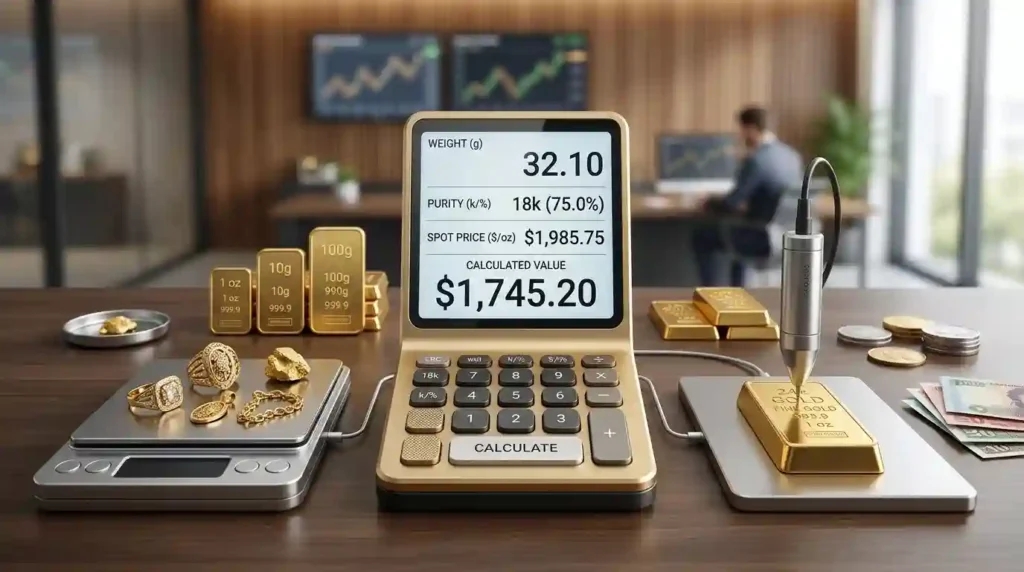
Estimated gold value = Weight × Purity factor × Pure gold price per unit
The formula works only when the weight and the price use the same unit. Grams need a price per gram. Troy ounces need a price per troy ounce.
For example, 18K gold has a purity factor of 0.75. A mismatch in units is the most common error I see, even more than a wrong price.
Why a Calculator May Not Be Truly Real-Time
Several things can slow a calculator down.
- The source feed may be delayed.
- The site may cache the data.
- The page may refresh only when you open it or press refresh.
- Currency rates may update at a different time than gold prices.
So a calculator that looks live may not be. Always check for a timestamp. It is the quickest honest signal.
What a Good Gold Calculator Should Display
A clear tool shows you where its price came from. Look for these items.
- A named data source or a plain description of it.
- A last updated time, ideally with a time zone.
- The price unit and the currency.
- Whether the price is spot or futures, where it matters.
- A note on whether the result is metal value or a payout estimate.
This table is a quick quality checklist. Clear details matter more than a flashy number that moves on screen. A good tool lets you see where the quote came from and when it last refreshed.
| Feature | What readers should look for |
|---|---|
| Source | Named provider or clear methodology |
| Timestamp | Date, time, and preferably time zone |
| Data type | Live, delayed, benchmark, or historical |
| Units | USD per troy ounce, gram, or another clear unit |
| Purity calculation | Correct karat or fineness factor |
| Limitations | Clear notice that estimated metal value is not a guaranteed offer |
How to Check Whether Gold Price Data Is Current and Reliable
Here is a short routine. I use it before I trust any gold calculator, especially when a valuable item is on the line. It takes only a few minutes.
Find the Last Updated Timestamp
Look for the last refresh time. Then check which clock it uses. It may be your local time, London time, or U.S. Eastern time.
Be careful if a page says it is live but shows no time at all. That claim cannot be checked.
Verify the Source
Follow the provider link if there is one. Read how the provider describes its own data.
Also tell the original source apart from a site that only republishes it. A copy of a price may be older than the original.
Confirm the Price Type
Next, find out which kind of price you are looking at. It could be one of these.
- Spot gold.
- A futures price.
- An official benchmark.
- A historical reference price.
The label tells you how far to trust the number for today’s use.
Compare Two Independent References
Check a second source at about the same time. Use the same units and the same currency.
A small gap is normal. A large gap is a reason to stop and look for the cause before you buy or sell.
Check the Calculator’s Own Refresh Behavior
Reload the page if that makes sense. Look for a manual refresh button. See if the quote changes on its own, even when you do not touch the inputs.
Here is my rule. If a calculator shows no source, no timestamp, and no note on its method, treat the result as an unverified estimate. Do not assume it reflects the latest market.
What U.S. Buyers Should Know About Gold Price Data
Let us place all this in a U.S. setting. The aim is to help you read market references without mixing them up with store prices or a promised payout.
Spot Gold Price vs. the Price You Pay in a U.S. Store
The spot price is a market reference. It is not the price tag on a ring.
Jewelry adds the cost of work, shop overhead, and brand value. Bullion coins and bars often sell at a premium over the reference price.
So a store price will usually sit above spot. And a buyer’s offer for your old gold will usually sit below the full metal value.
Prices During U.S. Market Hours
Gold trades in global markets. So prices can change outside normal U.S. stock market hours.
U.S. economic reports can also move prices. Examples include jobs and inflation data.
Do not trust the time you opened a page. Trust the timestamp on the quote.
Consumer Guidance and Source Verification
The U.S. Federal Trade Commission offers guidance on buying gold jewelry. It explains quality markings and how to check a seller. It also stresses written return policies.
If you are thinking about gold as an investment, read the Commodity Futures Trading Commission’s consumer guidance. It warns that precious metals can bring price swings and fraud.
For method and delay details, I rely on the LBMA and ICE Benchmark Administration for benchmarks and on CME Group for futures data delays. For U.S. consumer protection, I use the FTC and the CFTC. None of these groups endorse any calculator, and I do not suggest that they do.
Common Mistakes When Reading Gold Price Updates
Small slips can turn a fair estimate into a misleading one. Here are the ones I see most. Each has a quick fix.
Assuming Every Website Shows Live Prices
Many sites show delayed or cached data. Check the data label and the timestamp first.
Confusing a Gold Benchmark With a Live Quote
The LBMA Gold Price is set twice a day. It is not a running quote. Learn its publication schedule before you compare it with a live number.
Mixing Troy Ounces and Grams
One troy ounce is about 31.1035 grams. Convert the price and the weight to matching units before you multiply.
Ignoring Currency Conversion
A price in another currency has a second moving part. Check the currency and the time of the conversion.
Treating Estimated Gold Value as a Dealer Offer
Metal value is not a payout. Dealer margins, purity tests, and the condition of the item can all change the final offer.
Relying on a Screenshot or Old Price
A screenshot freezes one moment. Gold keeps moving. Use a current source, and recheck the price before you act.
Frequently Asked Questions About Gold Price Data Sources and Update Frequency
Here are short, direct answers to the questions I hear most. Each one stands on its own.
Where Do Gold Price Websites Get Their Data?
They may use exchange feeds, benchmark prices, market data providers, or other financial data services. The exact source depends on the website.
How Often Do Gold Prices Update?
Market quotes can change many times in active trading. Benchmark auctions, delayed quotes, and historical datasets each follow their own schedule.
Is the LBMA Gold Price Updated Every Second?
No. It is set in two daily auctions. They are expected to start at 10:30 a.m. and 3:00 p.m. London time.
Are CME Gold Prices Real-Time?
CME offers several data access options. Its public quotes are delayed by at least 10 minutes. So check the exact feed you use.
My Gold Calculator Shows an Old Price. Why?
The source may be delayed. The site may cache the price. Or the tool may not have refreshed. Check its timestamp and source note.
Is a Weekly Gold Price Chart Good for Today’s Gold Value?
It helps with history and trends. But a weekly dataset is not a current market quote.
Which Gold Price Source Is Best for a Gold Calculator?
Pick a source that fits the tool’s purpose. It should name the price type, the timestamp, the units, and the update method.
Use a Gold Calculator With Transparent Price Data
Now put this to work. Open a gold calculator and look for the source, the timestamp, the currency, and the weight unit. If one is missing, treat the result with care.
Remember that a market reference is not a guaranteed retail price or dealer offer. For more help, read our guides on gold purity, how to calculate gold value, and how to avoid gold-buying scams.
Final Recommendation
When I review a gold calculator, I start with the price, not the answer. I ask where the quote came from and when it last changed.
Learning gold price data sources and update frequency takes only a few minutes. It also protects you from stale numbers and false confidence.
Use a clear tool, compare two sources, and keep the units matched. For valuable items, ask a trusted professional to test and quote them. A calculator is a guide, not a promise.