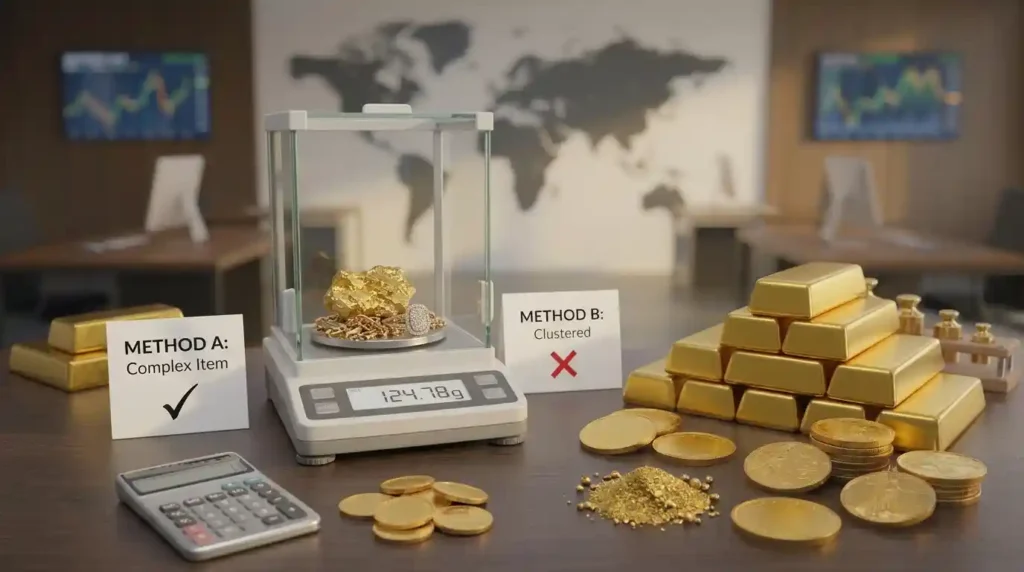
Picture a man in Portland who finds an old 14K bracelet in a drawer. He weighs it on a kitchen scale and checks the gold price online. The math says the bracelet is worth a lot. So he feels great. Then a local gold buyer offers far less. I have seen this story many times, and it comes down to common mistakes when calculating gold value. People use the wrong weight, purity, price unit, or selling price. This guide shows each error, the right formula, and how to compare a calculator guess with a real offer.
So why was the offer so low? Here are the usual reasons:
- The scale showed total jewelry weight, not just gold weight.
- The owner used a 24K spot price for 14K gold.
- The price was per troy ounce. But the math used regular ounces.
- The guess was a paper value, not a buyer’s cash offer.
Why Is Calculating Gold Value More Complicated Than It Looks?
Gold value is not just weight times today’s price. You need to know how much real gold is in the item. You also need to know which price fits it. Skip either one, and the answer drifts. Let us look at the pieces.
Think of baking a cake. You need the right flour, the right amount, and the right oven heat. Gold math works the same way. One wrong part spoils the whole thing.
Four Numbers You Need Before Calculating
Every good estimate starts with four inputs:
- Gold weight in grams, troy ounces, or another clear unit.
- Gold purity, such as 10K, 14K, 18K, or 22K.
- The current gold spot price.
- Any costs, premiums, or buyer cuts that apply.
Think of these as four keys. You need all four to open the lock. If one is wrong, the answer will be off. I check each one twice before I trust a result. For a full walk through, see our guide on how gold calculators work.
A fresh price is key too. Check live gold price sources on the day you plan to sell. Prices move, and an old figure can cost you.
The Difference Between Gold Melt Value and Selling Price
Many people mix up four prices. They are not the same.
- Melt value: The estimated market value of the pure gold content.
- Retail price: What a customer pays for a finished product.
- Scrap-gold offer: What a buyer offers for unwanted jewelry.
- Bullion resale price: The amount a dealer may pay for a qualifying bar or coin.
These numbers are not interchangeable. A gold necklace’s retail price pays for more than raw metal. It pays for design, labor, and store costs. A scrap buyer may offer less than the melt value. To see how the two differ, read gold price vs gold jewelry price.
Here is a simple way to see it. Say you buy a bracelet for $900 at a store. Later, a buyer offers $400. That is not a rip off by default. The store price had design and labor in it. The buyer’s price is for the metal. Still, read how to avoid gold buying scams so you can spot a bad deal.
Basic Gold Value Formula
Here is the core formula:
Gold value = Pure gold weight x Gold price per unit
Now find the pure gold weight:
Pure gold weight = Gold alloy weight x (Karat / 24)
This gives an estimated metal value. It is before buyer cuts, costs, or premiums. It is a starting point, not a final check. For more on weight based math, see how to calculate the value of gold by weight.
Keep the units the same. If the weight is in grams, the price must be per gram. If the weight is in troy ounces, the price must be per troy ounce. That one rule fixes many errors.
Mistake 1: Using Total Jewelry Weight Instead of Actual Gold Weight
This is one of the easiest ways to overstate a piece. A scale does not know which parts are gold. It just weighs everything. I fell for this once on a ring with a large stone. The number looked great. The real gold was far less.
Many sellers do this by habit. They put a piece on the scale and trust the number. It feels fast and neat. But it hides the stones, the glue, and the small parts. Slow down for one minute, and you will avoid the trap.
Why Gross Weight Can Give You the Wrong Result
Gross weight is the total weight on the scale. It may count more than gold:
- Gemstones.
- Enamel.
- Non-gold settings.
- Other parts.
A heavy stone can make a ring look more valuable than its gold suggests. Clasps, springs, and small parts may also have a different metal mix.
So do not treat total weight as gold alloy weight. That one habit causes more bad math than any other. Our guide to gold value by weight shows how the split changes the math.
Hollow pieces add one more twist. A hollow bangle looks big. Yet it holds less metal than a solid one of the same size. The scale shows the truth about weight. It does not show how the weight is spread.
How to Calculate Gold Weight Correctly
Follow four steps:
- Start with the total weight.
- Name the non-gold parts.
- Get a sound guess of the gold alloy weight.
- Use that weight in the purity math.
A buyer should separate the gold from the stones and other parts. The table below shows a made up case. It is not a claim about a standard ring.
Table 1: Gross Weight vs. Gold Weight: A Practical Example
| Item component | Weight |
|---|---|
| Total ring weight | 12.0 g |
| Gemstone and non-gold parts | 2.0 g |
| Gold alloy weight | 10.0 g |
| Gold purity | 18K |
| Pure gold content | 7.5 g |
The formula is:
10 x 18 / 24 = 7.5 g
Read the table as a story. The ring weighs 12 grams. Two grams are not gold. Ten grams are gold alloy. Of those ten, only 7.5 grams are pure gold. See how the number shrinks at each step?
What to Do When You Cannot Separate the Components
Sometimes you cannot tell how much the stones weigh. Do not guess by eye. That leads to errors.
- Ask a jeweler or gold buyer to assess the non-gold parts.
- Ask for a breakdown of the tested gold weight and purity.
- Think about outside testing for costly pieces.
Stones are hard to judge from looks alone. A small stone in a deep setting can weigh more than you expect. A big stone can be light. A pro has the tools to check. It is a small step that can save you from a big gap.
If a buyer will not explain the test, find another buyer. A fair one shows the screen or the scale. Ask to watch the weighing. You have every right to see it.
Mistake 2: Confusing Karat With Gold Purity Percentage
The karat number is not the percent. Typing 18 where 75% belongs can wreck the answer. So can treating 14K as pure gold. Let us fix both.
Here is a trick I use. I say the karat out loud as a fraction. 18K is 18 out of 24. That sounds like three quarters, and it is. That tiny habit has saved me from many slips.
What 10K, 14K, 18K, and 22K Actually Mean
Karat counts gold parts out of 24. So 18K means 18 parts gold and six parts other metals. Use this formula to get the percent:
Gold purity (%) = Karat / 24 x 100
The FTC uses the same idea. Its consumer page on buying jewelry says 18K is 18 parts gold and six parts other metals. It says 14K is 14 parts gold and ten parts other metals. If you want more on the math, read how gold purity is calculated.
A higher karat means more gold and a softer metal. A lower karat means less gold and a tougher metal. Neither is wrong. They just fit other needs. A ring you wear daily may do well at 14K. A special piece may suit 18K.
Common Karat Conversion Errors
Watch for these slips:
- Treating 18K as 18% gold.
- Treating 14K as 100% gold.
- Assuming every 24K item is exactly 100.000% pure.
- Mixing up karat (K) with carat, the gem weight unit.
Carat and karat sound alike. They are not alike. Carat is for stone weight. Karat is for gold purity.
Table 2: Gold Karat Conversion Chart
Use this chart as a quick guide when you use a calculator. It matches the FTC’s plain wording on parts of gold.
| Karat | Gold purity percentage | Other metals |
|---|---|---|
| 10K | 41.67% | 58.33% |
| 14K | 58.33% | 41.67% |
| 18K | 75.00% | 25.00% |
| 22K | 91.67% | 8.33% |
| 24K | 100% nominal | 0% nominal |
Note: Real fineness may be stated in parts per thousand. If a product has a documented fineness, use it.
Pure gold has no perfect label. Even a 24K item may be 99.9% or 99.99% pure, based on the product. So if you have a bar or coin, read its stated fineness. It will beat a rough rule.
Mistake 3: Using the Wrong Gold Price
The price on a finance site is a market guide. It is not a promise for your ring or your coin. Treat it as a starting line, not a finish line.
There are many quotes on the web. Some show the spot price. Some show a store price. Some show a buy price. Know which one you see before you use it.
Confusing Spot Price With Retail Gold Price
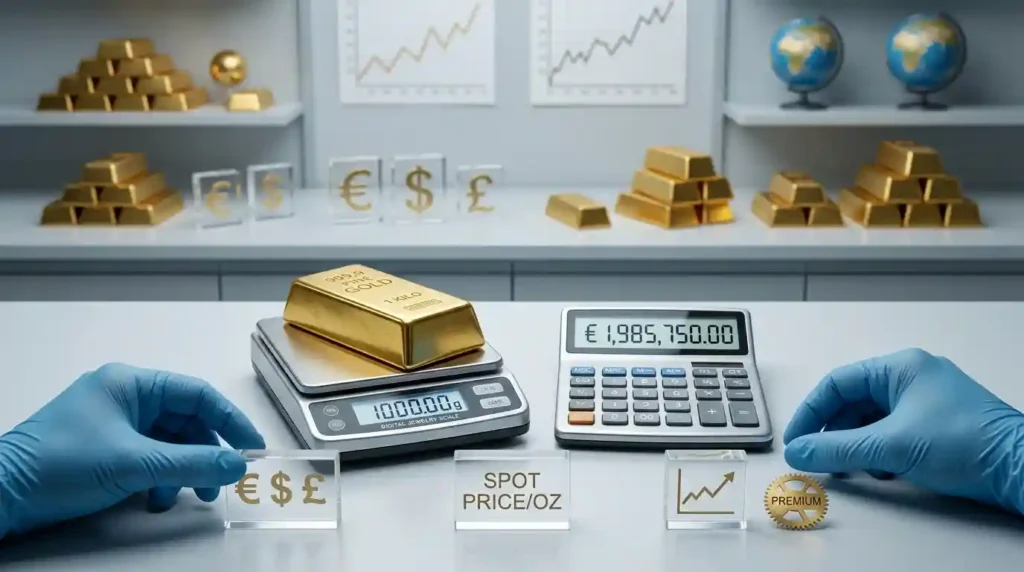
Spot price and retail price ask different things.
- Spot price is a market guide for gold.
- Retail jewelry prices include design, labor, and seller costs.
- Bullion prices can include a dealer premium.
- Scrap buyers may offer less than spot value.
The CFTC defines spot price as the cash price for immediate delivery of the metal. That is raw metal, not a finished ring. For the full story, read how the price of gold is calculated.
One more check. Do not use the price on a jewelry ad as your gold price. That price has labor and profit in it. If you want a view of how rings are priced, see our guide on gold price vs gold jewelry price.
Using Yesterday’s Price or an Outdated Quote
Gold prices move during market hours. A saved screenshot can go stale fast. An old news story can too.
- Check the date, time, and currency on the quote.
- Check if the price is per gram or per troy ounce.
- Do not mix quotes from two different days.
To see why prices shift so much, read why gold prices change every day. And see our list of gold price data sources for places to check.
Here is a habit that helps. Write down the price and the time on paper. Then, when a buyer quotes you, you can compare like with like.
Ignoring Bid Price and Ask Price
Two prices exist at any moment. The bid price is what a buyer will pay. The ask price is what a seller wants.
The bid is lower than the ask. The gap is the dealer’s spread. The CFTC says a dealer sells above spot and buys back below spot. It also says each dealer sets its own spread. So it pays to shop around.
This is why buying and selling gold can feel lopsided. You buy at the higher price. You sell at the lower one. The CFTC also tells you to check the actual weight and price, and to ask about buy-back terms and fees.
Plain words help here. Think of a used car lot. The lot buys your car for less than it sells the same car. Gold dealers work in the same way. The gap pays their costs and profit.
Mistake 4: Mixing Up Troy Ounces and Regular Ounces
This small slip can cause a big error. Gold markets use troy ounces. Groceries use regular ounces. They are not the same.
Why does gold use troy ounces? It is an old system that markets still use. You do not need to know its full history. You only need to know it is not the same as a kitchen ounce.
What Is a Troy Ounce?
Here are the key facts:
- One troy ounce is about 31.1035 grams.
- One regular (avoirdupois) ounce is about 28.3495 grams.
- The two units are not interchangeable.
- Gold spot prices are often quoted in U.S. dollars per troy ounce.
A troy ounce is about 10% heavier than a regular ounce. Mix them up, and your value is off by that much. That is real money on a big piece. Learn more in our guide to gold value per ounce.
A quick tip. If your scale shows ounces, check if it means troy or regular. Most kitchen scales show regular ounces. Switch to grams to be safe. Grams are the same everywhere.
How to Convert Gold Price Per Troy Ounce to Price Per Gram
Use this formula:
Price per gram = Price per troy ounce / 31.1034768
Here is a made up case. Say gold is quoted at $3,000 per troy ounce:
$3,000 / 31.1034768 = about $96.45 per gram
This is an example to teach the math. It is not a live quote. For more steps, see how to calculate gold price per gram.
Why not just use the ounce price? You can. But grams are easier for small pieces. Most jewelry weighs only a few grams. A per gram price lets you multiply with no extra steps.
Why Pennyweight Can Cause Confusion
A pennyweight is a small troy unit. One troy ounce equals 20 pennyweights. Some U.S. gold buyers quote prices per pennyweight.
That can trip you up. A price per pennyweight looks small next to a price per ounce. They are not wrong. They just use a new unit.
Always ask which unit a buyer uses. Never compare a per gram quote with a per pennyweight quote until you convert them. NIST lists the factors for troy ounces, grams, and pennyweights. Our grams, ounces, and pennyweights guide puts them in plain words.
Say a buyer offers $60 per pennyweight. Divide by 1.5552 to get the price per gram. That is about $38.58 per gram. A pennyweight is about 1.5552 grams. Since 31.1035 grams divided by 20 is 1.5552.
Mistake 5: Forgetting to Account for Gold Purity Before Applying the Price
Using the 24K price on the full weight of a 14K or 18K item overstates the gold. You are paying for metal that is not gold. I see this mistake more than any other with new sellers.
Let us make it easy. Pure gold weight is the only weight that gets the gold price. Everything else is just carrying cost.
Why the Spot Price Is Usually a Pure-Gold Reference
The market price is for gold itself. It is not a price for alloys. Jewelry alloys hold gold plus other metals.
So you must find the gold content first. Only then do you apply the pure gold price. Skip that step, and you price the copper and silver as if it were gold. That is where the gap comes from.
The CFTC describes spot price as a cash price for the metal. It is not set for an 18K ring or a 10K chain. So you must scale the weight to match the price. Our guide on how to calculate gold value by weight shows the steps.
A Simple 14K Gold Value Example
Here is a made up case:
- Gold alloy weight: 10 grams.
- Purity: 14K.
- Made up pure gold price: $100 per gram.
First, find the pure gold:
10 x 14 / 24 = 5.833 g
Then find the metal value:
5.833 x $100 = about $583.33
This is a melt value guess. It is before fees, spreads, or other cuts. Compare that with $1,000 if you had used all 10 grams. The gap is big.
Try it with 18K too. Take the same 10 grams. Multiply by 18 and divide by 24. You get 7.5 grams. At $100 per gram, that is $750. So the jump from 14K to 18K adds about $167 here.
How to Avoid Double-Adjusting for Purity
You can also err the other way. Do not cut the weight by karat and then cut it again.
- Do not shrink the weight by karat and then apply a second purity discount.
- Do not use a price already tuned for 14K and then multiply by 14/24 again.
- Check if the calculator wants pure gold weight or total alloy weight.
Read the labels on each field. A tool that asks for “pure gold weight” has done the karat step for you. A tool that asks for “alloy weight” will do it for you. Mix them up, and you pay the purity tax twice.
A quick test can help. Run your math two ways. Then compare. If the two answers do not match, one of them has a slip. Find it before you act.
Mistake 6: Assuming Melt Value Equals the Cash Offer
Your calculator shows one number. A buyer offers another. That does not mean the tool is broken. It means the two numbers ask different things.
Think of melt value as a ceiling. Few buyers pay all of it. Most keep a share for costs and profit. That is how the trade works.
What Is a Gold Buyer’s Payout Percentage?
A buyer may pay less than the melt value. The gap can cover:
- Refining.
- Testing.
- Handling.
- Business costs.
Buyers use their own rates. So do not treat one payout rate as a rule for all. I never quote a fixed percent, because it varies by buyer, place, and day. The best move is to ask each buyer how they set the offer.
Be careful with pushy buyers. Read our guides on how to avoid gold buying scams and gold valuation scams.
If one buyer offers far less than the rest, step back. If one offers far more, also step back. Both can be red flags. A fair offer tends to sit in a sane range.
Forgetting Dealer Fees and the Buy-Sell Spread
Fees can eat a lot of your return. Ask about each one:
- Testing, refining, shipping, and insurance charges.
- The buy-back price for bullion.
- The amount you get after all cuts.
The CFTC says to get all fees, costs, and commissions in writing before you sign. It also says that if fees are not offered in writing, that is a red flag. That advice is aimed at bullion buyers. But it fits any gold deal.
The CFTC also says to ask how much you would get if you sold the metal back tomorrow. That one question shows the true cost of a deal. It works for bars, coins, and even a plan to sell later.
Comparing Offers the Wrong Way
Many people compare the wrong things. Fix that with four rules:
- Compare offers for the same weight and purity.
- Check that every buyer uses the same price unit.
- Compare the final cash paid, not the ad rate.
- Ask if stones or other parts are in the quoted weight.
One buyer may show a high rate but take big fees. Another may show a lower rate and take none. The final cash tells the truth. To see where to shop, see the cheapest place to buy gold in the USA.
Table 3: Melt Value vs. Buyer Offer vs. Retail Price
Three prices can describe the same item. Yet each answers a different question. A buyer’s offer is not the value of the gold. It is also not the price at the store.
| Price type | What it means | What to remember |
|---|---|---|
| Melt value | Estimated value of the gold content | Before transaction deductions |
| Scrap-gold offer | Buyer’s cash offer | May be below melt value |
| Retail price | Price charged for finished jewelry | Includes more than gold content |
| Bullion dealer buy-back | Dealer’s purchase price for bullion | Check spread and conditions |
Write each offer on a card. List the rate, the cuts, and the final cash. Then sort them. The best one is the one that gives you the most cash for the same gold.
Mistake 7: Trusting a Hallmark Without Checking the Item
A stamp is useful. But it is not a magic promise. Not every part of a piece has to match the stamp.
A stamp helps you start. But it is only the start. I treat each stamp like a name tag at a party. It tells me who someone claims to be. It does not prove it.
What a Gold Hallmark Can Tell You
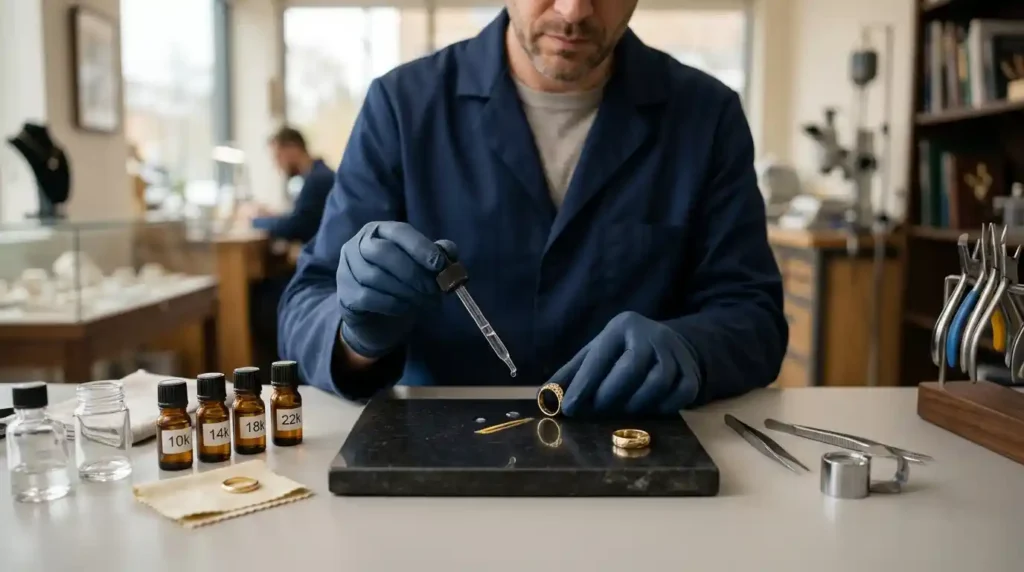
Marks like 10K, 14K, 18K, and 22K tell you the claimed gold share. Look for a maker’s mark too. It may show who made the piece.
Treat a hallmark as a first check. It is a clue, not final proof. Some marks wear off. Some are fake. And some parts of a piece may have no mark at all. For a deeper look, read our guide for first-time gold buyers.
A common case is a chain with a 14K stamp and a clasp with no mark. The clasp could be another metal. Test both.
Gold-Plated and Gold-Filled Jewelry Confusion
Solid gold, gold-filled, and gold-plated items are not the same.
- Solid gold is gold alloy all the way through.
- Gold-filled has a thicker gold layer bonded to a base metal.
- Gold-plated has a thin gold coat over another metal.
Plating can wear away. A gold color does not prove a piece is solid gold. So never type a plated item’s total weight into a solid gold calculator. The FTC’s Jewelry Guides cover how these items should be described. You can read the final rule in the Federal Register.
Look for marks like GP, GF, or HGE. They can point to plating or filling. A mark such as “18K GP” does not mean 18K solid gold. It means an 18K plate on a base metal.
When to Get a Professional Gold Test
Get a test in these cases:
- The hallmark is missing or unclear.
- The piece has repairs or mixed parts.
- The result will affect a high value sale.
- A buyer’s test is far from what you expect.
A test is cheap next to a bad sale. If you are unsure, ask for it. A good buyer will not mind.
A test can use X-rays or other tools. Ask which one the tester uses. Ask where on the piece they test. More than one spot gives a better picture.
Mistake 8: Using a Gold Calculator Without Checking Its Inputs
A calculator can do perfect math and still give a wrong answer. It trusts what you type. If the facts are wrong, the result is wrong. This is the old rule: bad data in, bad data out.
A tool is only a helper. You are still the driver. Take a minute to check each field before you press a button.
Entering the Wrong Weight Unit
Check which unit you use. It could be grams, troy ounces, or pennyweights.
- Do not assume every tool uses grams.
- Confirm the unit on your scale before you type.
- Keep the unit the same from start to end.
I have seen a kitchen scale set to ounces. The owner typed the number as grams. The result was off by a factor of about 28. Look at the little unit label first.
One more tip. Many tools let you pick a unit from a list. Look at the list each time. A tool may reset to a default after a refresh.
Selecting the Wrong Karat
Karat is the next common slip.
- Check the stamp or test result.
- Do not guess from color.
- If purity is unknown, test the item first.
Color can fool you. Rose gold, yellow gold, and white gold can all share one karat. Many look very different. So a color tells you little about purity. See our overview of purity math for more.
If a piece has no stamp, do not pick a karat at random. Get a test. Or use the lowest karat as a safe guide while you wait.
Forgetting What the Calculator Actually Estimates
Not every tool does the same job. Ask these questions:
- Does it show melt value?
- Does it estimate a scrap gold payout?
- Does it include a dealer discount?
- Does it use a live price or one you type in?
A tool that shows melt value is not a quote. A tool that includes a dealer discount is not melt value. Know which one you use. Then compare it to the right number.
Look for a note near the result. It should say what the number means. If it does not, ask the site, or use another tool. Clear labels are a sign of care.
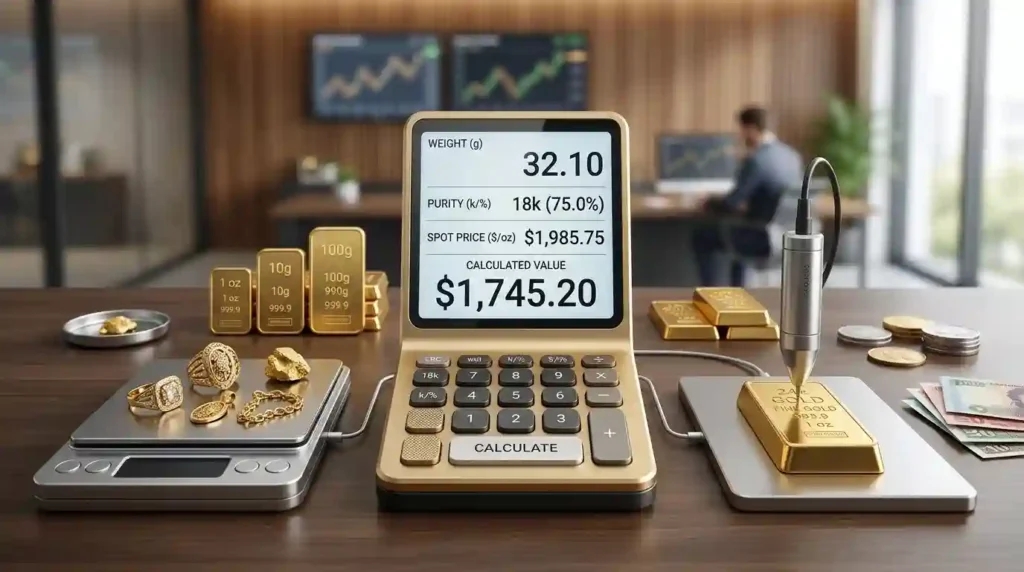
A Better Way to Use a Gold Value Calculator
Use this short checklist each time:
- Confirm the gold alloy weight.
- Pick the right weight unit.
- Enter the checked karat or fineness.
- Check the gold price and its time stamp.
- Review the pure gold weight it shows.
- Treat the result as a guess, not a promised offer.
Try our free gold value calculator with this checklist at hand. It takes about a minute.
Table 4: Gold Value Calculation Mistakes and Their Fixes
Save this table before you visit a local buyer or compare online offers. It sums up the main errors and how to fix each one. Think of it as a pocket guide.
| Common mistake | Why it causes trouble | How to fix it |
|---|---|---|
| Using gross jewelry weight | Counts stones and other materials | Use gold-alloy weight |
| Treating 14K as pure gold | Overstates gold content | Apply 14/24 |
| Using regular ounces | Wrong weight conversion | Use troy ounces |
| Applying an old spot price | Estimate may be outdated | Check the current quote |
| Ignoring dealer spread | Overestimates cash received | Compare buy-back offers |
| Trusting a stamp alone | May miss repairs or plating | Verify when needed |
| Entering the wrong unit | Produces a faulty result | Check calculator settings |
Run the math by hand once. Then run it in the tool. If the two match, you can trust the tool. If they do not, check each input. For tool tips, read how gold calculators work.
A Step-by-Step Way to Calculate Gold Value Correctly
This is the process you can follow at home. Use it before you sell a piece or compare a dealer’s quote. Go in order. Do not skip a step.
Keep a pen and paper close. Six short steps will take you from a scale reading to a fair price check.
Weigh the Gold Item (Step 1)
Use a good digital scale. Record the weight in grams.
- Note if the reading includes stones or other parts.
- Keep the unit in your notes.
- Weigh the piece twice and compare.
Small scales can drift. A second reading helps you catch a slip. Write the numbers down. So you do not rely on memory.
If you can, weigh each part on its own. Weigh the chain, then the pendant. Small parts show up this way.
Confirm the Gold Purity (Step 2)
Next, find the karat.
- Check the hallmark.
- Review any receipt or certificate.
- Get a pro test if purity is unsure.
- Do not assume every part has the same karat.
A clasp may be one karat. The chain may be another. If you are unsure, ask the tester to check each part.
Old gold is the hardest. Marks fade with time. Repairs add new metal. When in doubt, test. For more on this, read what first-time gold buyers should check.
Check the Current Gold Price (Step 3)
Use a reliable market quote.
- Confirm the currency and the unit.
- Check if it is per gram or per troy ounce.
- Note the date and time.
Change to per gram if your weight is in grams. Use the formula from Mistake 4. Then you can multiply with no unit mix up.
A quote with no time is a weak quote. Look for a time stamp. Use the same price all through your math.
Calculate Pure Gold Weight (Step 4)
Use this formula:
Pure gold weight = Gold alloy weight x (Karat / 24)
Say you have 15 grams of 18K gold alloy. Then 15 x 18 / 24 equals 11.25 grams of pure gold. Keep two decimals, and round only at the end.
Check your answer. The pure gold weight must be less than the alloy weight. If it is more, you made a slip.
Calculate Estimated Melt Value (Step 5)
Use this formula:
Melt value = Pure gold weight x Price per gram
Take our 11.25 grams and a made up $100 per gram. The melt value is $1,125. That is a guess before any buyer cuts. It is a top line, not a check.
Write the answer with a note. Say that it is a guess, and say which price you used. Then you can see how the number changes when the price moves.
Compare Actual Offers (Step 6)
Now go shopping for offers.
- Get more than one when you can.
- Ask for the tested weight and purity.
- Ask for a written list of cuts.
- Compare the final cash amount, not just the rate.
Hold your math next to each offer. If one is far lower, ask why. The answer often shows a fee you can avoid.
Take your time. Selling gold is not a race. A day or two of checking can pay off. For more tips, browse our gold guides.
U.S. Expert Guidance and Reliable Gold Value References
Good advice needs good sources. Here are three U.S. agencies I trust. A calculator guess is not a formal appraisal. It is not a promised sale price either. I did not invent any expert quotes. Each point below is a short paraphrase of public guidance.
Each agency has a clear role. NIST covers units. The FTC covers how sellers talk about gold. The CFTC covers prices and fees.
NIST: Precious Metals Weight and Unit Conversions
The National Institute of Standards and Technology keeps weights and measures facts. Its page on precious metals conversion lists the units used in gold sales.
Use it to check one key fact. One troy ounce equals 31.1034768 grams. Use it for the troy ounce, gram, and pennyweight links too. Right units are the base of right math. So double check them each time.
Use these facts to build your own check sheet. Write down 31.1034768 grams per troy ounce, and 20 pennyweights per troy ounce. Keep it by your scale.
FTC: Understanding Gold Jewelry Marks
The Federal Trade Commission shares buyer tips on jewelry. Its buying jewelry page explains that karat marks show gold content.
The FTC also oversees the Jewelry Guides. These guides cover how sellers should describe gold items, including plated and filled ones. Read each tag and listing with care. Ask the seller to clarify any word you do not know.
If a tag or listing is vague, ask. Words like “gold tone” or “gold look” do not mean solid gold. Ask the seller to say plainly what the item is.
CFTC: Understanding Spot Price, Premiums, and Fees
The CFTC and FINRA wrote a customer advisory on buying physical gold, silver, or other metals. It aims at bullion and gold IRA fraud. Yet its core advice helps any buyer or seller.
It explains spot price and dealer spread. It tells you to ask for all fees in writing. It says to multiply the weight by the spot price and compare that to the retail price. It also tells you to ask for the dealer’s buy-back price.
If you plan to invest, also read how to invest in gold for beginners.
This agency also warns about high spreads. Some frauds charge huge ones. The lesson for you is to compare. A fair deal holds up when you check it.
Frequently Asked Questions About Common Gold Value Calculation Mistakes
These short answers cover what readers ask most. Each one points back to the longer steps above.
What Is the Most Common Mistake When Calculating Gold Value?
The most common mistake is using total jewelry weight with no check for purity or non-gold parts. The right math needs the gold alloy weight and the karat. Then you apply the price.
In my view, this one beats all the rest. Fix it first.
How Do I Calculate the Value of 14K Gold?
Multiply the gold alloy weight by 14/24 to find the pure gold weight. Then multiply that by the current pure gold price in the same weight unit. For 10 grams, that is 5.833 grams of gold.
At a made up $100 per gram, that is about $583.
Is Gold Value Based on Gross Weight or Net Weight?
For jewelry, use the weight of the gold alloy, not the gross weight. Take out stones and other non-gold parts if they are in the weight you measured.
Net gold alloy weight is the one to use.
Is a Troy Ounce the Same as a Regular Ounce?
No. A troy ounce is about 31.1035 grams. A regular ounce is about 28.3495 grams. Gold prices usually use troy ounces.
Use grams to be safe.
Why Is a Gold Buyer’s Offer Lower Than the Calculator Value?
A calculator often shows melt value. A buyer may cut costs or apply a spread. So the final offer can be lower. Ask the buyer to explain each cut.
Compare at least two buyers.
Does a Gold Calculator Show the Exact Selling Price?
No. It gives a guess from the facts you enter. The real price depends on verified weight, purity, market price, and the buyer’s terms.
Treat it as a guide.
Should I Use the Spot Price or the Retail Gold Price?
For a basic metal value, use the spot price for pure gold. Retail prices include design, labor, and other costs. So they are not the same thing.
Spot price fits metal value best.
Can I Calculate Gold Value Without Knowing Its Purity?
You can only get a rough guess. For a firm estimate, get the item tested or find proof of its fineness. See our guide to gold calculators for more.
Final Recommendation
I have checked many pieces and many quotes. The pattern is clear: the common mistakes when calculating gold value are all small, and all fixable. Use the right weight, the right karat, the right price unit, and the right price type. Then compare your math with real offers, not just one. If you want to know more about my work, visit my author page. And for more clear guides, browse the gold blog.
Calculate Your Gold Value With the Right Numbers
Check weight, purity, price unit, and the current market price before you trust any number. A calculator guess is a starting point. Use it to compare offers, not to settle one. Try our gold value calculator to run the math. If you need to check your inputs first, use our gold purity calculator and the weights and units guide to convert your numbers.