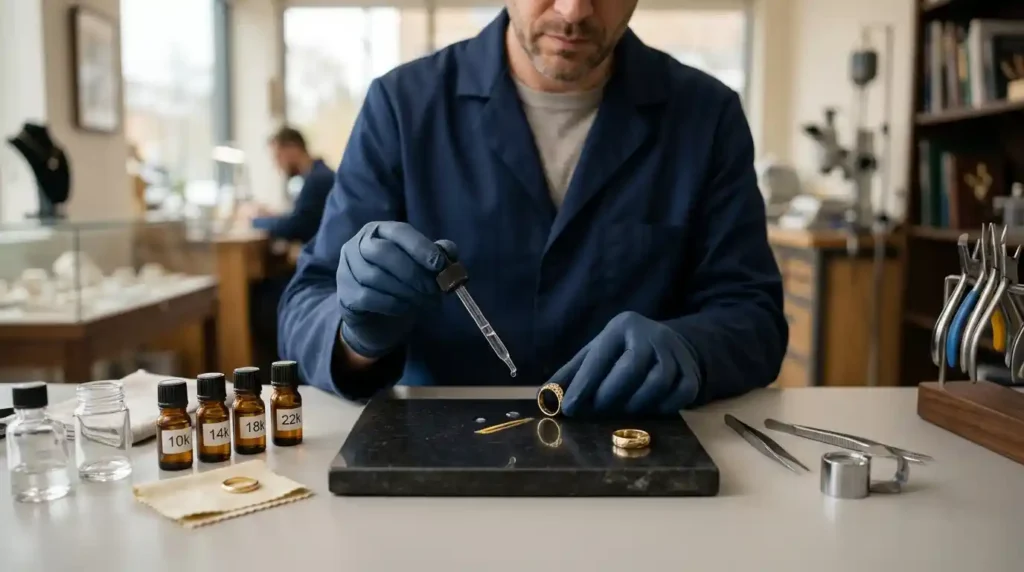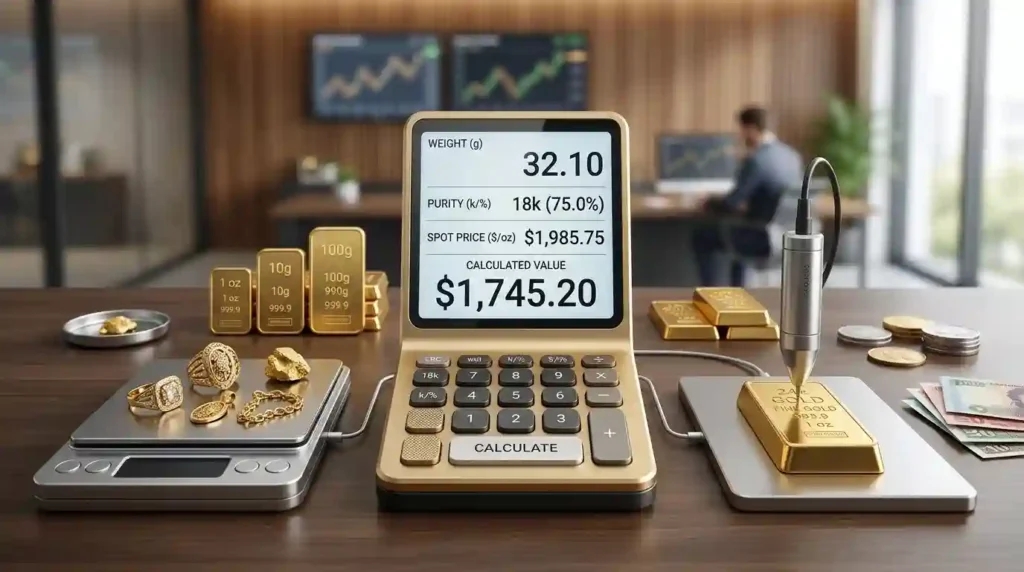
Imagine you find your grandmother’s gold ring in a jewelry box in Seattle. It looks dull, and the color seems a bit off. You wonder: can gold purity change over time, and is it still 18K? I have held many old rings like this. The short answer is no, not by age alone. Solid gold does not drop in karat as the years pass. But plating can wear off. Repairs can add other metal. Tests can differ by method and spot. Let us sort out which one you face. A gold purity calculator can then check the math.
Here is what we will cover:
- Solid gold and why its karat stays put.
- Gold-plated pieces and how the coating wears.
- Repairs, soldering, and mixed metals.
- Why a test can give a new result.
- How to use a gold purity calculator to read karat values.
Does Gold Purity Actually Change Over Time?
Here is the key point. The age of a gold item does not change its karat rating. How the piece is built matters far more. So does what has happened to it. I use this rule each time someone shows me an old ring.
Take an 18K ring bought ten years ago. It does not turn into 14K just because it was worn for a decade. The gold share stays the same. What can change is the surface, or the parts around it.
Think of a cake with 18 parts flour and 6 parts sugar. Leave it on the shelf, and the mix stays the same. Gold alloy acts in much the same way.
Why Solid Gold Does Not Normally Lose Its Purity
Gold jewelry is usually an alloy. That means gold is mixed with other metals. Pure gold is soft. So makers add metals like copper or silver to make it strong.
The karat number shows the share of gold in that mix. Wear and air do not turn 18K into 14K. Gold also resists most things in daily life. It does not rust. It does not melt away in a sweaty hand.
Dents, scratches, and dull spots do not prove a lower karat either. They only show use. Want the full math behind karat marks? Read how gold purity is calculated.
I once held a ring that was worn every day for forty years. It was thin and soft at the edges. Yet a test showed the same karat as the stamp. The ring lost size, not karat. That is the story for most solid gold.
What 24K, 22K, 18K, and 14K Mean
Karat tells you how many parts out of 24 are gold. So you can turn any karat into a percent with one formula:
Gold purity (%) = Karat / 24 x 100
The table below shows standard karat values. The FTC says 18K is 18 parts gold and six parts other metals. It says 14K is 14 parts gold and ten parts other metals. You can read that on the FTC consumer page on buying jewelry.
Table 1: Gold Karat and Gold Purity Percentage
| Gold karat | Gold content | Other metals |
|---|---|---|
| 24K | 99.9% or near-pure gold, depending on standard | Very little |
| 22K | 91.67% | 8.33% |
| 18K | 75% | 25% |
| 14K | 58.33% | 41.67% |
| 10K | 41.67% | 58.33% |
Note: 24K is the usual name for pure gold. Real fineness can vary by product and standard.
Read the table by rows. A higher karat means more gold and less of other metals. It also means softer metal and a deeper yellow color. A lower karat means a tougher piece with a paler look. Neither one is wrong. Each has its place.
Does Old Gold Have the Same Karat as New Gold?
Yes, it can. An old 14K ring can stay 14K for a hundred years. Age alone does not raise or lower the gold share.
But old pieces have a long life. Some got repairs. Some got new parts. A new clasp may not match the old alloy. So the ring may be 14K. A fix may not be.
An old hallmark is a useful clue. Still, do not treat it as proof for every part. New to this? See what first-time gold buyers should check before you buy or sell an old piece.
Some old pieces carry marks from makers who are long gone. Those marks can still help a tester. Photograph them. Even a faint stamp can point you to the right karat. Our karat to percent steps will help you read them.
Can Gold Jewelry Lose Purity Through Everyday Wear?
Many searches start here. A ring or chain looks off after years of use. People worry the gold itself has changed. Let us look at what really happens.
Short answer: not in the way most people fear. Let us take each worry in turn.
What Happens When Solid Gold Jewelry Gets Scratched?
A scratch moves or removes a tiny bit of metal. That is all. The metal left behind is the same alloy as before. So the karat does not change.
Heavy wear can cut a piece’s weight over the years. Think of the thin spot on the inside of an old band. That is lost metal. It is not a change in percent.
Here is the difference. Losing material means less gold in grams. Changing karat means a new gold share. Scratches do the first one. They do not do the second. See how weight and karat link in our guide to calculating the value of gold by weight.
Picture a bar of soap. Use it for a year, and it gets smaller. It is still the same soap. A gold ring wears the same way. It just does so far more slowly.
Can Sweat, Soap, Perfume, and Water Affect Gold Purity?
Normal sweat, soap, and water do not change the karat of solid gold. You can wash your hands without worry.
But some things can harm the other metals in an alloy. They can also harm finishes and parts that are not gold.
- Perfume and lotion can leave residue.
- Harsh cleaners can dull a finish.
- Chlorine can damage gold alloys under some conditions.
My tip is simple. Take off your rings before you swim in a chlorine pool. Do the same before you use strong cleaners. It costs you nothing, and it protects solder joints and settings.
Salt water and pool water are two more cases. Salt water is fine for solid gold. But rinse it off after. Pool chlorine is the one to avoid. Dry it with a soft cloth. Store it apart from other pieces. That stops scratches.
Why Does Gold Jewelry Change Color With Age?
Color change is common. Here are the usual causes:
- Dirt and product buildup on the surface.
- Tarnish or corrosion of the alloy metals.
- Rhodium plating wearing off white gold.
- Gold plating wearing thin.
- Polishing that changes the look of the surface.
- Other metals showing up as a coating wears away.
Now the key point. A color change is not a reliable karat test. A dull 18K ring can look worse than a bright plated one. Never judge karat by eye alone.
White gold deserves a special note. Many white gold rings have a thin rhodium coat. Over time, that coat wears and the warmer tone of the gold shows. The ring did not lose gold. It lost a coat. A jeweler can re-coat it.
Can Gold Plating Wear Off and Change the Apparent Purity?
Gold-plated pieces are not the same as solid gold. They have a thin layer of gold over another metal. So wear can change how the surface looks. It can also change what a surface test sees.
The word apparent matters here. The piece looks changed. But the base metal was always the same. Plating just hid it for a while.
What Happens When Gold Plating Wears Away?
Plating is a thin gold coat on top of a base metal. Think of it like paint on a wall. Rub it enough, and the wall shows through.
Friction does the work. Rings, bracelets, necklaces, and watch bands all rub on skin and clothes. Common wear points include:
- The underside of a ring.
- The edges of a bracelet.
- Necklace clasps.
- Spots where a watch band touches your wrist.
As the layer thins, the base metal shows. It may look gray, pink, or brassy. That is the color of what lies under the gold. The base metal never turns into gold. It was always there.
How fast does it wear? It depends on the coat and on how you use the piece. A ring takes more abuse than an earring. So a ring will show wear first. A piece you wear daily shows wear sooner.
Does Gold-Plated Jewelry Become Less Pure Over Time?
In a way, yes. But not like solid gold. The coat gets thin or vanishes in worn spots. The metal under it does not become gold. It stays what it was.
So treat a plated piece as plated. It may have looked like gold at first. Do not call it solid gold. Four terms come up a lot:
- Gold-plated: a thin gold coat over another metal.
- Gold-filled: a thicker gold layer bonded to a base metal.
- Gold overlay: a gold layer applied over a base metal.
- Solid gold: gold alloy all the way through.
The Jewelry Guides from the FTC cover how sellers should describe these items. For one, the final rule keeps a 1/20 weight guide for “gold filled.” Read it in the Federal Register.
Table 2: Solid Gold vs. Gold-Plated vs. Gold-Filled Jewelry
Words on a tag affect value. The FTC separates gold alloy items from items with a gold surface coating. This table shows how each type tends to age.
| Jewelry type | Construction | What can happen over time? |
|---|---|---|
| Solid 14K gold | 14K gold alloy throughout | Scratches and wear, but no automatic karat loss |
| Solid 18K gold | 18K gold alloy throughout | Surface wear without automatic purity change |
| Gold-plated | Thin gold coating over another metal | Coating can wear away |
| Gold-filled | Mechanically bonded gold-alloy layer | Layer can wear, but is generally thicker than ordinary plating |
| Gold vermeil | Gold plating over sterling silver | Gold layer can wear and reveal silver beneath |
Plated items sold as solid gold are a classic trick. Learn the signs in how to avoid gold buying scams.
How to Recognize Worn Gold Plating
You can spot clues at home. Use good light and a small magnifier if you have one.
- Look for a different color under the surface.
- Check edges and high friction spots.
- Look for uneven color near clasps and joints.
Do not rely on looks alone. A clean, bright piece can still be plated. A tired, dull piece can still be solid. A pro may need to inspect it. That is a fair step for any piece you care about.
One more test is a magnet. Real gold is not magnetic. But some base metals are. A magnet is not proof. Many fake pieces are not magnetic. Still, a strong pull is a red flag worth a closer look.
Can Jewelry Repairs or Mixing Metals Change Gold Purity?
A piece can leave a workshop with a new mix in one spot. That is a big reason old or fixed items give odd test results. The gold did not fade. A part of the piece was just made with something else.
Think of repairs as small edits to a story. Most are fine. A few change the facts. Let us see which ones matter.
Can Soldering Affect Gold Purity?
Solder is a metal that joins two parts. Jewelers melt it into a seam. It must melt at a lower heat than the piece. So its mix often differs from the main alloy.
That means a solder joint can test unlike the rest of the piece. You may see this on chains, rings, and clasps. A fixed link in a chain is a common case.
None of this means a jeweler did bad work. It is normal craft. But it is smart to ask what was used in a repair.
Good jewelers pick a solder close to the karat of the piece. That keeps the color and gold share near the same. Ask them about it. Their answer tells you how much care they take.
Does Ring Resizing Change Its Gold Content?
Resizing often adds or removes metal. To make a ring bigger, a jeweler may add a small piece. To make it smaller, they cut out a section.
The new metal may not match the old alloy. A repaired section can then give a new result. The rest of the band is still the same as before.
I always say the same thing. Ask the jeweler which metal and karat they used. Ask for it in writing. Keep the repair receipt with the ring. That one page can save you a long debate later.
Cutting a ring smaller removes gold. Adding a piece to make it bigger adds metal. So the weight changes. That matters if you plan to sell by weight. Write down the weight before and after, if you can.
Does Combining Different Gold Karats Change Purity?
Yes. Melting or mixing gold of two karats gives a new gold share. Here is a simple case. Mix 14K and 18K gold, and you do not get 18K. You get something in between.
The final purity depends on how much of each gold you use. It also depends on what each one holds. Math decides the outcome. Hope does not.
Do not confuse this with refining. Refiners use special steps to separate metals. Normal repairs do not do that. A repair may mix metals. But it does not purify them.
A quick example helps. Melt 10 grams of 14K with 10 grams of 18K. The result is about 16K, since the two sit midway. The math is a weighted average. That is why you cannot guess the outcome by eye.
What About Jewelry With Multiple Components?
Many pieces have more than one part. Chains, clasps, jump rings, and trim may not share one alloy. A single stamp may not describe each part.
So test the main body first. Then test any part that looks odd. A clasp that looks brighter or darker than the chain is worth a check.
Think of a watch. The case, the band, and the clasp may all be made in many ways. Gold jewelry can work the same way.
This also matters when you sell. A buyer may test only the chain. The clasp may carry its own karat. Ask them to test each part. So you get a fair offer for the whole piece.
Why Can a Gold Purity Test Give Different Results Over Time?
Sometimes the gold has not changed at all. The method, the test spot, and the build can explain the gap. That is good news for most people.
Two tests a year apart may not match. That does not mean the gold changed. It may mean the testers used new tools or new spots.
How XRF Gold Testing Works
XRF stands for X-ray fluorescence. A handheld device sends X-rays at the metal. The metal then sends back its own signal. The device reads that signal to find which elements are there.
Jewelers and gold buyers like XRF for a few reasons:
- It is fast.
- It does not harm the piece.
- It lists the metals it finds.
But it reads only the area it touches. That fact will matter in the next part.
A good tester also checks the device. They scan a known sample first. That step is called calibration. It keeps readings steady. Ask if the shop does it each day.
Why Surface Testing Can Be Misleading
A surface test checks the top of the metal. If the top is not like what lies below, the result can mislead you.
- A plated surface may test differently from the metal under it.
- One small spot may not show the whole item.
- Solder, coatings, and mixed builds can shift a reading.
GIA explains that gold plating can change XRF results. It notes that some plating on 10K gold can make it read as 14K or 18K. You can read the details in the GIA lab note on gold-plated gold.
For that reason, a pro may test several spots. They may also use a microscope or another method. If your reading changed, ask where on the piece it was taken.
Learn how scams use this gap in our guide to gold valuation scams.
Other Methods Used to Check Gold Purity
There is more than one way to test gold:
- Acid or touchstone testing.
- Fire assay.
- XRF analysis.
- A close look at stamps and build.
Each method has strengths and limits. GIA ran a study by Meredith Mercer. It compared fire assay, touchstone, density, and XRF. You can read it in the GIA paper on methods for determining gold content. It shows that no single method fits every case.
Be careful with home acid kits. They can give a rough guide. But not a sure or exact result.
Table 3: Gold Purity Testing Methods Compared
Think of this from a buyer’s side. A quick screen, a no-harm check, and a firm answer are three needs. Pick yours. The best test depends on which one you want.
| Testing method | Main advantage | Limitation |
|---|---|---|
| XRF testing | Fast and generally nondestructive | Surface and calibration limitations |
| Acid testing | Useful for basic karat comparison | May mark or damage the tested area |
| Fire assay | Established quantitative assay method | Destructive and requires specialist equipment |
| Hallmark inspection | Quick first check | A stamp alone cannot prove current composition |
Fire assay is the classic lab method. A small sample is melted and measured. It is very exact. But it harms the sample. So it fits bars and scrap more than a treasured ring.
How to Check Whether Your Gold Purity Has Changed
Use the four steps below. They work for an old ring, a chain, or a gift you inherited. Follow them before you sell, repair, or value a piece.
Take your time. A calm, slow check beats a rushed one. You do not need fancy tools for the first two steps.
Check the Hallmark or Karat Stamp (Step 1)
Look for a stamp. Common ones are 10K, 14K, 18K, 22K, and 24K. You may also see numbers like 585 or 750. Look inside the band, on the clasp, or on a small tag.
Also look for a maker’s mark. It may be a name or a logo.
A stamp is a good place to start. It is not final proof. Some stamps wear off with time. Some are fake. Treat the stamp as a clue.
If you plan to buy, use this buyer checklist for first-time gold buyers. It covers stamps and more.
Inspect the Jewelry for Wear or Repairs (Step 2)
Now look at the piece with care. Check edges, clasps, joints, and seams. Look for exposed base metal or uneven color.
Note any past repairs or resizing. A thick seam on a ring can point to a repair. A clasp that does not match the chain can too.
Write down what you see. A short note helps a tester later. Take a photo in good light as well.
A small loupe helps a lot. A 10x loupe costs little. Hold it close to your eye. Bring the ring up to it. You will see seams, pits, and worn spots.
Get a Professional Gold Purity Test (Step 3)
Next, see a trusted jeweler or tester. Ask these things:
- Do you use XRF or another method?
- Did you test more than one area?
- Did you note the plating or repairs I told you about?
Tell the tester what you know. Share any plating, repairs, or mixed parts. If the piece has real resale value, get the result in writing.
Pick a tester with a clear process. Ask how long they have used the tool. Ask if they will explain the reading. A good one will teach you as they go.
Compare the Result With the Original Karat Mark (Step 4)
Now compare the test with the stamp. Say the ring is stamped 18K, and the test says 17.6K. A small gap is not proof of fraud. Tests have limits.
If the result is a big surprise, ask for a second test. Try a new spot or a new method. For a high value item or a dispute, think about an outside assay.
Stay calm. Most gaps have a plain reason.
Keep in mind that makers have small allowed gaps in karat. A reading a little under the stamp may be normal. A big drop, like 18K to 10K, needs a second look.
How a Gold Purity Calculator Helps You Understand Gold Content
Once you know the karat, a calculator turns it into a percent. Then you can guess gold content and value. Our guide on how gold calculators work shows what each tool does.
Think of the calculator as a pocket helper. It is fast and clear. But it needs good facts to work well.
Convert Gold Karat Into Purity Percentage
Use this formula:
Gold purity = Karat / 24 x 100
Here is an example:
18 / 24 x 100 = 75%
So an 18K gold alloy holds 75% gold by weight. A 14K piece holds about 58.33%. Try the math with our gold purity calculator in a few seconds.
Here is a quick table in your head. 24K is 100%. 18K is 75%. 14K is about 58%. 10K is about 42%. Those four numbers size up most pieces at a glance.
Calculate Pure Gold Content From Jewelry Weight
Now use weight too. Here is the formula:
Pure gold weight = Gold alloy weight x (Karat / 24)
Here is a sample:
- Jewelry alloy weight: 10 grams.
- Karat: 18K.
- Pure gold content: 10 x 18 / 24 equals 7.5 grams.
This example assumes all 10 grams are gold alloy. Remove stones and other non-gold parts first. Then use the formula. For per gram math, see how to calculate gold price per gram.
Once you know pure gold weight, you can find worth. See how to calculate the value of gold by weight for the next step.
What a Gold Purity Calculator Cannot Tell You
A calculator is a math tool. It is not a lab. It cannot do these things:
- Physically test an item.
- Detect hidden plating or solder.
- Confirm that a hallmark is real.
- Fix a wrong karat or weight you type in.
It only works with the values you give it. A wrong input gives a wrong answer. That is why testing comes first.
Table 4: Example Gold Purity Calculator Results
These examples show one weight at four karat levels. The same 10 grams holds less or more pure gold each time. Use the table as a quick check on your own math.
| Gold weight | Karat | Gold purity | Pure gold content |
|---|---|---|---|
| 10 g | 14K | 58.33% | 5.83 g |
| 10 g | 18K | 75% | 7.50 g |
| 10 g | 22K | 91.67% | 9.17 g |
| 10 g | 24K | 100% nominal | 10.00 g |
Use the result as a guide, not a verdict. Add a real test, and the picture gets clear.
When Should You Have Old Gold Jewelry Tested?
Not every old ring needs a lab visit. But some cases are worth a pro check. Here are the main ones.
Think of a test as insurance. It costs a bit up front. It can save you much more later.
Before Selling Old or Inherited Gold
Check the karat before you take an offer. A buyer’s quick test may differ from yours. So compare more than one buyer.
Ask each buyer how they found the content and the price. A good buyer will show you. If not, walk away. Our guide on how the price of gold is calculated helps you check their math.
Also learn about common gold valuation scams before you sell.
Inherited gold can carry feelings too. Take your time. There is no rush to sell. For more selling tips, browse our gold guides.
After Jewelry Repairs or Resizing
A repair may add new metal. So check that area if the metal may differ. Keep the repair receipt and the metal details.
If value hangs on exact karat, get a test. This matters most for heirlooms and high value rings. A short test costs less than a wrong guess. For deal tips, read how to avoid gold buying scams.
If a shop did the work, ask for a note on the metal used. Put the note in a folder with the receipt. Years later, that folder may be the proof you need.
When the Jewelry Looks Different or Has Exposed Metal
First, tell tarnish from worn plating. Tarnish is a surface film. Worn plating shows a new color under the gold.
Next, find out what the piece is. Is it solid gold, gold-filled, or plated? If you cannot tell, ask a pro. Testing is the safe way to find out.
Also see gold price vs gold jewelry price to learn why looks and gold value differ.
A green mark on your skin can be a clue. It often points to a base metal, such as copper. It does not always mean the piece is fake. But it is worth a closer look.
U.S. Expert Advice and Reliable Gold Purity References
Good advice needs good sources. Here are two U.S. groups I trust for this topic. I did not make up any quotes. Each point comes from their public work.
Two names stand out for U.S. readers. One protects shoppers. The other tests and studies gems and metals.
What the Federal Trade Commission Says About Gold Quality
The FTC runs a consumer page on buying jewelry. It explains the karat mark. It also says pure gold is soft. So it is often mixed with other metals.
The FTC also enforces the Jewelry Guides. They also guide how plated and filled items are described. So the words on a tag matter. Does a listing say “gold” but not solid, filled, or plated? Ask before you buy.
In short, the FTC helps you read tags and marks. Use its page as a quick reference at the counter.
What the Gemological Institute of America Says About Testing
GIA is a respected U.S. gem lab. In 2025, GIA ran a lab note called “Gold-Plated Gold.” Carlos Bautista wrote it. He is an analytics technician at GIA in Carlsbad, California.
The note shows a pendant sold as 18K solid gold. The base tested 10K, and the top layer tested 18K. The report says the plating had “rubbed off due to use.” Wear changed what the buyer saw.
GIA also warns that XRF can fail when a piece is coated with the same element. That is why a microscope check matters too.
The takeaway is clear. A test is a tool, and tools have limits. A tester who checks the surface and the base gives you the best answer.
Practical Advice for U.S. Gold Buyers
After years of looking at old pieces, I keep to a few rules:
- Ask for the karat and the build type in writing.
- Keep receipts and repair records.
- Do not rely on color or one surface test.
- For costly pieces, get an outside assessment.
If gold is part of a bigger plan, read how to invest in gold for beginners. And for dealer terms, see the cheapest place to buy gold in the USA.
Keep a small folder for each valuable piece. Add the receipt, test result, repair notes, and photos. It takes ten minutes and helps for years.
Frequently Asked Questions About Gold Purity Over Time
Here are short answers to the questions I hear most. Each one links back to the deeper steps above.
Can 18K Gold Become 14K Over Time?
No. Aging and wear do not turn a uniform 18K alloy into 14K. Repairs, mixed metals, or a test on a new part may explain a low reading.
A test shows 14K on a ring stamped 18K? Look at the spot tested. It may be a repair.
Does 24K Gold Lose Purity?
Not just because it gets older. But mixing, dirt, or changes to the piece can alter what you hold.
Pure gold is the least likely metal to change. It does not react with air or water. The risk is mixing, not aging.
Can Sweat Reduce Gold Purity?
Normal sweat does not change the karat of solid gold. It can leave residue. It may affect some alloy metals or finishes.
Wipe your piece with a soft cloth after a workout. That keeps it clean.
Does Gold Tarnish Mean It Is Fake?
No. Tarnish or a dull look does not prove a piece is fake. Alloy metals, plating, and dirt all change how gold looks.
Solid gold itself does not tarnish. But the other metals in the alloy can darken at the surface. A quick clean often fixes it.
Does Gold-Plated Jewelry Become Less Gold Over Time?
Yes. The coating can wear off and show the metal under it. That does not mean solid gold lost its karat. It means the piece was never solid gold.
Can Cleaning Gold Jewelry Change Its Purity?
Normal cleaning does not change the karat of solid gold. Harsh chemicals or rough methods can harm finishes. Use mild soap and a soft cloth.
Skip toothpaste and baking soda scrubs. They can scratch the surface.
Can a Gold Purity Test Be Wrong?
Yes. Results depend on the method, the setup, and the test spot. Plating and solder can give a false reading. A second test can help.
Ask where on the piece the test was done.
Should I Test Old Gold Before Selling It?
Yes, most of all when the piece is costly, repaired, or unmarked. An outside test helps you compare offers. See gold price data sources and why gold prices change every day before you sell.
Final Recommendation
I have looked at many old rings, chains, and heirlooms. Here is what I tell anyone who asks, can gold purity change over time? Age alone does not lower the karat of solid gold. What fools people is plating wear, repairs, and test gaps. So read the stamp. Look for wear. Get a pro test when it counts. Then do the math yourself. Learn more about my work on my author page or in the gold blog.
Check Your Gold Purity Before You Estimate Its Value
Age alone does not lower the karat of solid gold. But plating wear, repairs, and test gaps can cause doubt. So verify the karat first, then work out the value. Use our gold purity calculator to turn karat into a percent. Then use our gold value calculator to guess worth by weight. Also learn gold value per ounce and the grams, ounces, and pennyweights behind it.