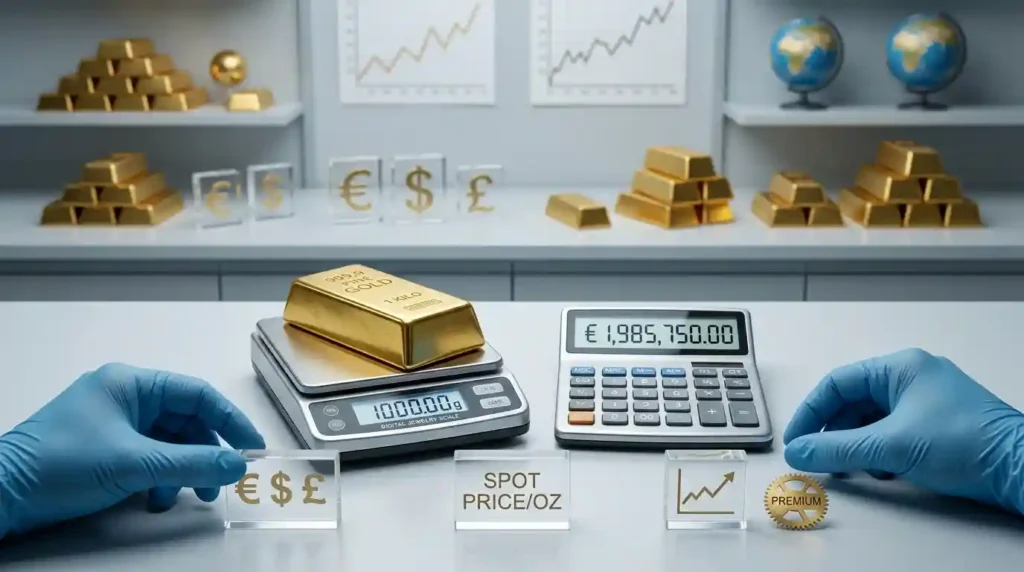
The gold price on your screen is almost never the price on your receipt. Picture a Tuesday morning in New York City. Someone checks gold online, then carries an old bracelet to a jewelry store. One site shows a price per troy ounce. Another shows a price per gram. The buyer offers a third number. So, how is the price of gold calculated? It happens in two steps. First, the market sets a base price. Second, that price turns into the value of one item, using weight, purity, currency, and dealer costs. Below, I give you a simple formula, worked examples, and a way to check any gold calculator. One fair warning first. Market value is not always what you pay for jewelry or get for scrap gold.
How Is the Market Price of Gold Determined?
Start with the market. The base price comes from huge numbers of trades around the world. No one sits at a desk and picks a number each morning. Let me show you what moves it.
Gold Supply and Demand
Gold prices follow supply and demand, like most traded goods. Supply comes from mine production and recycled gold. Demand comes from jewelry, investment, central banks, and technology. Investment demand includes bars, coins, and funds backed by gold.
In recent years, central banks have been large buyers. Their buying can shape market mood. Other buyers watch what national banks do. A shift in supply or demand can push the price up or down. A slowdown in mining can tighten supply. A drop in investor interest can ease demand.
Jewelry is a big piece of demand. Investors and central banks add more. Technology uses a small amount. Price also feeds back into supply. When prices climb, more people sell old jewelry. That adds recycled gold to the market. In that way, high prices can help ease the very tightness that caused them.
Inflation, Interest Rates, and the U.S. Dollar
Some investors turn to gold when the economy feels shaky. They see it as a store of value. Interest rates also matter. Gold pays no interest. So when rates rise, bonds and savings accounts can look better. That is the opportunity cost of holding gold.
The U.S. dollar plays a role too. Gold is usually quoted in dollars. A stronger dollar can make gold pricier for buyers who use other currencies. That can cool demand.
Here is the key point. No single factor always moves gold the same way. Analysts have seen gold rise even while the dollar stayed strong. Treat each factor as one piece of a bigger puzzle.
Economists often talk about real yields. That means interest rates after inflation. When real yields are low, gold’s lack of interest hurts less. When they are high, it hurts more. This is a helpful lens, not a rule.
Spot Gold Price vs. the LBMA Gold Price
The spot price is a market reference for gold traded for near-term delivery. It changes all day while markets are active.
The LBMA Gold Price is a benchmark. It is set in electronic auctions at 10:30 a.m. and 3:00 p.m. London time. The result is quoted in U.S. dollars per troy ounce. It covers gold delivered in London. ICE Benchmark Administration runs the auctions on its own, as the LBMA prices page explains.
The two are close relatives. But they are not the same thing. A benchmark is fixed twice a day. The spot price keeps moving.
How does the auction work? It runs in short rounds. Buyers and sellers place orders. The price settles when buy and sell interest balance. One more detail helps. LBMA prices are not published on weekends or UK bank holidays. So a benchmark you see on a Sunday is old news. I keep that in mind when I check a price late in the week.
Why Gold Prices Change Throughout the Day
Gold quotes can shift minute by minute during active trading. Big economic news can move them. So can currency swings and changes in investor demand.
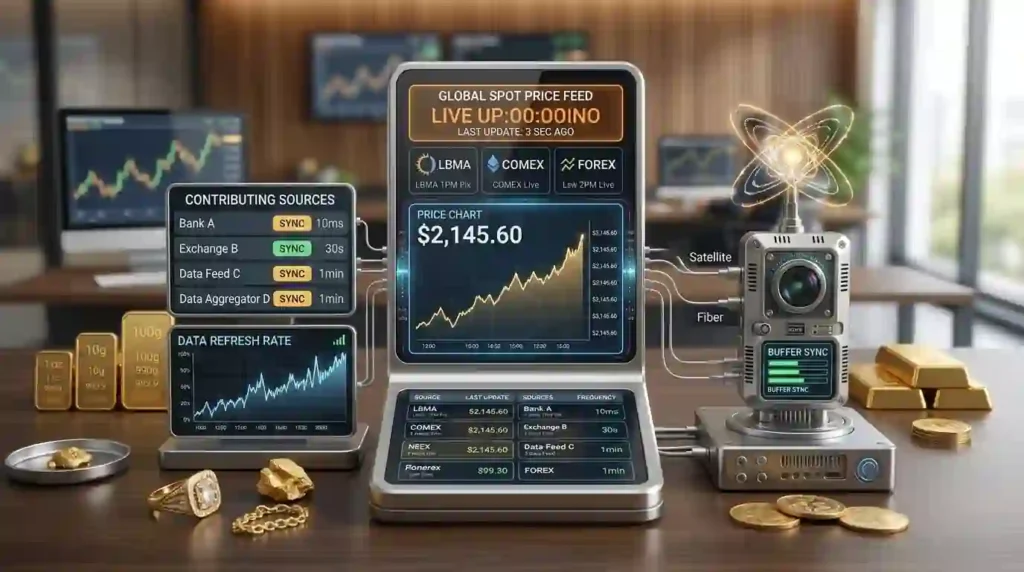
Also, the price you see may lag. Some websites show delayed data. Others refresh on a timer. That is why I always check the source and the time stamp. Our guide to gold price data sources and update times shows what to look for.
Here is a habit that helps. I note the time whenever I write down a price. A quote from 9 a.m. can look very different by lunch. If you plan to sell, the time of your quote matters. Ask the buyer which price they are using and when it was taken. That one question catches a lot of confusion.
What Formula Is Used to Calculate the Price of Gold?
Now for the math. The good news is that it is simple. You only need three steps. Convert the unit, apply purity, then multiply.
The Basic Gold Price Formula
Markets quote gold per troy ounce. Your scale likely reads grams. So you need a bridge. Here it is.
Gold Price per Gram = Gold Price per Troy Ounce ÷ 31.1035
One troy ounce equals about 31.1035 grams. That number is the key to every unit swap in this guide. Keep it handy.
Why divide? Because there are about 31 grams in each troy ounce. So the price of one ounce is spread across about 31 grams. Here is a quick check. Suppose gold is $3,000 per troy ounce. That is a made-up number. Divide by 31.1035 and you get about $96.45 per gram. If your answer looks far from that, you likely divided by the wrong number.
How to Calculate the Value of Pure Gold
Once you have a price per gram, you can value a piece of pure gold. Use this formula.
Gold Value = Weight × Purity Factor × Price per Unit of Pure Gold
The units must match. If your weight is in grams, use a price per gram. If your weight is in troy ounces, use a price per troy ounce. Mixing them is the top mistake I see. A gold calculator can handle the swap, but you should still know what it does.
Here is a short example. Say you hold 5 grams of 24K gold. Purity is 1.0. Use the made-up price of $96.45 per gram. The math is 5 × 1.0 × $96.45 = $482.25. For alloyed gold, the purity factor drops below 1.0. That one number is what separates pure gold from jewelry in the formula.
How to Calculate Gold Purity
Karat tells you how much of the item is gold. Pure gold is 24 karat. Use this formula.
Purity Factor = Karat ÷ 24
- 24K = 100 percent under the simple formula.
- 22K = about 91.67 percent.
- 18K = 75 percent.
- 14K = about 58.33 percent.
Real items can differ a little. A 14K piece is often stamped 585, which means 58.5 percent. Testing results and product specs may also change the assumed purity. See how gold purity is calculated for the testing side.
Try a quick example. A necklace weighs 20 grams and is marked 14K. Purity is 14 ÷ 24, or about 0.5833. Multiply 20 by 0.5833. You get about 11.67 grams of fine gold. The other 8.33 grams are alloy metals. Those carry no gold value. This step is the one people skip most often.
Why the Formula Is Only One Part of the Price
The formula gives you the value of the gold inside the item. That is all. It does not include craftsmanship, brand value, collector value, shipping, taxes, or dealer premiums.
So a calculator result is not a final price. It is an estimate of metal value. A real deal adds or subtracts costs on top. For a buyer, costs are added. For a seller, costs are deducted. Keep that gap in mind.
Here is what a calculator usually leaves out.
- Making charges and design work.
- Brand names and collector appeal.
- Shipping, insurance, and payment fees.
- Sales tax, which varies by state.
- Dealer premiums and margins.
Keep this list near your results. It explains most gaps between a calculator and a real quote. For more explainers like this, browse the Gold Calculator blog.
How to Calculate the Gold Price per Gram, Ounce, and Kilogram
Different sellers use different units. A bullion site may use ounces. A jewelry shop may use grams. This section helps you compare them fairly.
Convert Gold Price per Troy Ounce to Grams
Divide the price per troy ounce by 31.1035. Use the same currency from start to finish.
Do not swap in a regular ounce. A troy ounce is about 10 percent heavier than the everyday ounce you use in the kitchen. That small slip can throw off every number after it. Gold markets use the troy ounce, so you should too.
Here is a common slip. Some people divide by 28.35, the grams in a regular ounce. That makes the gram price too high. Use 31.1035 for gold. Another tip helps. After you divide, multiply back by 31.1035. You should land on the original price. It takes five seconds and catches typos.
Convert Gold Price per Gram to Kilograms
Multiply the price per gram by 1,000. A kilogram holds 1,000 grams.
This step changes the unit, not the market price. The gold is worth the same. You are only counting it in bigger chunks. Bar dealers often use kilograms, so this step comes up often.
Calculate Gold Price in U.S. Dollars
First, check what the source quotes. It might show U.S. dollars per troy ounce or per gram. If a source uses another currency, you need an exchange rate. Conversion spreads and timing can change the displayed result a little.
Table 1: Gold Price Unit Conversion Examples
Unit mix-ups are one of the easiest ways to get a misleading comparison. This table shows the arithmetic with a made-up price. It is not a current gold quote. Assume gold is $3,000 per troy ounce.
| Unit | Calculation | Illustrative price |
|---|---|---|
| Troy ounce | Given price | $3,000.00 |
| Gram | $3,000 ÷ 31.1035 | About $96.45 |
| 10 grams | $96.45 × 10 | About $964.50 |
| Kilogram | $96.45 × 1,000 | About $96,450 |
Values are rounded. For a real deal, use the same source price at full precision.
How Does Gold Purity Affect the Price?
Two pieces can weigh the same and still hold different amounts of gold. Purity is the reason. It is a major input in any gold value calculator.
What Do 24K, 22K, 18K, and 14K Mean?
Karat is a measure of gold content. The whole alloy has 24 parts. So 18K gold has 18 parts gold and six parts other metals. 14K has 14 parts gold and 10 parts other metals.
The FTC says the karat mark tells you how much pure gold a piece holds. It also notes that pure 24K gold is soft. That is why jewelers mix it with other metals for strength. Higher karat means more gold per gram.
How to Calculate the Value of 18K Gold
Let me walk through an example. The price is made up to keep the math easy.
- Weight: 10 grams.
- Purity: 18 ÷ 24 = 0.75.
- Hypothetical pure gold price: $100 per gram.
- Estimated metal value: 10 × 0.75 × $100 = $750.
That is your metal value before any fees or premiums. You can test other weights and karats with the gold calculator guide.
Now compare it with 14K. Use the same weight and price. Ten grams of 14K is 10 × 0.5833 × $100, or about $583.33. That is $166.67 less than the 18K piece. The weight did not change. Only the gold content did. This is why you should never guess the karat.
Why Hallmarks Need Careful Interpretation
You may see marks like 585, 750, or 916. They show the claimed fineness. 585 is about 14K. 750 is 18K. 916 is about 22K.
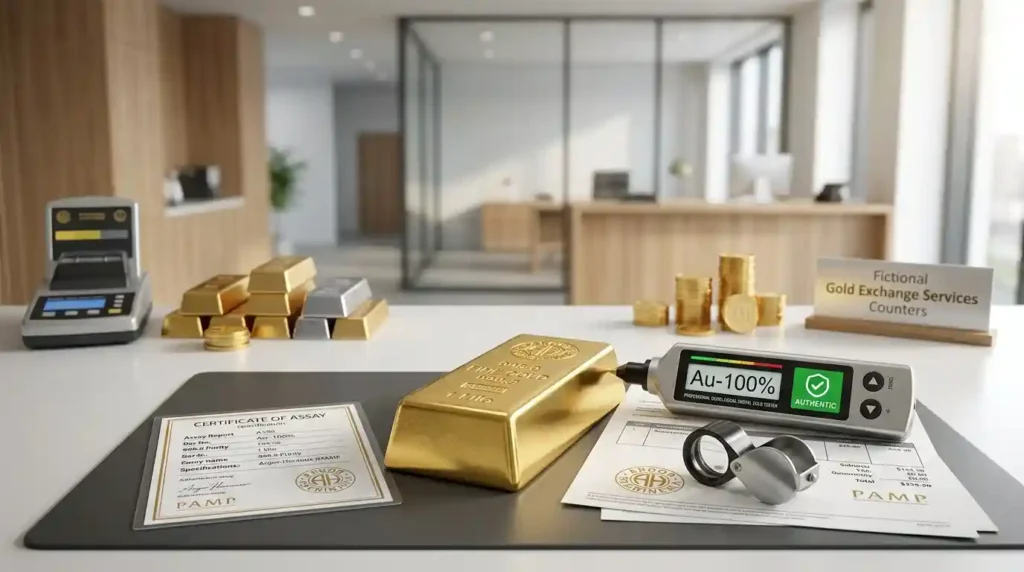
A hallmark is useful evidence. But it does not prove an item is genuine. The FTC advises that a karat mark should come with the maker’s trademark. If you are unsure, an independent test can help. This matters most on big deals. Our gold buying scams guide explains when to test.
Table 2: Gold Purity and Estimated Metal Value
Purity changes how much gold sits inside a given weight. This table uses one made-up price so you can see the effect of karat alone. Assume each item weighs 10 grams, with pure gold at $100 per gram.
| Gold type | Approximate purity | Estimated metal value |
|---|---|---|
| 24K | 100% | $1,000 |
| 22K | 91.67% | About $916.67 |
| 18K | 75% | $750 |
| 14K | 58.33% | About $583.33 |
| 10K | 41.67% | About $416.67 |
These are simple estimates before costs or premiums.
Why Is the Gold Price Different at Jewelry Stores?
Now let’s move from metal value to real store prices. This helps you avoid comparing two different things.
Gold Spot Price vs. Retail Jewelry Price
The spot price is for gold in the market. It is not the price of a finished ring or necklace. A store price may include labor, design, branding, rent, and other costs.
Gemstones and decorative work can add value too. But they may not add the same value when you sell. A buyer who wants scrap gold pays for metal, not for style.
Picture two 10-gram chains in 14K. One is plain. The other is from a famous designer. The metal value is the same. The store prices can be far apart. The difference is brand, design, and overhead. That gap is not a mistake. It is just not metal value. Know which price you are looking at.
Why Gold Buyers Offer Less Than the Estimated Metal Value
A buyer’s offer is usually below your estimated metal value. That is normal. Here are the usual reasons.
- Refining and processing costs.
- Testing, handling, and running costs.
- Dealer margin and resale risk.
- The condition and makeup of the item.
None of this is a scam by itself. The buyer should still explain the gap. If the buyer will not, read our gold buying scams guide before you sign anything.
My advice is to run your own number first. Enter your weight and karat using the steps in our gold calculators guide. Then ask the buyer what share of that value they are paying. A clear, fair answer is a good sign. A vague answer means you should compare other buyers.
What Is a Gold Premium?
A premium is the amount paid above a market reference price. Coins and bars often carry one. It can cover making the product, shipping it, and dealer costs.
Demand matters too. A popular coin may carry a bigger premium than a plain bar. Premiums vary by product and by market. So always ask what premium is built into a quote.
Here is a made-up example. Say spot gold is $3,000 per ounce. A one-ounce coin sells for $3,150. The extra $150 is the premium. That is 5 percent over spot. Premiums on coins can be higher or lower. Compare them across dealers. A low premium is not always better if the seller is not trustworthy.
Taxes, Shipping, and Other Transaction Costs
Sales tax rules differ by U.S. state and by product. Shipping, insurance, and payment fees may apply too. Compare the final cost, or your net proceeds, not the headline rate.
Ask for an itemized receipt. It should show the metal price, any premium, tax, and shipping as separate lines. That makes it easy to see where your money went.
Table 3: Gold Market Price vs. Actual Transaction Price
One gold price cannot answer every question. The right comparison depends on what you want. It might be raw metal, finished jewelry, bullion, or a dealer payout.
| Price type | What it represents | Factors that affect it |
|---|---|---|
| Spot price | Market reference for gold | Trading activity and market conditions |
| Melt value | Estimated value of gold content | Weight, purity, spot price |
| Retail jewelry price | Cost of finished jewelry | Craftsmanship, brand, overhead |
| Bullion purchase price | Cost to buy coins or bars | Spot price, premium, product demand |
| Dealer offer | Amount offered to the seller | Metal content, costs, margin, condition |
How Does a Gold Calculator Calculate Gold Value?
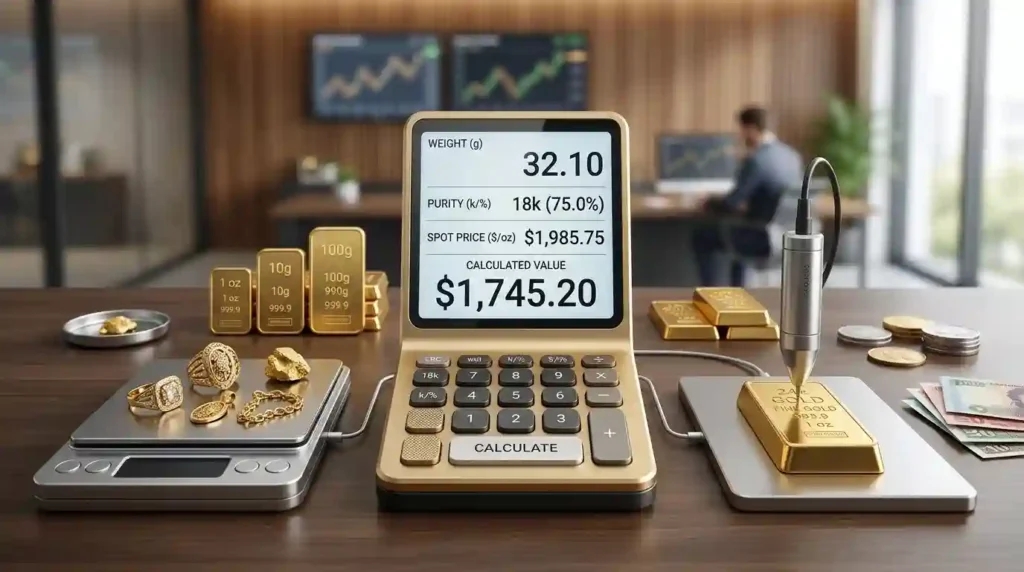
A calculator follows the same formulas you just learned. Your job is to feed it good inputs. Here is how I use one.
Step 1: Enter the Gold Weight
Enter the weight in grams, troy ounces, or another supported unit. Check that the unit is right. This is the most common slip.
If you know the weight of stones or other non-gold parts, leave them out of the gold weight. A diamond adds no metal value. Counting it as gold inflates your result.
Use a digital scale that reads to 0.01 gram. Place the item on it and wait for a steady reading. Weigh it twice. If the two numbers differ, weigh again. Small errors add up on heavy pieces. Write the weight down before you visit a buyer. Then run it through a gold calculator to see the metal value.
Step 2: Choose the Gold Purity
Pick the right karat or fineness. A 14K ring should be entered as 14K, not 18K. One wrong pick changes the result a lot.
If you do not know the purity, a calculator cannot find it from weight alone. Weight tells you nothing about karat. When accuracy matters, consider independent testing.
When You Do Not Know the Karat
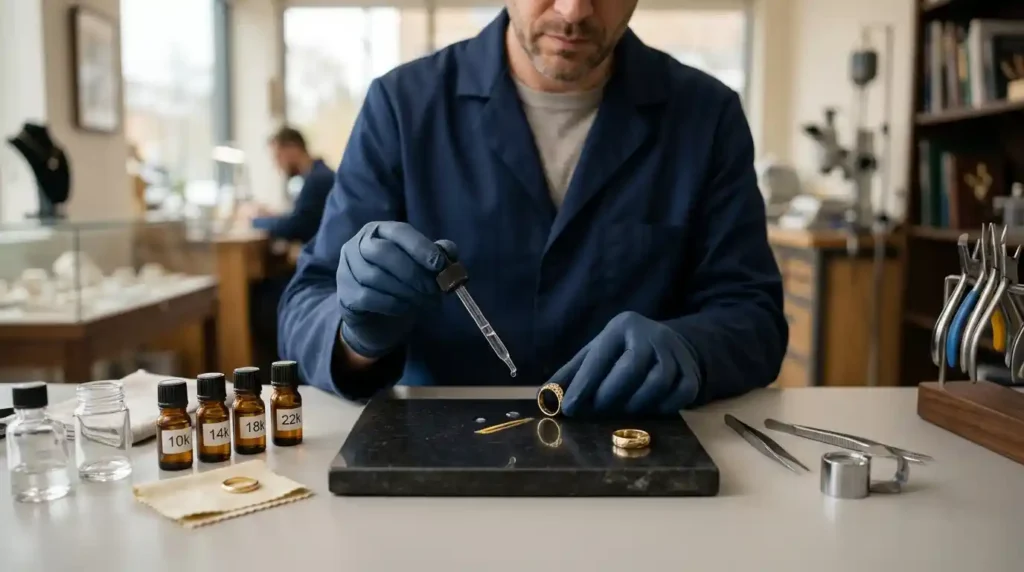
Look for a stamp first. Check the inside of a ring band or near the clasp of a chain. You may see 10K, 14K, 18K, 417, 585, or 750.
No stamp? Do not guess. Take the piece to a trusted jeweler for testing. Our gold purity testing guide explains common methods. Until you know the karat, treat any calculator result as a rough guess.
A word on home tests. A magnet can show that an item is not gold if it sticks. But gold does not stick, and many fakes do not stick either. So a magnet cannot prove purity. Other home tricks are not reliable either. When money is on the line, use a proper test.
Step 3: Check the Gold Price Input
Confirm the price per gram or per troy ounce. Check the currency and the time stamp. Then find out how the calculator gets its price. It may use a live feed, delayed data, or a price you enter yourself.
Each choice is fine if it is clear. A hidden delay is not fine. Read about how often gold price sources update to see why this matters.
Also check whether the tool uses a spot price or a benchmark. They are close but not identical. If the tool lets you type your own price, use a source you trust and note the time.
Step 4: Review the Estimated Value
Check the result against the formula. Look for stated assumptions, rounding, or deductions. Then ask one key question. Is this a metal value estimate, or a projected payout?
Those are different numbers. A metal value ignores dealer costs. A projected payout includes them. Most online tools show metal value, so treat the output as a starting point from a gold calculator.
Do a rough check in your head. Round the weight, purity, and price. Multiply the rounded numbers. If your quick answer is far from the tool’s answer, find the gap before you trust either.
A Full Worked Example in Four Inputs
Let’s run one together. The price is made up. It is not a current quote.
- Weight: 8 grams.
- Karat: 14K, so purity is 14 ÷ 24 = 0.5833.
- Price: $3,000 per troy ounce, or about $96.45 per gram.
- Fine gold: 8 × 0.5833 = about 4.67 grams.
Metal value: 4.67 × $96.45 = about $450. A buyer may offer less after costs. That gap is normal if it is explained.
Now flip it to the buyer’s side. If a buyer pays a share of that $450, the offer will be lower. Ask what share they use. Then compare it with other buyers. The share is the number that really changes your payout.
Common Gold Calculator Mistakes
Most errors are not hard math. They are small input slips. Watch for these.
- Entering a regular ounce instead of a troy ounce.
- Selecting the wrong karat.
- Using a stale market price.
- Mixing currencies.
- Treating melt value as a guaranteed dealer offer.
I double-check units first. It takes ten seconds and prevents most bad results.
A few more to watch. Do not count gold-plated items as solid gold. Plated items hold only a thin layer. Do not forget to remove the weight of stones. And do not trust a result with no date on the price. A stale input is the quiet killer of good math. See how gold price sources update to avoid it.
What Factors Make Gold Prices Rise or Fall?
Gold can move fast because several markets move at once. The table below gives a quick view. It also shows why no factor is a sure thing.
Table 4: Factors That Can Move Gold Prices
Reading this table helps you avoid a common trap. Many headlines claim one event always lifts or drops gold. The real picture is more mixed.
| Factor | How it may affect gold | Why it is not guaranteed |
|---|---|---|
| Inflation expectations | May raise interest in gold as a store of value | Rates and the dollar can outweigh it |
| Interest rates | Higher rates can raise the cost of holding gold | Other demand can offset the effect |
| U.S. dollar | A stronger dollar can make gold pricier abroad | Gold has risen in strong dollar periods |
| Central banks | Large buying can add demand | Buying can slow or reverse |
| Geopolitical risk | May lift safe haven demand | Gold can still fall in a crisis |
Inflation and Interest-Rate Expectations
When people expect prices to rise, some look at gold. They hope it holds value. Expected interest rates matter just as much. If rates are expected to climb, gold can lose some appeal. If rates are expected to fall, gold can gain some.
Do not assume inflation always lifts gold. It has not worked that way every time.
One more point. Markets price in what they expect, not just what has happened. So gold can move on a forecast before any data arrives.
U.S. Dollar Strength
Gold is commonly quoted in U.S. dollars. When the dollar strengthens, buyers in other currencies pay more. That can weigh on demand. When the dollar weakens, the reverse can happen.
The link is real but loose. Other forces can overpower it.
If you shop in a different currency, check the exchange rate on the day. A small swing in currency can change your price by more than you expect.
Central-Bank Demand and Investor Activity
Central banks can buy or sell gold. Their moves can change demand and sentiment together. Money flowing into funds backed by gold can also add demand. Money flowing out can reduce it.
These flows show what big players think. They do not guarantee where the price goes next.
Reports on central bank buying can arrive late. So the full picture often lags. Treat early headlines with care.
Geopolitical Risk and Market Uncertainty
In tense times, some investors seek gold as a safe place. That can lift demand. But gold can still fall during uncertain times. Investors sometimes sell gold to raise cash. So safe haven talk is a hint, not a promise.
Look at the size and speed of a move before you act. A sharp jump on breaking news can fade. I do not try to time the market. I focus on checking the price source and the final terms.
How to Check Whether a Gold Price Is Accurate
Before you trust a website or accept an offer, run a quick check. It takes only a few minutes.
Verify the Price Source
Look for a named data provider or benchmark. A real source tells you where the number comes from. Separate a market quote from a retailer’s own estimate. Then check whether the price is live, delayed, or historical.
Our guide to gold price data sources shows how to read these labels.
Ask three simple questions. Who publishes this number? How often does it refresh? Does it show a time? If a page answers none of them, treat the price as a rough guide only. Our guide to gold price data sources shows what good labeling looks like.
Check the Timestamp and Units
Confirm the date and time. Check the currency and the weight unit. A price per ounce is not a price per gram. If needed, convert the price yourself with the formula from earlier.
A stale number is easy to miss. The page may look fresh while the data is hours old.
One more point on time. LBMA benchmark prices are not published on weekends or UK bank holidays. So a benchmark label on a weekend page may be a few days old. Spot quotes behave differently. They update while markets are open. Know which type you are reading.
Compare With a Second Reference
Pull a second price from another source at about the same time. Compare like with like. Do not set a spot quote against a benchmark and call one wrong.
If the gap is large, investigate. Check units, time, and currency first. The cause is usually simple.
A simple routine works for me. Open two sources side by side. Note the time on each. Convert both to the same unit. If they still differ, check whether one is a spot quote and the other a benchmark.
Confirm the Final Transaction Terms
Ask for an itemized buy price or sell offer. Check premiums, fees, taxes, and deductions. Get the terms in writing before you commit.
For a trusted reference, see the World Gold Council’s gold price data. It explains that gold has a spot price, the LBMA Gold Price, and regional prices. It also quotes prices per troy ounce.
Keep a copy of the quote. If the final payment differs, you have proof of what was promised.
Expert Tips for Buying or Selling Gold in the United States
Now let’s turn the math into habits. A calculation helps you decide. It does not guarantee a fair deal.
Check Gold Jewelry Markings
Look for a karat mark. The FTC says that if you do not see the maker’s trademark beside it, do not buy the piece. That is strong advice from a primary source.
Read the FTC’s consumer guide to buying gold jewelry. If purity is unclear, ask for a test. A purity testing guide can help you prepare.
A real stamp often sits inside a ring band or near a clasp. Use a magnifier. If the stamp looks blurry or uneven, ask questions.
Compare More Than One Offer
Get written quotes from reputable buyers. Compare the net payout, not just the advertised rate. Ask how each buyer weighs, tests, and prices the item.
A high rate can hide big fees. A lower rate with no fees can win. See our gold buying scams guide for tricks to watch for.
Visit at least three buyers if the piece is valuable. Take the same weight and karat to each. Write down every offer with the date and time.
Be Careful With Investment Claims
Treat guaranteed returns as a warning sign. So is pressure to buy right now. Check premiums, storage fees, and buyback terms. Research the seller before you send any money.
Gold prices rise and fall. No honest seller can promise a profit.
If someone calls you out of the blue about gold, hang up. Look up the company on your own. For a deeper look at warning signs, our gold buying scams guide is a good next read.
Use a Gold Calculator as a Starting Point
Use it to estimate metal value and compare quotes. Do not use it to prove a piece is real. A calculator cannot tell you about rare or collector value.
If an item may have artistic, antique, or coin value, get a qualified appraisal. Start with a gold calculator, then check the details with a pro.
I treat the calculator result as my floor for questions, not my final answer. If an offer is far below it, I ask why. If it is near it, I still read the terms.
Frequently Asked Questions About Gold Price Calculation
Here are short answers to common follow-up questions.
How Is the Daily Gold Price Set?
Gold trades in global markets all day. Benchmarks like the LBMA Gold Price are set through scheduled auctions, at 10:30 a.m. and 3:00 p.m. London time.
Is the Spot Price the Same as the Price of Gold Jewelry?
No. Finished jewelry may include labor, design, branding, overhead, and other costs. The spot price covers only the metal reference.
How Do You Calculate the Price of Gold per Gram?
Divide the price per troy ounce by about 31.1035. The result is the price per gram. Use the same currency throughout.
Why Does a Gold Buyer Pay Less Than the Spot Price?
The buyer may deduct refining, handling, and running costs. They may also add a margin. The offer should still be clear. If it is not, see our gold buying scams guide.
How Much Is 18K Gold Worth per Gram?
Multiply the pure gold price per gram by 0.75. That gives a simple metal value for 18K. Real deals may differ.
Does a Gold Calculator Use Live Prices?
Some use live or near-real-time feeds. Others use delayed or manual prices. Check the source and the time stamp. Our page on gold price update times can help.
Is 24K Gold Always Worth More Than 18K Gold?
For the same weight and the same pure gold price, yes. 24K holds more gold. But finished items can also depend on design, condition, and more. Learn the basics in our gold purity guide.
Who Sets the Price of Gold?
No single person or government sets one worldwide price. Trading in global markets, plus benchmarks like the LBMA Gold Price, creates shared reference points. Local dealers then add their own costs.
What Is a Troy Ounce of Gold?
A troy ounce is the unit used in precious metals markets. It equals about 31.1035 grams. It is heavier than a regular ounce, so never swap them.
Try the Gold Calculator With Your Own Numbers
Now try it yourself. Enter your gold weight, purity, and market price. Check the unit and the time stamp. Then compare the result with your manual math and a written dealer offer. You can start with our gold calculator. Remember, the output is an estimate. It is not a guaranteed purchase or selling price.
Final Recommendation
I keep one habit when I look at gold prices. I separate the metal value from everything else attached to it. So, how is the price of gold calculated? Start with a market price per troy ounce, convert it to grams, and apply weight and purity. Then remember that jewelry, coins, and scrap all add costs or deductions on top. Always ask whether a quote is spot, benchmark, or retail before you compare it. You can learn more about me on my author page. You can also browse more gold purity and valuation guides or return to the home page. This guide is for education and is not financial advice.