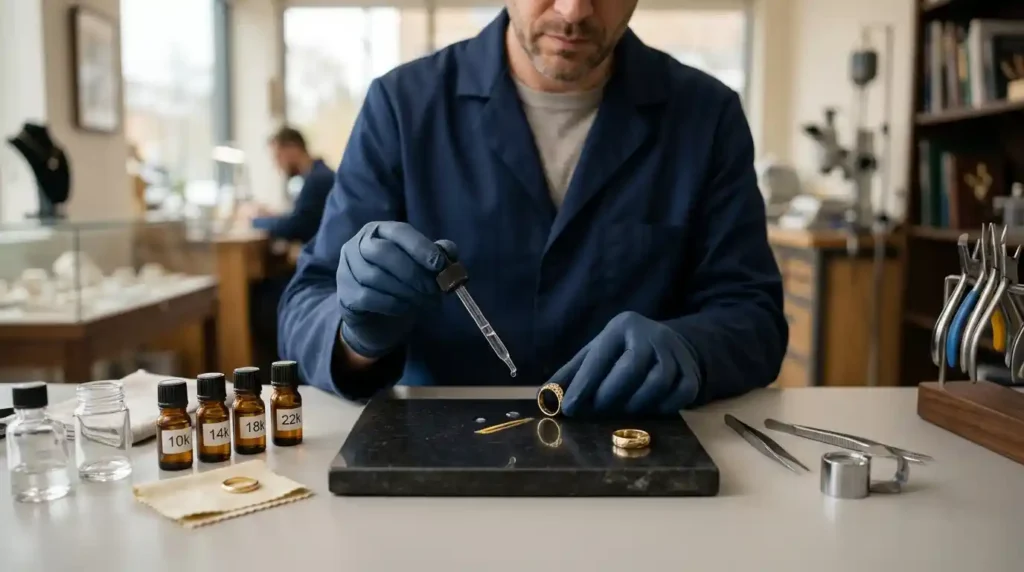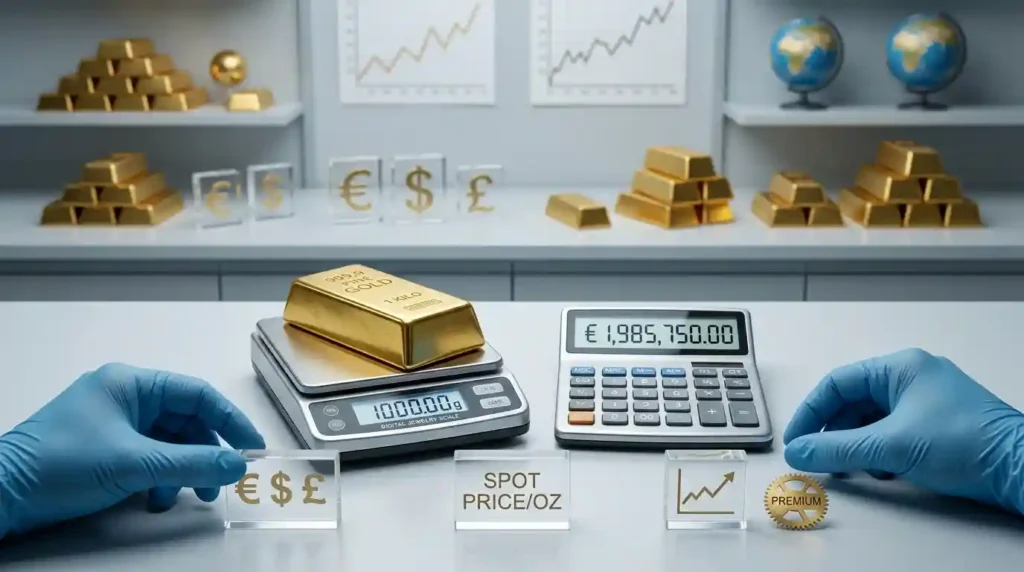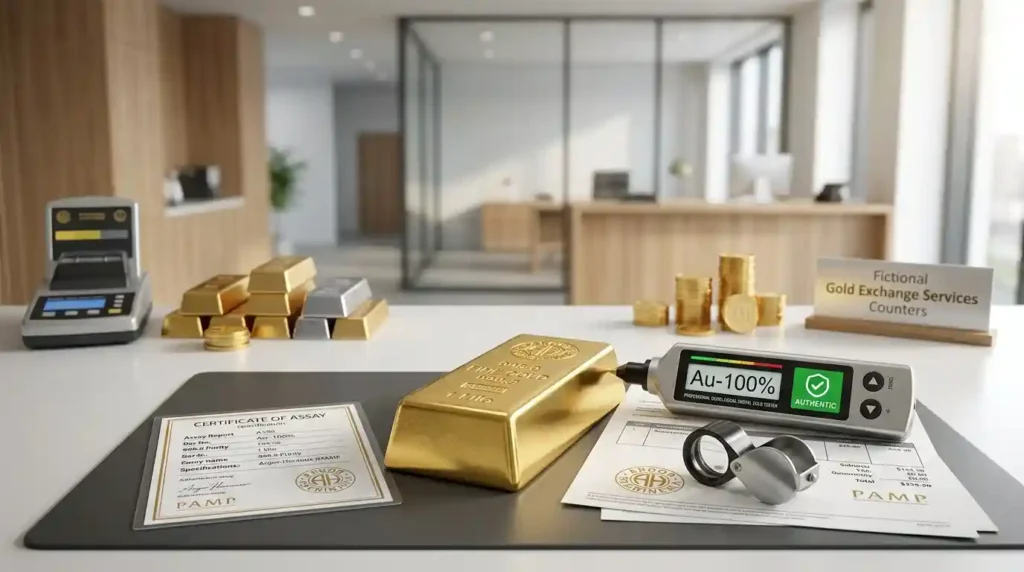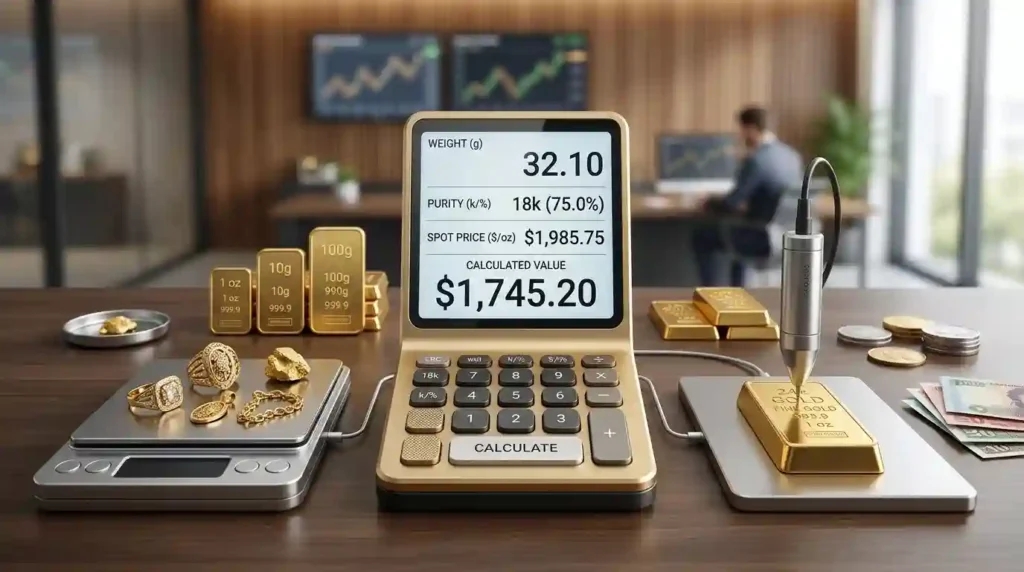
It is Saturday morning in Seattle, and you are checking an old gold chain before you visit a local gold buyer. One website lists a price per ounce. Another shows a price per gram. The buyer says the chain is 18-karat gold. So which number should you trust? I have faced this exact puzzle, and the good news is that the math is simple. Here is how to calculate gold value per ounce, step by step. The answer rests on four things: the current spot price, the weight of your item, its purity, and whether you want the metal value, a retail price, or a resale offer. I will share one clear formula, worked examples, and easy unit conversions. Please remember that every result is an estimate. It is not a guaranteed dealer offer.
What Does Gold Value Per Ounce Mean?
Before you do any math, learn the key terms. This keeps you from mixing up the market price of pure gold with the value of a piece of jewelry. They are not the same thing. I see this mix-up more than any other.
Let me share a quick story. A reader once told me a shop quoted her $1,800 for a chain. She felt cheated, because the spot price for an ounce looked higher. But the chain weighed far less than an ounce. It was also 14K. Once we ran the math together, the offer made sense. The shop was not tricking her. She had simply compared the wrong things.
Think of it like coffee beans and a latte. The beans have a market price. The latte at a cafe costs more. It includes labor, rent, and profit. Gold works the same way. The metal has one price. A finished item has another. For a deeper look at the second idea, read our guide on gold price vs. gold jewelry price.
What Is the Gold Spot Price?
The spot price is the current market reference price for gold. It is usually quoted per troy ounce in U.S. dollars. It changes as the market trades.
Websites may show slightly different spot prices. Why? Data timing, market feeds, and delayed quotes can all play a role. So always check the time stamp. Our post on gold price data sources and update times explains these gaps.
A spot quote is also not the price you pay for a coin. It is not the price you receive for scrap jewelry either. Dealers add premiums when they sell. They take deductions when they buy. So the spot price is a starting point, not a final price.
I treat the spot price like a thermometer. It tells me the temperature of the market. It does not tell me what I will pay or receive. For that, I need weight, purity, and a real quote. Keep this picture in mind and you will avoid most beginner mistakes.
What Is a Troy Ounce of Gold?
A troy ounce is the unit used in precious metals trading. It is not the same as the standard U.S. ounce you use in the kitchen. The troy ounce is heavier.
Here is the exact conversion. One troy ounce equals 31.1034768 grams. A standard U.S. ounce is about 28.3495 grams. Do not use 28.3495 when you convert a spot price quoted per troy ounce. That slip can cost you real money.
Let us see how much. Say you use 28.3495 for an item that really needs 31.1034768. Your result will be off by about 9.7%. On a $2,000 piece, that is nearly $200. A tiny slip in a conversion factor becomes a big gap in dollars. Always double-check the factor before you press equals.
The National Institute of Standards and Technology, or NIST, is a trusted source for precious metal conversion facts. I check my numbers against it.
Is One Ounce of Jewelry the Same as One Ounce of Pure Gold?
No. This point trips up many people. The total weight of a gold alloy is not the weight of the pure gold inside it. Other metals make up the rest.
Stones, clasps, solder, and other non-gold parts also change the value. Here is a quick example. An item that weighs one troy ounce and is made from 18K gold holds only 0.75 troy ounces of pure gold. So it holds less than one ounce of pure gold. Always separate the total weight from the gold content.
One more tip on weight. Jewelry scales show total weight, not gold weight. A ring with a large stone may weigh 8 grams in all. The gold may be only 5 grams. If you count all 8 grams, you will overstate the value. Ask the jeweler for the stone weight, or use a trusted estimate. To learn how purity is tested, read how gold purity is calculated.
How to Calculate Gold Value Per Ounce
This is the main answer you came for. I will show the simplest formula first. Then I will show how to adapt it for different weights and purity levels. Try each step on paper before you use a calculator. It builds confidence fast.
The Basic Gold Value Formula
Here is the core idea.
[ \text{Gold value}=\text{Pure gold weight}\times\text{Price per unit of pure gold} ]
For an item weighed in troy ounces, use this version.
[ \text{Estimated value}=\text{Weight in ozt}\times\text{Spot price per ozt}\times\text{Purity} ]
Write purity as a decimal. For example, 18K gold has a nominal purity of 18 ÷ 24, which is 0.75. For 14K, the number is 14 ÷ 24, or about 0.5833. This one idea powers every example in this guide.
Why divide by 24? Because pure gold is defined as 24 parts out of 24. A karat is one part in 24. So 18K means 18 parts gold and 6 parts other metal. Once you see it as parts of 24, you will never forget the formula. It is just a fraction.
Calculate the Value of Pure 24K Gold
Start with the easiest case. Follow these steps.
- Find the current spot price per troy ounce.
- Confirm that the item is truly 24K, or use a reliable purity check.
- Multiply the number of troy ounces by the spot price.
That gives you the estimated metal value. Keep in mind that even high-purity bullion may sell above spot when you buy it. It may sell below spot when you sell it. The exact price depends on the deal. See our guide to the price of gold to learn how spot value and premiums fit together.
Calculate the Value of Gold With Lower Purity
Most jewelry is lower than 24K. So you need one extra step. Here is the method.
- Convert the karat to a decimal by dividing the karat by 24.
- Multiply the total alloy weight by that purity fraction.
- Multiply the pure gold weight by the current spot price.
A karat mark is useful evidence. But a mark alone does not guarantee the true makeup of an item. If the value is large, ask a trusted jeweler to test it. A small fee is worth the peace of mind.
There are a few common ways to test. A jeweler may use an acid kit, an electronic tester, or an X-ray scanner. Each has strengths. Most are fast and safe for your item. Ask which one will be used and whether it leaves a mark. A clear answer is a good sign of a careful shop.
Quick Formula for Gold Value Per Gram
Jewelry is often weighed in grams. So the gram method is handy. First, divide the spot price per troy ounce by 31.1034768. That gives the spot price per gram.
Then multiply the price per gram by the item’s weight in grams. Then multiply by the purity. This is the same result as the ounce method. It just uses a unit that fits a jewelry scale.
Here is a quick check you can do. Take a $2,400 spot price. Divide by 31.1034768. You get about $77.16 per gram. Now take a 5 gram 14K ring. Multiply 5 by $77.16, then by 0.5833. You get about $225. You could also use ounces. 5 grams is about 0.1608 troy ounces. Multiply by $2,400 and 0.5833, and you land at about $225 again. Both paths agree. For more steps, read our guide on how to calculate gold price per gram.
Gold Purity and Its Effect on Value Per Ounce
Gold jewelry is often mixed with other metals. These add strength, color, or lower cost. This section shows how purity changes the metal value of an item with the same total weight.
Gold Purity and Karat Conversion Table
The figures below are illustrative. They are not live prices. They assume a hypothetical spot price of $2,400 per troy ounce of pure gold. They also assume an item that weighs exactly one troy ounce in total. I use a table like this to show new buyers why karat matters so much.
| Gold purity | Approx. gold content | Estimated metal value |
|---|---|---|
| 24K | 99.9% for typical fine gold | $2,397.60 |
| 22K | 91.67% | $2,200.08 |
| 18K | 75% | $1,800.00 |
| 14K | 58.33% | $1,399.92 |
| 10K | 41.67% | $1,000.08 |
Calculation note: The values use the stated purity fractions and the hypothetical $2,400 spot price. The 24K row assumes 99.9% purity, not a mathematically pure 100%.
Look at the gap between 24K and 10K. It is nearly $1,400 for the same weight. That is why you must never value a piece by weight alone.
This also explains why two chains with the same weight can have very different prices. A 10K chain and an 18K chain may look alike. But the 18K chain holds far more gold. If you shop for jewelry, ask for the karat before you ask for the price. It changes everything.
How to Calculate Gold Purity From Karats
The formula is simple. Karats divided by 24 gives the approximate gold fraction. Here is an example. 14 ÷ 24 is about 0.5833.
Do not confuse karat with carat. Our gold purity guide covers the difference. Karat measures gold purity. Carat measures the weight of gemstones. They sound the same, but they mean different things.
You may also see fineness marks like 999, 916, 750, and 585. These show gold content in parts per thousand. A 750 mark means 75% gold, which matches 18K. A 585 mark means 58.5%, which is close to 14K. A 916 mark is about 22K.
Hallmarks can also include a maker’s mark or a country mark. These help trace where an item came from. They are not proof of purity by themselves. A fake can carry a real looking stamp. That is why testing matters for valuable items. Our guide on first-time gold buyer checks shows how to read marks safely.
A common question is whether a magnet test works. Gold is not magnetic. So a strong pull suggests another metal. But many fakes are also not magnetic. So a magnet test can rule out some pieces, but it cannot prove gold. Never rely on it alone.
Does Higher Purity Always Mean a Higher Resale Offer?
Not always. Purity changes the gold content. But weight, condition, authenticity, buyer costs, and demand matter too.
Some pieces carry value beyond their melt value. A branded or collectible piece may sell for more than its metal worth. Other pieces sell mostly for their metal. So a higher karat helps, but it is only one part of the offer.
Condition matters too. A bent or broken chain still has metal value. But a buyer may pay a little less if it needs more work. Antique pieces may bring extra from collectors. A local dealer or auction house can tell you if your piece has that kind of value. It is worth asking before you sell for scrap.
How to Convert Gold Prices Between Ounces and Grams
Gold sites often quote troy ounces. Jewelry scales often show grams. Knowing how to switch between them helps you compare prices without a costly unit error. I keep these two formulas close at hand.
I write both on a small card. It sits next to my scale. When a buyer quotes a number, I can check it in under a minute. If you are new, try the same trick. A tiny card can save you from a big mistake.
Convert Gold Price Per Ounce to Price Per Gram
Use this formula.
[ \text{Price per gram}=\frac{\text{Price per troy ounce}}{31.1034768} ]
Here is a hypothetical example. Say the spot price is $2,400 per troy ounce.
[ $2,400\div31.1034768\approx$77.16 ]
So the price is about $77.16 per gram of pure gold. This is a made-up number for teaching. Use a live price for real decisions.
Live prices also differ by source. Some show the bid. Some show the ask. The two can differ by a small amount. For rough estimates, either is fine. For a real sale, ask the buyer which price they use. Our guide on gold price sources explains these terms.
Convert Gold Price Per Gram to Price Per Ounce
Reverse the math. Multiply the price per gram by 31.1034768.
[ \text{Price per troy ounce}=\text{Price per gram}\times31.1034768 ]
Use the same currency on both sides. Use the same purity basis too. If you compare a 24K price per gram with a 14K price per ounce, your result will be wrong. For a full guide to this topic, see how to compare grams, ounces, and pennyweights.
Common Gold Weight Units in the United States
NIST’s precious metals conversion information is a great help when you compare a jewelry buyer’s quote with an online gold calculator. The table below lists the units you will meet most. I pulled these from the standard factors, so you can check any tool against them.
| Unit | Equivalent weight | Common use |
|---|---|---|
| 1 troy ounce | 31.1034768 grams | Bullion spot price quotes |
| 1 gram | 0.03215075 troy ounces | Jewelry weighing |
| 1 pennyweight (dwt) | 1.55517384 grams | Some U.S. jewelry buyers |
| 1 troy ounce | 20 pennyweights | Precious metal calculations |
| 1 standard U.S. ounce | 28.3495 grams | Everyday weighing, not the gold market ounce |
How to Avoid Unit Conversion Mistakes
Follow these four habits.
- Check whether a quoted ounce is a troy ounce.
- Do not mix grams and troy ounces in one formula.
- Keep the purity basis the same.
- Round only at the end of the calculation.
These small habits stop most errors. I once saw a reader lose track of units and think a chain was worth double. A simple check caught it.
The fix was easy. He wrote the unit next to every number on a sheet of paper. Grams went with grams. Troy ounces went with troy ounces. The mistake showed up right away. That tiny habit is worth copying.
Worked Examples: Calculate Gold Value Step by Step
Real examples help you check your own math. I use easy numbers so you can follow along. All prices are hypothetical. They are not today’s gold quote. Please try each example on paper first.
One Troy Ounce of 24K Gold
Assume a spot price of $2,400 per troy ounce. Assume an item holds one troy ounce of 99.9% gold. Here is the math.
- Weight: 1 troy ounce.
- Purity: 0.999.
- Calculation: 1 × $2,400 × 0.999 = $2,397.60 estimated metal value.
Notice that a $2,400 spot price does not guarantee a $2,397.60 payment. A buyer may offer less. A dealer may charge more if you buy. The spot price is a reference only.
Think about what you would do with the number. If you plan to sell, the metal value gives you a target. If you plan to buy, it shows you the base cost of the gold. In both cases, the real price will sit above or below. Your estimate tells you how far. Our guide to the value of gold by weight explains why.
A 10-Gram 18K Gold Chain
Now try a chain. Follow the steps.
- Spot price: $2,400 per troy ounce.
- Convert to grams: about $77.16 per gram.
- Weight: 10 grams.
- Purity: 0.75.
- Calculation: 10 × $77.16 × 0.75 ≈ $578.70 estimated metal value.
This result leaves out any buyer deductions. It also leaves out extra value from design or brand. So treat it as a floor for the metal, not a promise of an offer.
If you want to go deeper, try changing one input at a time. Raise the spot price by 5%. See how the value moves. Lower the purity from 18K to 14K. See the change. This kind of play builds a feel for the math. After a few tries, you will estimate in your head.
Comparing Two Offers for the Same Item
Say the chain has an estimated metal value of $578.70. One buyer offers $440. Another offers $500. The difference is $60.
Now look at each offer as a share of metal value. $440 is about 76% of $578.70. $500 is about 86%. The second buyer pays a much higher share. That is a useful way to compare.
Ask each buyer if testing, refining, or other fees come out of the offer. See also how gold price and jewelry price differ. A higher offer with fees may be lower than a plain offer. Get the final number in writing.
I also like to ask one more question. How long is the offer good for? Some buyers hold a price for a day. Others only for a few minutes. If the market moves while you think, the offer may change. Knowing the time limit lets you plan. Our guide on gold valuation scams shows what to watch for.
Worked Calculation Table
The examples use a hypothetical $2,400 spot price. They show the method. They do not predict current prices or dealer offers. Use the table as a model for your own sheet.
You can build the same table in a spreadsheet. Make columns for item, weight, unit, karat, purity decimal, and value. Add a cell for the spot price. Link each row to that cell. When the spot price changes, every row updates at once. That is a great way to track a small collection.
| Item | Weight | Purity | Approx. metal value |
|---|---|---|---|
| 24K gold | 1 ozt | 99.9% | $2,397.60 |
| 18K chain | 10 g | 75% | $578.70 |
| 14K ring | 5 g | 58.33% | $225.05 |
| 22K item | 20 g | 91.67% | $1,414.64 |
Values are rounded estimates. Real results depend on tested purity, true weight, and the spot price you use.
Gold Spot Value vs. Retail Price vs. Melt Value
The number on a gold calculator is only one part of a real deal. This section shows why the price of a coin or necklace can differ from its calculated metal value. Once you know the three terms, you will read quotes with more ease.
What Is Spot Value?
Spot value is based on the market reference price for gold. It is usually quoted per troy ounce. It changes as global markets and trading change.
It does not include retail premiums or dealer deductions. So it is a clean market number, but it is not a shopping price.
Sometimes people ask why the spot price on one site is higher than on another. Some sites show futures prices. Others show the cash price. The two can differ a little. For daily use, the gap is small. For large deals, ask which price the dealer uses. To see why the market moves, read our post on how gold calculators work.
What Is Melt Value?
Melt value is the estimated value of the gold in an item if you value it for its metal. It depends on weight, purity, and the spot price.
It is not always what a scrap buyer will pay. The buyer has costs to cover. So melt value is a guide, not a guarantee.
The word melt can be confusing. It does not mean the item will be melted. It is just a way to say we value only the metal. Many items are resold whole. But the term helps us compare. It gives a clean base for the math.
Why Is the Retail Price of Gold Higher Than Spot?
Several costs sit between the metal and the shelf.
- Minting, refining, distribution, and dealer costs.
- Premiums on bullion coins and bars.
- Brand, craft, rarity, or collector value for some products.
The U.S. Mint explains that bullion coin prices usually include the metal value plus a premium for minting, distribution, and marketing. That is a good way to think about retail gold.
For jewelry, the extra cost can be larger. A finished ring may sell for twice its metal value. Some of that pays for labor and design. Some pays for the store. When you sell it back, you do not get that part. That is why resale offers can look low next to the price tag.
Compare the Three Values
This table sums up the terms. Each value has a different job. I suggest you note which one you are reading before you decide anything.
| Value type | What it means | Best use |
|---|---|---|
| Spot value | Current market reference price | Market comparison |
| Melt value | Estimated gold content value | Scrap jewelry estimate |
| Retail price | Amount charged to buy an item | Shopping and purchase comparison |
| Resale offer | Amount a buyer offers you | Deciding whether to sell |
How to Use a Gold Value Calculator
A good calculator makes the math easier. It should not hide its assumptions. Here I explain each input, so you can check whether the result makes sense. You can try our gold value calculator as you read.
Enter the Current Gold Spot Price
Choose a source that names its currency and unit. Check the time stamp. Check whether the price is live or delayed.
Avoid typing a price per gram into a field that expects a price per troy ounce. That is a common slip.
A good test is to enter a known case. Use one troy ounce at 24K. The result should equal the spot price. If it does not, check the unit. If the result is 31 times too small or too large, you mixed grams and ounces. This test takes ten seconds. The answer will look odd, but many people do not notice.
Enter Weight and Purity
Select the right weight unit. Enter the item’s total weight. Choose the correct karat or fineness.
Do not count gemstones or non-gold parts as gold weight when you can remove them or measure them. If you cannot separate them, ask a pro to assess the piece. Our first-time buyer guide has more tips.
Understand the Calculator Result
A good tool shows these things, as we explain in how gold calculators work.
- Estimated pure gold content.
- Estimated spot-based metal value.
- An optional resale estimate, only if it explains its assumptions.
- A clear note that the result is not a guaranteed buyback quote.
Read each line. If a tool shows only one big number with no notes, be careful.
Also check how the tool rounds. Some round at every step. Others round only at the end. The second kind is more exact. If two tools give slightly different answers, rounding may be the reason.
What Makes a Gold Calculator Trustworthy?
Look for these signs.
- It shows the formula or explains the calculation.
- It states the unit of weight and the purity assumption.
- It shows when the gold price was last updated.
- It separates metal value from retail price and resale offers.
- It does not promise guaranteed profits or guaranteed dealer payouts.
If a tool fails these checks, try another. For help comparing tools, see our review of gold calculators.
Why Gold Value Per Ounce Changes
Your gold may have the same weight and purity as last week. Yet its estimated value can change. The reason is the market price. When spot moves, your estimate moves too.
Key Factors That Affect Gold Prices
Many forces move gold. Here are the main ones.
- U.S. dollar moves and currency exchange rates.
- Interest rates and the cost of holding gold.
- Inflation hopes and economic conditions.
- World risks and investor demand.
- Central bank activity, investment flows, and momentum.
The World Gold Council groups these drivers into broad themes. They include economic growth, risk and uncertainty, opportunity cost, and momentum. These themes give helpful context. But they cannot predict tomorrow’s price with certainty.
I know it is tempting to try. Many of us have wished we had bought last month. But no one can time the market every time. A better plan is to focus on what you can control. You can control the quality of your estimate and the number of offers you gather. For more, read how the price of gold is calculated.
Should You Recalculate Gold Value Every Day?
You do not need to. But you should recheck the spot price before a purchase or sale. Use the same time and the same source when you compare offers.
Do not treat one daily quote as a promise for a later deal. Prices can move in an hour, and our post on gold price conversions shows how to compare quotes taken at different times. I always refresh my number right before I talk to a buyer.
If you are tracking over time, keep a short log. Write the date, time, and spot price. Add your item’s value. After a few weeks, you will see how much the value moves. It is a helpful way to stay calm about small changes.
Common Mistakes When Calculating Gold Value
Small slips in weight, purity, or units can create large gaps in your result. Review these checks before you trust any number. I have made a few of these myself.
Using a Standard Ounce Instead of a Troy Ounce
A standard ounce weighs about 28.35 grams. A troy ounce weighs 31.1034768 grams. If you mix them, your result is off by about 10%.
Go back to the correct factor of 31.1034768 grams for each troy ounce. When in doubt, use grams.
Treating 18K Gold as Pure Gold
18K gold is nominally 75% gold. So you cannot value the full weight as pure gold. Only three quarters of the weight counts as gold.
Multiply by 0.75 before you apply the spot price. The same idea applies to every karat below 24.
For 14K, multiply by 0.5833. For 10K, multiply by 0.4167. For 22K, multiply by 0.9167. Keep these three numbers handy. With them, you can value most jewelry in a few steps.
Confusing Gold Value With a Guaranteed Offer
A buyer’s offer may include refining costs, business costs, testing results, and resale risk. So the offer may sit below your estimate. Ask each buyer to explain how they set the number.
Using an Old Spot Price
Check the date, time, and unit of the quote before you calculate. An old price gives an old answer. A screenshot from last week is not a live price.
Forgetting Stones and Other Materials
Do not count gemstones, steel springs, or other non-gold parts as gold weight. If you cannot separate them safely, ask for a professional assessment. A small fee can save you from a big error.
If you do the work yourself, a jeweler’s scale that reads to 0.01 gram is ideal. A kitchen scale is fine for rough numbers. But small errors add up at current prices. For a costly piece, a precise scale pays for itself.
Expert Advice and Trusted Sources for Gold Valuation
A formula is not enough. You also need a way to check it. I rely on recognized U.S. sources. I avoid claims about sure returns, because no honest source can promise them.
What NIST Can Help You Verify
NIST publishes precious metals conversion information. It covers troy ounces, grams, and pennyweights. You can use its factors to check any calculator formula.
A good reference is the NIST Office of Weights and Measures. If a tool gives you a result that looks off, test it with these factors. It takes a minute and builds trust.
One more tip. Keep a printout of the factors. Show it to a buyer if there is a dispute about units. A buyer who respects the standard will agree. A dishonest one may show the warning signs of a gold scam. A buyer who does not may be hiding something.
What the U.S. Mint Advises Consumers to Check
The U.S. Mint’s bullion consumer guidance says that spot prices change every day. It urges buyers to research current market prices, premiums, and the standing of a dealer.
I follow that advice every time. A dealer’s name and history matter as much as a low price.
Ask how long the dealer has been in business. Ask if they are willing to put the offer in writing. Ask if they weigh in front of you. These small questions reveal a lot. Honest dealers answer them with ease. Also read our guide to gold buying scams before you send money to anyone.
A Practical Checklist Before Buying or Selling
Use this list each time.
- Check the latest spot quote.
- Confirm troy ounce or gram units.
- Verify purity and weight.
- Compare at least two reputable dealer quotes.
- Ask about premiums, fees, and deductions.
- Keep the written quote or receipt.
This list is short on purpose. You can run it in ten minutes. And it can protect you from the most common mistakes.
If you sell often, add one more line. Write the buyer’s name and the time of the quote. If you return later, you can compare. It also helps if you need to dispute a payment.
Frequently Asked Questions
Here are short answers to the questions I hear most. For more topics, browse our gold blog.
How much is one ounce of gold worth?
It depends on the current spot price and on whether ounce means a troy ounce. A lower purity item holds less gold than an equal weight item of pure gold.
What is the way to calculate the value of gold by weight?
Use this formula: weight × spot price for the matching unit × purity fraction.
How many grams are in one ounce of gold?
One troy ounce is 31.1034768 grams. A standard U.S. ounce is about 28.3495 grams. They are not the same. NIST publishes the standard factors.
How do I calculate the value of 18K gold?
18K gold is nominally 18/24, or 75%, gold. Multiply its weight by the spot price for the same weight unit. Then multiply by 0.75.
Is gold spot price the same as the price I will receive when selling?
No. Spot is a market reference. Your payment depends on the buyer’s offer, the purity check, fees, and any extra value from design or collecting.
Why do different gold calculators show different values?
They may use different spot sources, update times, units, purity rules, or rounding. Some tools estimate spot value. Others estimate melt value or a resale offer. See our guide on gold price conversions for help lining them up.
Can I calculate gold value without knowing its purity?
You can only make a rough guess, and only if you state an assumed purity. For a reliable value, use a trusted hallmark as a first clue. Then think about a professional test.
Final Recommendation
I have spent years helping people turn confusing gold quotes into plain numbers. My advice on how to calculate gold value per ounce is simple. Start with a fresh spot price. Confirm the unit. Weigh only the gold. Multiply by the purity as a decimal. Then treat the answer as an estimate, not a promise. Compare at least two reputable offers before you sell. You can learn more about me on my author page. A careful estimate gives you power at the counter. It also protects you from pressure.
Calculate Your Gold’s Estimated Value
Now try it yourself. Open our gold calculator, enter a current spot price, confirm the unit, and select your item’s known purity. Treat the result as an estimate. Compare reputable dealer offers before you decide. Check your gold’s estimated value, compare your numbers, and go into your next gold transaction better prepared. For a deeper look at weight-based math, read our guide on calculating gold price per gram.