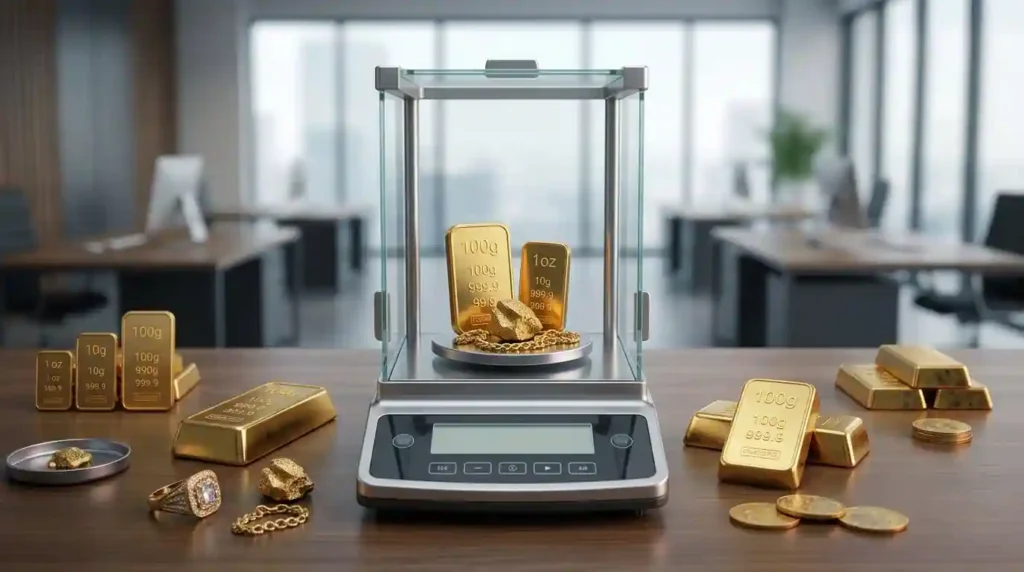
Weight alone never tells you what gold is worth. On a Saturday morning in Seattle, a friend found her grandmother’s 14K gold chain in an old jewelry box. She asked me what it might be worth before she visited a local buyer. I weighed it, checked the stamp, and did the math at her kitchen table. That is how to calculate the value of gold by weight: you need the weight, the purity, and the current price of pure gold. This guide gives you one simple formula and worked examples, and our gold calculator gives you the fastest check. Keep one point in mind. The result shows the value of the metal, not always the amount a buyer will pay.
What Determines the Value of Gold by Weight?
Three inputs shape the value of any gold item. They are the item’s weight, its gold purity, and the current price of pure gold. Two rings can weigh the same and still hold different amounts of gold. A 10 gram ring in 10K gold has far less gold than a 10 gram ring in 18K gold. Let’s look at each input one at a time.
Weight in grams, ounces, and pennyweights
Most scales show grams, and that is the unit I use for jewelry. Gold markets use troy ounces. Some U.S. buyers quote pennyweights. One troy ounce equals 31.1034768 grams. One pennyweight equals about 1.55517 grams. Pick one unit and stay with it through the whole calculation.
Now think about what the scale reads. It reads the whole item. A ring with a diamond weighs more than its gold alone. A clasp, a spring, or a steel pin can add weight too. Only the gold part counts toward the value.
That gold part is also a mix. It holds pure gold and other metals. So the real gold content matters more than the total weight. Before I run any numbers, I ask one question. How much of this weight is actually gold?
Karat and gold purity
Karat tells you how much of an alloy is pure gold. Pure gold is 24K. It is soft, so jewelers mix it with metals like copper, silver, or zinc. The mix makes the piece stronger and gives it different colors.
Here is the quick scale. A 24K item is 100% gold by the usual math. A 22K item has 22 parts gold out of 24. An 18K item is 75% gold. A 14K item is 58.33% gold. A 10K item is 41.67% gold. In the U.S., 10K is generally the lowest karat that can be sold as karat gold.
Do not mix up karat with carat. Carat measures the weight of a gemstone. A one carat diamond tells you nothing about the purity of the ring around it. If you want a deeper look at testing, read about how gold purity is calculated.
The current gold price
The spot price is the market price for one troy ounce of pure gold. Think of it as the base price. Every gold value estimate starts there.
The spot price moves with market conditions. Currency shifts, interest rates, and demand can all change it. A value you calculate today can differ from the value next week. That is normal.
Here is the catch. Sources quote the price per troy ounce. Your scale reads grams. So you must convert the price to a gram rate before you multiply. I skipped that step once early in my career. The error was large, and I never skipped it again. You can follow the current gold price and read more about the price of gold to see why it moves.
What Is the Formula for Calculating Gold Value by Weight?
Here is the main answer in one line. Save it, because you will use it each time the market moves. Each part of the formula has a simple meaning. Once you know them, the math takes less than a minute.
The basic gold value formula
Use this formula:
Gold Value = Weight x Purity x Pure Gold Price per Gram
Let’s break it down.
Weight is the item’s weight in grams. Use the gold part only if you know it.
Purity is the share of gold in the item, written as a decimal. For 14K gold, divide 14 by 24 to get 0.5833. A piece stamped 585 uses 0.585. The gap is tiny, but it is good to know the difference.
Pure gold price is today’s price per gram of 24K gold, in the same currency as your result.
Many gold calculators run this exact formula behind the screen. When you know the formula, you can check any tool.
Converting the spot price to a gram price
Use this formula:
Price per Gram = Gold Price per Troy Ounce / 31.1034768
One troy ounce equals about 31.1035 grams. It is not the same as the everyday ounce, which is 28.35 grams. This is the most common slip I see. The National Institute of Standards and Technology (NIST) publishes conversion guidance for precious metal sales.
Here is a hypothetical example. Say the price is $3,110.35 per troy ounce. Divide by 31.1034768. The answer is about $100.00 per gram. This is a made-up number for teaching. It is not a live quote. For a real figure, check a source that shows the price unit and the time, like our gold price page.
Finding the item’s pure gold content
Use this formula:
Pure Gold Weight = Item Weight x Purity
Here is an example. A 10 gram piece of 18K gold holds about 7.5 grams of pure gold. That is 10 times 0.75.
What about the other 2.5 grams? That part is other metals in the alloy. They give the piece strength and color. They add almost nothing to the gold value.
This step explains why a heavy piece is not always a valuable one. Weight shows the size of the piece. Purity shows how much of that size is gold. If you are unsure about the karat, learn how gold purity is calculated before you trust your result.
Calculating Gold Value Step by Step
I will use one example through every step. It is a 12.4 gram 14K gold chain. The gold price is hypothetical, at $3,110.35 per troy ounce. It is not a live market quote. Each step builds on the one before it.
First, weigh the gold item
Use a digital scale that reads in grams. A kitchen scale is fine for a first look. A jewelry scale that shows two decimals is better.
Record the weight to the precision the scale shows. Our chain reads 12.4 grams.
Next, check for non-gold parts. Look for stones, glass beads, steel springs, or a clasp made of another metal. These parts add weight but not gold value. If the item has stones you cannot remove, ask a jeweler for the weight of the gold portion.
A chain like ours has no stones. So I treat the whole 12.4 grams as gold alloy. Write the number down. You will use it in the last step.
Second, find the karat purity
Look for a stamp on the clasp, the inside of a ring, or a small tag. Common marks are 10K, 14K, 18K, or numbers like 417, 585, and 750. Those numbers show parts of gold per thousand.
Our chain says 14K. That gives a purity of 14 divided by 24, or 0.5833.
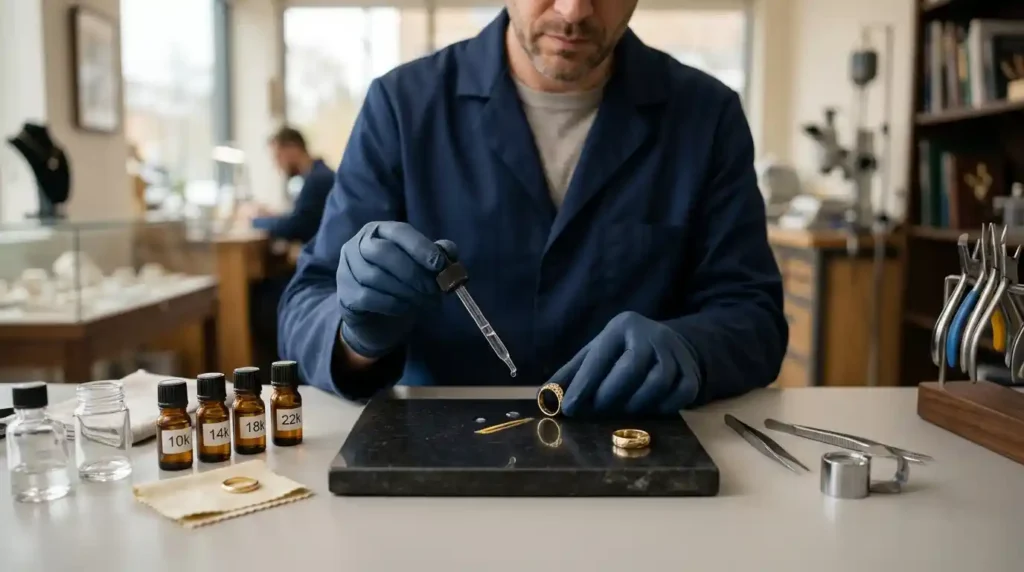
A word of caution here. A stamp is a clue, not proof. Marks can be worn, wrong, or fake. I have seen stamped pieces that tested lower than their mark.
If you feel unsure, get a professional test. A jeweler can test the metal in a few minutes. Our guide on how gold purity is calculated explains the common test methods.
Third, find the current pure gold price
Use a reputable source. It should show the price unit and a time stamp. Without those two details, the number is hard to trust.
Check the unit. Is the price in U.S. dollars per troy ounce or per gram? Many sources use troy ounces. Confirm this before you do any math.
Do not mix currencies or units. A euro price and a dollar price will give a wrong answer if you swap them. I keep a small note on my desk with the price, the unit, and the time. It saves me from silly errors.
For our example, we use the hypothetical $3,110.35 per troy ounce. If you want to follow real quotes, visit our page on the price of gold and compare it with the gold price guide.
Fourth, convert the price to a per-gram rate
Divide the price per troy ounce by 31.1034768.
For our example, that is $3,110.35 divided by 31.1034768. The result is $100.00 per gram.
Keep extra decimal places while you work. If the long number is 100.0000, keep it that way. Rounding early can shift your final answer by a few cents or more. This matters most for heavy pieces.
I like to write the full result on paper before moving on. That way I can check my work later. If you use a phone calculator, do not clear the screen until the final step is done.
Fifth, multiply weight, purity, and price
Now put it all together in one line:
12.4 g x (14 / 24) x $100.00 per gram = $723.33
Pure gold in the chain is about 7.233 grams. At $100 per gram, the metal value is $723.33.
Round to cents only at the very end. That keeps the estimate clean.
Here is the honest part. This number is the value of the metal. A buyer may offer less. They have testing costs, refining costs, and business margins. Read about gold buying scams so you can spot unfair offers and ask smart questions.
Using the Gold Value by Weight Calculator
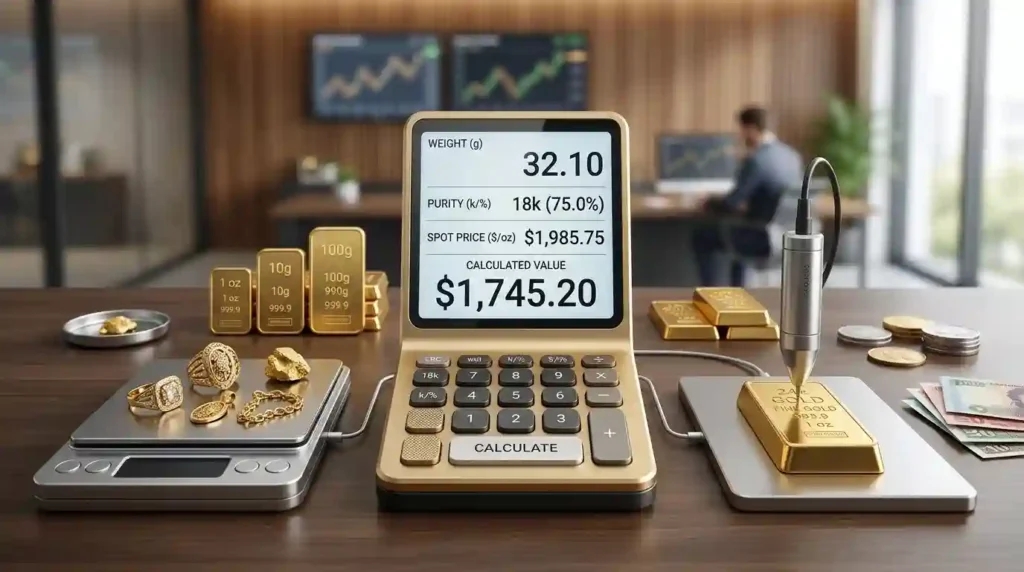
A calculator is the fastest way to get an estimate. It does the same math you just learned. The tool needs three inputs: weight, purity, and the gold price. It then shows the pure gold content and the metal value. Let’s walk through each field so you feel confident before you try it.
Enter the gold weight
Start with the weight field. Choose grams, troy ounces, or another supported unit. Grams are the easiest for most jewelry.
Double-check the unit before you press calculate. This is the top cause of wrong results. I have seen people enter 12.4 and leave the unit on ounces. The answer was off by a huge amount.
If your piece has stones or other parts, enter only the gold weight when you know it. If you do not know it, enter the full weight and treat the result as a high estimate. You can try the gold calculator with a few sample weights to see how the result changes.
Select the gold purity
Choose the right karat or fineness from the list. Common options are 10K, 14K, 18K, 22K, and 24K. Some tools also accept fineness numbers like 585 or 750.
What if the hallmark is missing or hard to read? Do not guess high. Pick a lower karat for a cautious estimate, or get the piece tested. A rough guess can mislead you.
Small pieces often have tiny stamps. A magnifier helps. Look at the clasp first, since many chains are stamped there.
If you want to know how testing works, read more about how gold purity is calculated. Then return to the tool with a better answer.
Enter or verify the gold price
Check where the price comes from. A tool may use a live price, a regularly updated price, or a rate you type in. Each one works, but you should know which one you have.
Look at the currency and the update time next to the price. If you cannot see them, treat the result with care. Do not assume a price is real time unless the tool says so.
If the price looks old, type in a fresh rate from a trusted source. Our gold price page is a good place to start. Remember to convert any per-ounce price to a per-gram rate if the tool asks for grams. Read your own numbers back once before you move on.
Read the estimated result
A good tool shows two results. The first is the pure gold content in grams. The second is the estimated metal value.
Look for the formula and your inputs beside the result. That small detail lets you check the math yourself. A calculator should never feel like a black box.
Some tools let you compare the estimate with a buyer’s offer. That feature is useful. If the offer is far below the estimate, ask the buyer to explain the gap. A fair buyer should be able to give you a clear answer.
Want to compare tools? See our overview of gold calculators and what each type can do.
Gold Value by Weight Chart for Different Karats
This chart helps when you know the weight but need to account for purity. The values below are percentages of pure gold. They are not guaranteed resale prices. I keep a copy of this table near my scale because it saves time on busy days.
| Gold purity | Gold content | Approximate fineness |
|---|---|---|
| 24K | 100%* | 999 or higher, depending on standard |
| 22K | 91.67% | 916.7 |
| 18K | 75% | 750 |
| 14K | 58.33% | 583.3 |
| 10K | 41.67% | 416.7 |
*For calculations, 24K is commonly treated as 1.000 purity. Real products may carry a stated fineness such as 999. The World Gold Council explains how karat and fineness describe gold purity. For more detail, see our guide on gold purity testing and math.
Working out 10 grams of 14K gold
Let’s use a hypothetical pure gold price of $100 per gram. Here are the steps.
- Weight: 10 grams
- Purity: 14 divided by 24 equals 0.5833
- Pure gold content: 10 times 0.5833 equals about 5.833 grams
- Estimated metal value: 5.833 times $100 equals $583.33
This is a simple melt value estimate. It is hypothetical. It comes before any buyer discount, fee, or other adjustment.
If the piece is stamped 585, the math changes a little. Use 0.585 and you get 5.85 grams of pure gold, or $585.00. The gap is small. Still, I suggest using the number that matches the stamp.
How the same weight changes value by karat
With a hypothetical price of $100 per gram, let’s compare 10 grams at each karat. The table shows why karat matters as much as weight. The same 10 grams can be worth more than twice as much in 24K as in 10K.
| Item weight | Purity | Estimated metal value |
|---|---|---|
| 10 g | 24K | $1,000.00 |
| 10 g | 22K | $916.67 |
| 10 g | 18K | $750.00 |
| 10 g | 14K | $583.33 |
| 10 g | 10K | $416.67 |
Keep a short note in mind. Actual fineness, verified weight, and the market price can all change the result. Treat the table as a guide, and check your own piece with care.
Gold Weight Conversion: Grams, Troy Ounces, and Pennyweights
Unit conversion matters more than most people expect. A buyer might quote a price per pennyweight. An online tool might show a price per gram. The numbers can look far apart even when they describe the same rate. This table shows the units you will meet most often.
| Unit | Conversion | Common use |
|---|---|---|
| 1 gram | 1 gram | Jewelry weighing and calculator inputs |
| 1 troy ounce | 31.1034768 grams | International precious metal pricing |
| 1 pennyweight (dwt) | Approximately 1.55517 grams | Some U.S. jewelry and gold buying deals |
| 1 kilogram | 1,000 grams | Larger bullion quantities |
NIST publishes guidance on these conversions, and it is a good reference to keep handy.
Convert a gold price from troy ounces to grams
Divide the price per troy ounce by 31.1034768. The answer is the price per gram.
Here is a hypothetical example. Say pure gold is $3,110.35 per troy ounce. Divide by 31.1034768. You get about $100.00 per gram.
Always confirm that the quoted price refers to a troy ounce. Some sellers use the ordinary ounce of 28.35 grams for other goods. Mixing the two will give you a wrong answer. If you want to follow the market, our price of gold guide explains how quotes are shown.
Convert grams to pennyweights
Multiply grams by about 0.6430149. The answer is the weight in pennyweights.
For example, 10 grams equals about 6.43 pennyweights. There are 20 pennyweights in one troy ounce.
Now the rate. If pure gold is $100.00 per gram, then one pennyweight is worth about $155.52. That is $100.00 times 1.55517.
Here is my warning. Do not compare a per-gram rate with a per-pennyweight rate without converting first. A buyer who quotes $155.52 per pennyweight and a site that shows $100.00 per gram may be using the same price. Do the conversion before you decide that one is better.
Melt Value vs. Retail Price vs. Cash Offer
This difference is key if you plan to sell. A calculator can estimate the value of the gold content. That number is not always the store’s offer. It is also not the price of a finished piece in a shop. The table below shows how the four values differ.
| Value type | What it means | What may affect it |
|---|---|---|
| Spot-based metal value | Estimated value of the item’s pure gold content | Gold price, weight, purity |
| Melt value | Estimated metal value if refined, subject to practical costs and recovery | Purity testing, refining loss, processing costs |
| Retail jewelry price | Price charged for a finished item | Design, workmanship, brand, stones, retail overhead |
| Dealer cash offer | Amount a buyer is willing to pay | Resale margin, testing, refining, business costs |
Why a gold buyer may offer less than the calculated value
A buyer is running a business. Here is why offers often come in below the metal value.
- Business and refining costs. Testing, melting, and refining all cost money.
- Resale margin and price risk. The market can move before the buyer sells.
- Uncertain purity or weight. If the buyer cannot confirm the karat, they may price in caution.
- Stones and non-gold parts. These may lead to deductions.
This does not mean every low offer is unfair. It does mean you should ask questions. Learn the common tricks in our guide on gold buying scams, and see how gold valuation scams work before you accept a number.
Does old or damaged gold still have value?
Yes, it often does. A dent, a snapped chain, or a broken clasp matters less to melt value than you may think. Purity and gold content drive the number.
The story changes for special pieces. Antique, designer, and collectible jewelry can be worth more than its metal. A broken vintage brooch may still carry real value as a piece of history.
If you think a piece may be collectible, get a separate appraisal before you sell it for scrap. I have seen families melt a rare item for the metal price and regret it later. When in doubt, ask an appraiser first. For more tips, browse the gold guides on our blog.
Valuing Gold Jewelry With Stones or Other Parts
The scale reading for a whole piece is not always its gold weight. This matters for rings with gemstones, watches, and mixed-metal pieces. Counting stone weight as gold will inflate your estimate. A careful step here protects you from a false hope.
Subtract non-gold components when their weight is known
Use the verified weight of the gold portion. The formula is simple:
Gold Weight = Total Weight - Weight of Non-Gold Parts
Here is an example. A jeweler confirms that the gold part of a 14K ring weighs 6.2 grams. At a hypothetical $100 per gram, the value is 6.2 times 0.5833 times $100. That equals $361.67.
Never guess the weight of a gemstone by eye. Stones vary in density and size. A wrong guess can swing the result by a large amount. If the stone is loose or removable, weigh it on its own. If it is set, ask a jeweler for help. Our guide on gold purity covers more about checking the metal itself.
Understand gold-plated and gold-filled items
Gold-plated jewelry has a thin surface layer of gold. The rest is a base metal. It is not solid gold throughout.
Gold-filled and gold-overlay items are different from plated ones, but they are still not the same as solid gold. A gold-filled piece has a thicker layer bonded to a base metal. FTC guidance generally expects the gold layer to be at least one twentieth of the item’s total weight for that label.
Be careful with looks and stamps. A gold color or a mark alone cannot tell you how much recoverable gold a piece holds. If you want to protect yourself from false claims, read about gold valuation scams and learn what to ask before you sell.
Checking Whether Your Gold Value Calculation Is Accurate
Small errors can grow into big ones. Before you trust a calculator result or accept an offer, run a few quick checks. I follow the same four checks every time. They take about five minutes and have saved me from many mistakes.
Check the weight and unit
Confirm that your scale measures in grams or the unit you intend. Some scales switch units with a button press. A quick glance can save you trouble.
Reweigh the item if the reading looks off. Place it in the center of the scale and wait for the number to settle. Try twice and compare.
Then check the calculator. Make sure it uses the same unit as your input. If you weigh in grams but the tool expects ounces, the result will be wrong. Matching units is the simplest fix in this whole process.
Verify purity
Look for a karat or fineness mark. Check the clasp, the inner band, or any small tag.
Remember that marks can be wrong. Wear, repairs, and fakes can all mislead you. A stamp gives you a starting point, not final proof.
When purity is uncertain, use a qualified jeweler or a professional testing service. Testing is quick and often low cost. It can change your estimate by a large amount, so it is worth the effort. Our guide to how gold purity is calculated explains the usual methods in plain language.
Verify the price source and timestamp
Check that the price is for pure gold. Check whether it is quoted per gram or per troy ounce. Confirm the currency too.
A price without a time stamp is hard to trust. Gold can move in a single day. If the quote is old, find a fresh one and run the numbers again.
I always recalculate if more than a few hours have passed and I am about to make a decision. A good habit is to save the source and the time with your result. For a place to begin, read about the price of gold and compare it with a quote you trust.
Compare more than one buyer
Do not rely on one offer. Visit or contact at least two or three buyers.
Ask each one for the same details. These include the tested karat, the measured weight, the price rate they use, and any deductions. Ask for a written breakdown where you can.
Then compare the offers using the same assumptions and units. One buyer may quote per gram and another per pennyweight. Convert them first. If a buyer will not explain the numbers, that is a warning sign. Learn the common red flags in our guide on gold buying scams.
U.S. Expert Advice for Estimating Gold Value
Good advice should come from sources you can check. For U.S. readers, two names matter most: the Federal Trade Commission (FTC) and NIST. I rely on both when I explain gold math to others. I do not use made-up quotes. What follows is a plain summary of their guidance.
FTC advice on checking gold jewelry
The FTC publishes a consumer guide called Buying Platinum, Gold, and Silver Jewelry. It explains how karat marks work and what they mean. It also explains why purity claims matter.
The guide encourages buyers to look for the quality mark and the maker’s registered trademark. These marks help you trace who stands behind the claim. It also tells shoppers to research sellers before they buy.
A mark is helpful, but it is not a guarantee. Testing may still be needed if you want to be sure. Treat the stamp as the first clue, then confirm it. For more on avoiding traps, see our post on gold valuation scams and other helpful gold articles.
Why NIST conversion guidance matters
NIST publishes conversion information for precious metals. It confirms that one troy ounce is 31.1034768 grams.
Correct units prevent costly errors. Per-gram, per-ounce, and per-pennyweight rates can look very different. They are only comparable after you convert them.
I like to use NIST values for every calculation. The numbers are exact, and they are easy to verify. If you ever feel unsure about a conversion, check it against the official figure before you act on it.
Common Mistakes When Calculating Gold Value by Weight
Most errors come from a few simple slips. I have made some of them myself. Here are the ones that most often lead to inflated or misleading estimates. Learn them once, and you can avoid them for good.
Treating all gold jewelry as 24K
Most jewelry is not pure gold. Lower karat pieces hold other metals. A 14K ring is only 58.33% gold.
If you treat it as 24K, you will overstate the value by a lot. At a hypothetical $100 per gram, 10 grams of 14K is worth $583.33, not $1,000.00.
Always apply the purity multiplier. It is the step that turns total weight into real gold weight. If you skip it, the rest of your math will not matter. Review how gold purity is calculated when you want a refresher.
Using the regular ounce instead of the troy ounce
A troy ounce is about 31.1035 grams. The regular ounce is about 28.35 grams. The gap is more than three grams.
Use the wrong one and your gram price will be off by about 10%. On a large piece, that is a real amount of money.
Gold is priced per troy ounce. Always use 31.1034768 when you convert. Check back to the conversion table above if you need a quick look. This one habit prevents the most common error I see in new sellers.
Assuming the calculator predicts a guaranteed sale price
A calculator shows an estimate. It does not show a promise. The result is the metal value based on your inputs.
A buyer’s offer will often differ. Fees, testing, and buyer margins all play a role. Some pieces may also carry collectible value that a simple tool cannot see.
Use the result as a guide for negotiation, not as a fixed price. If you want to know what different tools can and cannot do, read our overview of gold calculators. Then compare offers in writing.
Relying on an outdated or mismatched gold price
Gold prices change often. A price from last week may not match today’s market.
Check the time stamp, the currency, and the price unit. A price in euros per ounce will not work in a dollar per gram formula. Convert first.
Do not mix prices from different markets without care. Sources can differ slightly in how and when they update. Pick one trusted source and stay with it during a single calculation. You can start with our gold price guide to learn what a good quote looks like.
Frequently Asked Questions About Gold Value by Weight
These short answers are built for quick reading. Each one gives you the main point first. Use the links to go deeper on any topic. If you want the fastest path, our gold calculator can run the math for you.
Which formula works for gold value by weight?
Use this formula: weight times purity times the current pure gold price per unit. Keep the weight and the price in matching units, such as grams. Write purity as a decimal. For 14K gold, that is 14 divided by 24, or about 0.5833. The answer is the estimated metal value.
One gram of gold: what is it worth?
It depends on four things. They are the current pure gold price, the item’s purity, the currency, and whether you want metal value or retail price. At a hypothetical $100 per gram, one gram of 24K gold is $100.00. One gram of 14K gold is about $58.33. A live quote will give you a real number. See the price of gold for more.
Ten grams of 14K gold: what is it worth?
Use this math: 10 times (14 divided by 24) times the current 24K price per gram. At a hypothetical $100 per gram, the answer is $583.33. Replace $100 with a real price per gram to get a current estimate. Check the quote’s source and time first.
Is gold value calculated by weight or karat?
Both matter. Weight tells you how much material you have. Karat tells you how much of it is gold. You need both to reach a fair estimate. Two items with the same weight can have very different values if their karats differ.
Is melt value the same as resale value?
No. Melt value estimates the value of the metal content. Resale value depends on the buyer and on the item’s other qualities. Design, brand, age, and condition can all add to resale value. Costs and margins can lower what a buyer pays.
Can I calculate gold value without knowing its purity?
You can make a rough guess with a presumed karat. Use a cautious number, like 10K, to avoid inflating your hopes. A reliable value needs verified purity. A quick test from a jeweler solves the problem. Read more about how gold purity is calculated if you want to try it.
Do gold calculators show the exact amount a jeweler will pay?
No. A calculator estimates the value based on its inputs. It may not account for every buyer deduction. It also cannot see collectible value. Use it as a starting point, then ask buyers for written offers. Our guide on gold buying scams can help you stay safe.
Calculate Your Gold’s Estimated Value
You now have the formula, the steps, and the checks. Enter your gold’s weight, purity, and a current price into our gold calculator. Review the assumptions, then compare the estimate with a written buyer offer. If the purity is uncertain, get a professional test before you sell. For more tips, visit our gold blog.
Final Recommendation
I have weighed and valued many gold pieces, and one lesson stands out. Knowing how to calculate the value of gold by weight protects you from guesswork. Always use three inputs: verified weight, tested purity, and a current price with a clear unit. Convert troy ounces to grams before you multiply. Treat the result as a metal value, not a promise. Compare at least two written offers before you sell. If anything feels unclear, ask a qualified jeweler. A few careful minutes can save you real money.