I still remember the first time a friend in Minneapolis handed me a ring marked 14K and asked, “So how much of this is actually gold?” That question sits at the heart of how gold purity is calculated, and it is simpler than most people expect. Gold purity is based on the proportion of pure gold inside an alloy. Karat purity splits gold into 24 parts, while fineness measures gold in parts per 1,000. A stamp gives you a starting clue, but testing tools like a loupe, a digital scale, an acid kit, an electronic gold tester, or an XRF analyzer help confirm what that stamp claims. The FTC also encourages buyers to understand karat marks and gold descriptions before making a purchase, and that habit alone can save you from a costly mistake.
Featured snippet answer: Gold purity is calculated by dividing the karat rating by 24 and multiplying by 100. For example, 18K gold is 18 ÷ 24 × 100 = 75% pure gold.
What Does Gold Purity Mean?
Gold jewelry is rarely made from pure gold alone. The purity number tells you how much actual gold sits inside the piece compared with the other metals mixed into it. A higher number means more gold. A lower number means more filler metal. This one idea explains almost every karat stamp you will ever see.
Pure Gold vs. Gold Alloy
Pure gold is soft, bright yellow, and 24 karats by definition. Jewelers use 24K as the reference point because it represents gold with no other metal added. Most jewelry is not pure gold because pure gold bends and scratches too easily for daily wear. Makers blend in other metals to create a gold alloy, which is stronger and easier to shape into rings, chains, and bracelets. Fine gold refers to that pure 24K standard, while gold alloy refers to any blended version. Alloying changes hardness, color, durability, and how easily the metal can be worked into fine detail.
Why Gold Is Mixed With Other Metals
Jewelers commonly blend gold with copper, silver, zinc, nickel, or palladium. Each metal changes the final color and strength in its own way. Copper adds a warm rose tone. Silver cools the color toward a pale yellow. Nickel and palladium are often used in white gold blends. Here is a simple way to picture it. An 18K yellow gold ring is not “mostly fake gold.” It is 18 parts gold and 6 parts other metal, all melted together into one solid piece. The FTC explains this exact 24 part system in its consumer guidance, and it is worth remembering any time you see a karat stamp.
What Gold Purity Tells You
Purity tells you the gold content inside a piece. It hints at potential melt value, helps classify jewelry quality, and plays a role in resale conversations. Every testing tool on the market, from a simple loupe to a lab grade analyzer, exists to answer one question. How much of this item is really gold.
How Gold Purity Is Calculated From Karats
This is the core calculation behind how gold purity is calculated, and once you understand one formula, the rest becomes quick math you can do on your phone or a scrap of paper.
The Gold Purity Formula
Gold Purity Percentage Formula
Gold Purity % = (Karat ÷ 24) × 100
Karat represents the parts of gold present. Twenty four represents the total parts in the scale. Multiplying by 100 converts the fraction into a percentage you can actually use.
How to Calculate 18K Gold Purity
Start with 18 ÷ 24, which equals 0.75. Multiply 0.75 by 100 and you get 75%. So 18K gold is 75% gold, with the remaining 25% made up of other metals in the alloy.
How to Calculate 14K Gold Purity
Divide 14 by 24 and multiply by 100. That gives you 58.33%. Many sellers round this to 58.3% for convenience, since the extra decimal rarely changes a real world buying decision.
How to Calculate 10K, 22K, and 24K
Here are the common conversions you will run into again and again.
- 10K equals 41.67%
- 12K equals 50%
- 14K equals 58.33%
- 18K equals 75%
- 21K equals 87.5%
- 22K equals 91.67%
- 24K serves as the reference point for pure gold
Table 1: Gold Karat to Purity Percentage
This is the little chart worth keeping near your jewelry scale. If you are testing a handful of pieces on a Friday afternoon, doing the same division again and again gets old fast.
| Karat | Formula | Approx. Gold Purity |
|---|---|---|
| 10K | 10 ÷ 24 | 41.67% |
| 12K | 12 ÷ 24 | 50.00% |
| 14K | 14 ÷ 24 | 58.33% |
| 18K | 18 ÷ 24 | 75.00% |
| 21K | 21 ÷ 24 | 87.50% |
| 22K | 22 ÷ 24 | 91.67% |
| 24K | 24 ÷ 24 | 100%* |
*Commercial purity markings and applicable standards often involve small tolerances, so a stamp does not always mean the item is chemically perfect.
How Gold Fineness Is Calculated
Karat is common in US jewelry, while fineness shows up more often on bullion, coins, and international precious metal products. The math behind both systems is closely related, just expressed on a different scale.
What Is Gold Fineness?
Fineness is expressed in parts per 1,000 rather than parts per 24. A fineness of 750 means 750 parts gold out of 1,000. A fineness of 999 means 999 parts gold out of 1,000, which is about as close to pure as jewelry grade gold gets.
How to Convert Fineness Into a Percentage
Fineness ÷ 10 = Gold Purity %
A few quick examples make this clear.
- 999 ÷ 10 = 99.9%
- 916 ÷ 10 = 91.6%
- 750 ÷ 10 = 75%
- 585 ÷ 10 = 58.5%
How to Convert Karats Into Fineness
Karat ÷ 24 × 1,000 = Fineness
Using this formula, 18K converts to about 750. 22K converts to about 917. 14K converts to about 583. You may also see 14K stamped as 585 instead of 583, since manufacturers often round up slightly within allowed tolerances rather than stamping an awkward decimal.
Karat vs. Fineness
Table 2: Karat, Percentage, and Fineness Compared
This is where the numbers can look more complicated than they really are. Think of karat as “out of 24” and fineness as “out of 1,000.” Same basic idea, just a different measuring scale.
| Karat | Gold % | Approx. Fineness |
|---|---|---|
| 10K | 41.67% | 417 |
| 14K | 58.33% | 583 |
| 18K | 75.00% | 750 |
| 21K | 87.50% | 875 |
| 22K | 91.67% | 917 |
| 24K | 100% | 999/1000 |
How to Calculate the Amount of Pure Gold in Jewelry
Purity tells you the percentage. Weight tells you how much material sits in front of you. Combine those two numbers and you get a real estimate of the gold content inside a specific piece.
Pure Gold Weight Formula
Pure Gold Weight = Total Gold Alloy Weight × Purity Decimal
Example: A 10 Gram 14K Ring
Take a 10 gram ring stamped 14K. Multiply 10 grams by 0.5833, and you land on 5.833 grams of pure gold. The total ring weighs 10 grams, but the estimated pure gold content is 5.83 grams, with the remaining weight coming from alloy metals and possibly non gold components.
Example: A 25 Gram 18K Bracelet
Multiply 25 grams by 0.75, and you get 18.75 grams of pure gold hiding inside that bracelet.
Why Jewelry Weight Can Mislead You
A scale reads total weight, not gold weight. Gemstones, steel springs, clasps, hollow construction, mixed metal sections, solder, and non gold findings can all add weight without adding a single gram of gold.
Why You Should Not Automatically Weigh the Entire Piece
A 12 gram ring with a large center stone is not automatically 12 grams of gold bearing material. Skipping this step is one of the fastest ways to overestimate value.
What Tools Can Be Used to Calculate or Verify Gold Purity?
A calculator can tell you what a 14K stamp should mean in theory. A testing tool helps you find out whether the material in your hand actually behaves like real 14K gold.
Jewelry Loupe
A 10x loupe lets you inspect tiny marks up close. Use it to check hallmarks, maker’s marks, signs of wear, and stamps that look suspicious or altered.
Digital Jewelry Scale
A digital scale measures weight, not purity. Look for gram level resolution, a stable flat surface, proper calibration, and a working tare function before you trust any reading.
What a Scale Can and Cannot Tell You
A scale can measure mass and help you calculate estimated gold content once you know the karat. It cannot identify karat on its own, prove that an item is real gold, or detect plating by itself.
Gold Acid Testing Kit
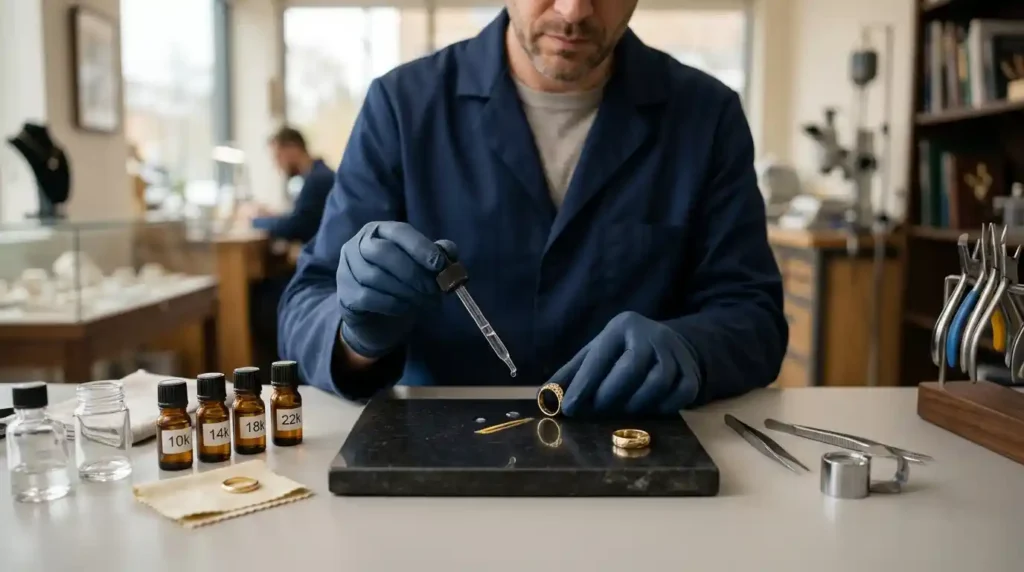
An acid kit works with a testing stone, test needles, and acid solutions of different strengths. You compare how the metal reacts against known karat standards. This method is affordable and widely used, though it carries real limitations around surface damage, safety, and the need for careful technique.
Electronic Gold Tester
Electronic testers rely on conductivity and electrical measurements to give a fast reading. They work well for quick screening, need periodic calibration, and can struggle with unusual alloys or heavily plated surfaces.
XRF Gold Analyzer
XRF stands for X ray fluorescence. This method offers non destructive analysis and reads the full elemental composition of a piece. It is a favorite among professional jewelers and precious metal dealers, though the equipment cost puts it out of reach for casual home testing.
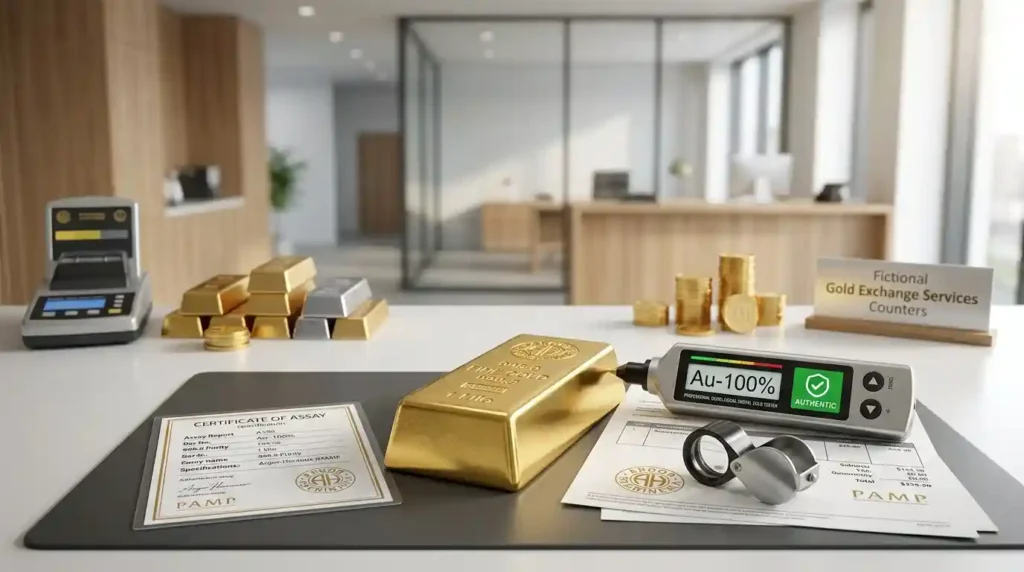
Fire Assay
Fire assay is a laboratory grade analytical method rather than a casual home test. It remains one of the most trusted ways to confirm gold purity when accuracy truly matters.
Gold Testing Tools Compared
There is no single magic gadget that solves every gold testing problem. A loupe is cheap and fast. An XRF analyzer is far more advanced and far more expensive. The right tool depends entirely on the job in front of you.
Table 3: Gold Purity Testing Tools
| Tool | Best Use | Speed | Cost | Main Limitation |
|---|---|---|---|---|
| 10x loupe | Inspect marks | Very fast | Low | Doesn’t prove purity |
| Digital scale | Measure weight | Very fast | Low | Doesn’t measure composition |
| Acid kit | Basic karat test | Fast | Low | Can damage surface |
| Electronic tester | Quick screening | Fast | Medium | Needs calibration |
| XRF analyzer | Professional analysis | Very fast | High | Primarily surface analysis |
| Fire assay | Laboratory analysis | Slow | High | Not practical for routine home use |
Experienced testers rarely rely on just one method. When a piece is valuable or looks suspicious, combining two or three tools gives a far more reliable answer.
How to Read Gold Hallmarks and Purity Stamps
Before reaching for acid or an analyzer, take a close look at the piece itself. A tiny stamped number can give you a helpful first clue, though it should never be treated as the final answer.
Common Karat Marks
Watch for 10K, 14K, 18K, 22K, and 24K stamped somewhere on the piece, often inside a ring band or near a clasp.
Common Fineness Marks
International pieces often use 375, 417, 585, 750, 875, 916, or 999 instead of a karat number.
Maker’s or Responsibility Marks
The mark stamped next to a fineness number often matters just as much as the number itself. GIA notes that US items carrying fineness stamps are expected to have a federally registered maker’s or responsibility mark, though enforcement and modern maker mark identification can be imperfect in practice.
Gold Plated and Gold Filled Marks
Look out for terms like gold plated, gold electroplate, gold filled, gold overlay, RGP, and vermeil. The FTC clearly distinguishes these products from solid gold and explains that plating can wear away over time with regular use.
Why 14K and 14K Gold Plated Are Completely Different
This distinction trips up beginners constantly. Solid 14K gold contains 14 parts gold throughout the entire piece. Gold plated items only carry a thin gold layer over a base metal core, meaning the actual gold content is a tiny fraction of what a solid piece would contain.
How Gold Purity Affects Gold Value
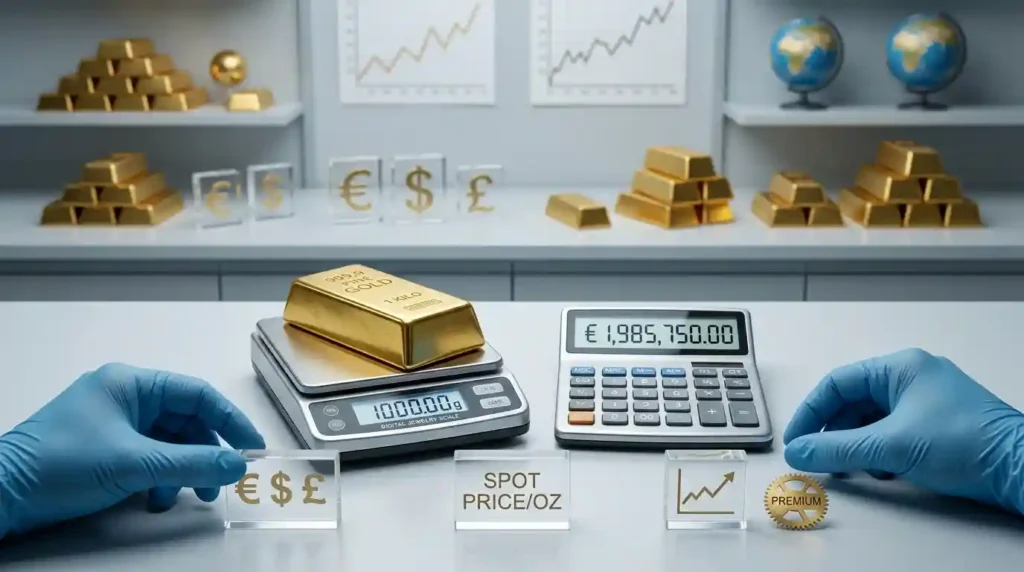
Purity is only one piece of the pricing puzzle. Weight, the current gold market price, craftsmanship, brand, gemstones, and dealer margin all shape what a piece is genuinely worth.
Calculate Fine Gold Before Estimating Value
Fine Gold Weight × Current Gold Price per Gram = Approximate Gold Value
This formula gives you an estimate, not necessarily the exact price a dealer will offer you.
Example of a 14K Gold Scrap Calculation
Picture a 20 gram piece of 14K jewelry. At 58.33% purity, the fine gold content comes out to 11.67 grams. Multiply that number by the current gold price per gram to reach an approximate value. Since gold prices shift daily, always check the live gold price at the time you are calculating rather than relying on a number from an old article.
Melt Value vs. Retail Jewelry Value
Scrap value, melt value, wholesale value, retail value, designer value, and collector value can all differ wildly for pieces containing the exact same amount of gold.
Table 4: What Can Change the Final Gold Value?
Two pieces can share the same karat and still sell for very different prices. A plain scrap chain and a signed vintage bracelet may contain a similar amount of gold, yet the market rarely treats them the same way.
| Factor | Why It Matters |
|---|---|
| Purity | Determines gold percentage |
| Weight | Determines total material |
| Gold market price | Changes daily |
| Brand | Can add premium |
| Condition | Affects resale |
| Gemstones | May add value or complicate weighing |
| Craftsmanship | Can raise retail value |
| Dealer or refiner margin | Reduces payout from theoretical melt value |
Expert Advice for Testing Gold in the USA
For anyone buying or selling gold in the United States, this section adds the practical trust layer. Here is what a careful buyer or tester should actually do before putting real money on the line.
Start With the Mark, Then Test
Inspect the hallmark first. Check for a maker or responsibility mark. Weigh the piece on a calibrated scale. Account for any non gold components. Run an appropriate screening test. Send high value pieces to a professional for testing.
USA Expert Reference: Jewelers Vigilance Committee
The Jewelers Vigilance Committee, known as JVC, serves as a leading US industry and legal compliance reference for jewelry marking and consumer protection. Their guidance shapes how sellers across the country label and market gold products.
What the FTC Says About Gold Purity Marks
The FTC’s consumer guidance explains that a karat mark tells buyers how much pure gold the jewelry contains, and that 18K specifically means 18 parts gold out of 24 total parts. The agency also advises shoppers to look for the name or a US registered trademark of the company standing behind that karat mark.
Practical USA Buyer Tip
Before buying an expensive piece, ask what karat it is. Ask whether it is solid, plated, or filled. Ask what testing was performed on it. Get any important claims in writing. Always check the store’s return policy before you pay. These habits line up closely with FTC consumer guidance.
Common Mistakes When Calculating Gold Purity
The formula itself is easy. The inputs are where things get messy. A wrong stamp, a stone left on the scale, or a plated surface can turn clean math into a very confident wrong answer.
Mistake #1: Assuming the Stamp Is Proof
A hallmark is useful evidence, not final proof. Testing is what actually verifies the claim.
Mistake #2: Confusing Karat and Carat
Karat measures gold purity. Carat measures gemstone weight. These two words sound alike but mean completely different things.
Mistake #3: Using Jewelry Weight as Gold Weight
Stones and non gold parts add weight without adding gold, which skews any calculation that skips this step.
Mistake #4: Treating 24K as a Typical Jewelry Standard
Pure 24K gold is soft and easily damaged, so most everyday jewelry uses lower karats for added strength.
Mistake #5: Forgetting Troy Ounces
A standard ounce is not the same as a troy ounce. Precious metals are measured in troy ounces, and mixing up the two units throws off any value calculation.
Mistake #6: Testing Only the Surface
Surface only testing can produce misleading results on plated items, gold filled pieces, and other coated materials.
Mistake #7: Trusting a Single Home Test on High Value Gold
For anything with serious financial stakes, a single home test is not enough. Professional verification protects both buyer and seller.
How to Calculate Gold Purity at Home: Step by Step
For a basic estimate, you do not need a laboratory. You need accurate information, a decent scale, and enough healthy skepticism to question a result that seems off.
Step 1: Inspect the Gold
Use a loupe to look for a karat stamp, a fineness number, a maker’s mark, and any signs of plating.
Step 2: Record the Weight
Place the item on a jewelry scale and record the weight in grams.
Step 3: Convert the Karat to a Decimal
Use these quick conversions. 10K equals 0.4167. 14K equals 0.5833. 18K equals 0.7500. 22K equals 0.9167.
Step 4: Calculate Fine Gold
Multiply weight by the purity decimal. For example, 12 grams times 0.750 equals 9 grams of fine gold.
Step 5: Verify If the Item Matters Financially
Consider an acid test, an electronic tester, an XRF reading, or a professional assay for anything with real financial stakes.
A Simple DIY Gold Purity Worksheet
Item weight: _____ g Karat: _____ K Purity decimal: _____ Estimated fine gold: _____ g Testing method: _____ Result: _____
Frequently Asked Questions About How Gold Purity Is Calculated
These are the quick questions readers tend to ask right after spotting a gold stamp or trying a purity calculator for the first time.
How Do You Calculate Gold Purity From Karats?
Use the formula K ÷ 24 × 100 to find the percentage of pure gold in any karat marked item.
How Pure Is 14K Gold?
14K gold is approximately 58.33% pure gold.
How Pure Is 18K Gold?
18K gold is 75% pure gold.
What Does 750 Mean on Gold?
A 750 stamp means 750 parts gold per 1,000, or approximately 75% pure gold.
What Does 585 Mean on Gold?
A 585 stamp indicates approximately 58.5% pure gold, roughly matching 14K.
Is 24K Gold 100% Pure?
24K is treated as the reference point for pure gold, though commercial fineness marks like 999 reflect the small tolerances allowed in real world manufacturing.
Can a Digital Scale Test Gold Purity?
No. A digital scale measures weight only. It cannot detect chemical composition or confirm karat on its own.
What Is the Best Tool for Testing Gold Purity?
It depends on your goal. Use a loupe for hallmarks, an acid kit for basic DIY testing, an electronic tester for fast screening, an XRF analyzer for professional grade analysis, and an appropriate assay method for laboratory grade certainty.
Can Gold Plated Jewelry Test as Gold?
Surface testing on gold plated jewelry can produce misleading results, since the thin outer layer may react like real gold even though the core underneath is a different metal entirely.
Final Practical Gold Purity Testing Workflow
The cleanest workflow stays simple. Inspect first, calculate second, test third. Never let a shiny surface or a tiny stamped number do all the talking for you.
For a Beginner
Loupe, then scale, then karat calculation, then a basic test.
For a Jewelry Seller
Loupe, then weight, then an appropriate tester, then documentation.
For High Value Gold
Inspection, then weight, then professional testing, then independent verification when it makes sense.
The One Formula to Remember
Gold Purity % = Karat ÷ 24 × 100
And for actual fine gold weight:
Fine Gold Weight = Total Weight × Purity Decimal
Final Recommendation
After spending years around jewelry counters, pawn shops, and casual conversations with friends holding a ring they just inherited, my honest recommendation is simple. Learn the karat formula first, because it takes thirty seconds and instantly makes you a smarter buyer or seller. Then treat every stamp as a starting clue rather than a guarantee, since even honest sellers rely on markings that can wear down or get misread over time. For anything under a hundred dollars in value, a loupe and a basic calculation are usually enough.
For anything that matters financially, pair your own math with a real test, whether that is an acid kit at home or a professional XRF reading at a local jeweler. Knowing how gold purity is calculated will not make you an appraiser overnight, but it will make sure nobody can talk circles around you the next time a stamped number shows up in your hand.